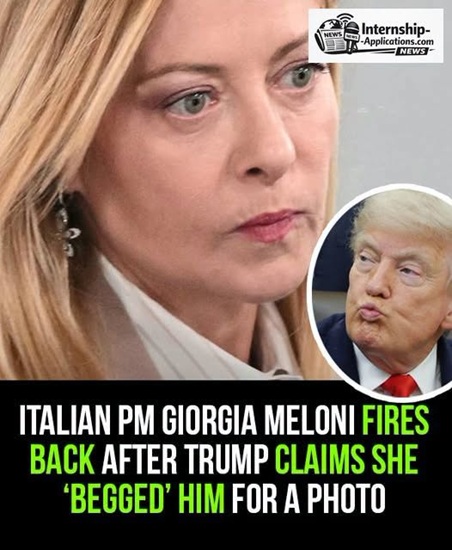
A recent exchange between former U.S. President Donald Trump and Italian Prime Minister Giorgia Meloni has drawn significant international attention, sparking discussion across political circles in both the United States and Italy. What began as remarks involving a photograph quickly evolved into a broader diplomatic conversation, highlighting the sensitivity of public statements between allied nations. The situation reportedly began during comments Trump made in an interview with La7, where he referenced a photograph with Meloni.
His remarks suggested a particular interpretation of how the interaction took place, implying that Meloni had been eager for the photo opportunity. These statements quickly circulated in media coverage and on social platforms, where they prompted immediate reactions and debate regarding their accuracy. Within a short period of time, Italian Prime Minister Giorgia Meloni responded publicly. She addressed the claims directly through social media, strongly rejecting the version of events presented in the interview.
Her response emphasized disagreement with the statements and made clear that she did not consider them accurate. The tone of her reaction indicated that she viewed the matter as important enough to address without delay.
Meloni’s response was widely shared and discussed in Italy, where it quickly became a topic of political and public debate. In her statement, she expressed that she did not recognize the description of events and rejected the suggestion that Italy or its leadership would need to seek approval in such a manner. Her remarks were interpreted by many as a defense of national dignity and diplomatic standing.
Following Meloni’s response, Italy’s Foreign Minister Antonio Tajani also commented on the situation. His reaction added further weight to the dispute, as he publicly expressed concern over the remarks and their broader implications. In a notable development, Tajani reportedly adjusted or canceled diplomatic travel plans to the United States, signaling that the issue was being taken seriously at an official level.
The involvement of senior Italian officials transformed what initially appeared to be a personal disagreement into a matter with diplomatic implications. Observers noted that such public exchanges between leaders of allied countries are relatively uncommon and can place additional strain on already complex international relationships.
The incident did not occur in isolation. Relations between the two political figures have experienced multiple points of disagreement in recent months, particularly on issues related to foreign policy and international security. While both leaders are often associated with similar political alignments, their approaches to certain global issues have differed, leading to periodic tensions.
One earlier point of friction involved military-related decisions and strategic cooperation. Discussions around the use of a strategic air base in Sicily became a notable example of disagreement between the two governments. Reports indicated differing views on military access and operational decisions, which led to public commentary from both sides. These developments contributed to a gradual cooling of what some observers initially expected to be a closer political alignment.
In addition to security matters, differences have also emerged in discussions related to international policy and broader geopolitical issues. While such disagreements are not unusual between allied nations, the public nature of recent exchanges has drawn increased attention. Analysts often note that when diplomatic disagreements move from private discussions into public statements, they can take on greater political significance.
Another dimension of the evolving tension has been related to public messaging and rhetorical criticism. Statements exchanged between the two sides have occasionally extended beyond policy discussions and into personal interpretations of actions and intentions. This shift has contributed to increased media coverage and public interest in the state of the relationship.
Public reaction to the latest exchange has been mixed, particularly within Italy. Some viewed Meloni’s response as a firm defense of national respect and international standing, while others interpreted the situation as an example of how quickly political narratives can escalate in the media environment. Social platforms amplified the discussion, with users debating both the content and tone of the remarks.
Political commentators have pointed out that modern diplomatic relationships are increasingly influenced by media dynamics and real-time communication. Unlike traditional diplomacy, where disputes were often handled privately, today’s political environment allows rapid public dissemination of statements, which can amplify misunderstandings or disagreements.
Experts also emphasize that alliances between countries are often complex and can involve disagreement even when broader strategic interests remain aligned. The United States and Italy continue to share important economic, security, and diplomatic ties, which provide a foundation for ongoing cooperation despite occasional tensions.
However, repeated public disagreements can introduce additional challenges to maintaining smooth diplomatic communication. When statements become personalized or widely publicized, they may influence public perception and create pressure on political leaders to respond more directly and visibly.
The recent controversy has therefore been viewed by analysts as part of a broader pattern of evolving political communication between high-profile leaders. While disagreements themselves are not unusual, the way they are expressed and amplified in modern media environments can shape how they are interpreted internationally.
Despite the attention surrounding the incident, both countries continue to operate within the framework of longstanding alliance structures. Economic cooperation, security partnerships, and diplomatic engagement remain in place, suggesting that institutional relationships are still stable even if individual exchanges are tense.
Looking ahead, observers suggest that the future of the relationship will depend on how both sides manage public communication and address disagreements moving forward. Diplomatic relationships often experience periods of strain followed by stabilization, and it remains possible that future interactions could return to a more neutral tone.
At the same time, the growing visibility of political discourse means that even relatively small incidents can gain significant attention and symbolic meaning. The photograph controversy illustrates how quickly modern political narratives can expand beyond their original context.
In conclusion, the exchange between Donald Trump and Giorgia Meloni highlights the intersection of media, politics, and diplomacy in today’s global environment. What began as a discussion about a photograph evolved into a broader conversation about respect, communication, and international relations.
While the immediate dispute may eventually subside, it has already contributed to ongoing discussions about the nature of modern diplomatic interaction and the importance of careful public messaging between allied nations.
