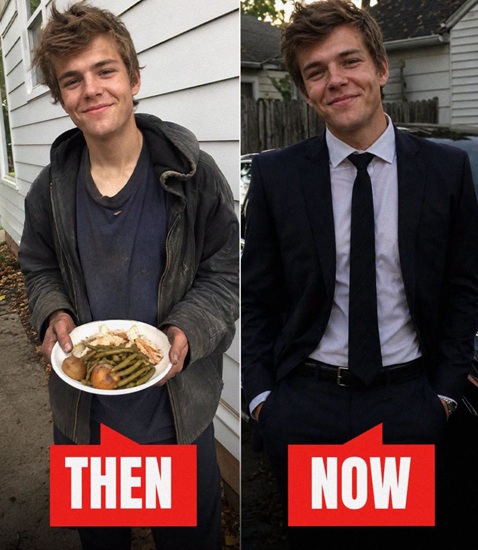
When I was eight years old, I believed my mother loved a stranger more than she loved me. At that age, I didn’t understand sacrifice, compassion, or the quiet promises people keep for those who have no one else. All I knew was that every week she carried warm meals across the road to a young homeless man named Luke while our own dinner table often held little more than soup and stale bread. Looking back now, I realize childhood has a way of turning confusion into certainty, even when that certainty is completely wrong.
Luke had appeared near the abandoned dump at the end of our street shortly after my father passed away. He looked exhausted, wore worn-out clothes, and rarely spoke unless someone addressed him first. Most neighbors avoided him, but my mother never did. Every afternoon she wrapped food in foil and quietly walked toward the edge of the neighborhood. Sometimes she carried chicken, other times fresh bread, and occasionally she packed a slice of pie that she had baked herself. I watched from our kitchen window, wondering why someone outside our family seemed to receive the best of what little we had.
The moment that stayed with me for years happened on a cool autumn afternoon. My mother had just finished baking an apple pie, my favorite dessert. I assumed we would finally enjoy something special together after weeks of simple meals. Instead, she carefully covered the pie, picked it up, and headed for the back door. When she calmly told me it was for Luke, disappointment quickly turned into anger.
I asked why someone we barely knew deserved something that I had been hoping to eat. My mother’s expression changed immediately. She firmly told me never to speak about another person’s hunger that way again. I had never seen her so upset, and although I stopped arguing, resentment quietly settled inside my heart.
From that day forward, I blamed Luke for everything. Every meal my mother shared with him felt like proof that I mattered a little less. Whenever he smiled or tried to wave as I walked home from school, I looked away. One afternoon he carved a small wooden bird and offered it to me. I dropped it onto the ground without saying a word. Instead of becoming angry, he simply smiled sadly and wished me a safe walk home. At the time, I believed his kindness was only another reason my mother admired him.
Years passed, and eventually Luke disappeared from the neighborhood. My mother never explained where he had gone, and I never asked. Life moved on. I left home after finishing school, built a life in another city, and slowly allowed distance to grow between my mother and me. We spoke only occasionally, usually on holidays or birthdays. Neither of us mentioned Luke again, but the silence between us became almost as heavy as the old misunderstanding itself.
Everything changed the day I received a phone call telling me my mother had suffered a severe stroke. I drove back immediately, hoping there would still be time to tell her everything I should have said years earlier. She was weak when I reached her bedside, but she recognized me. I apologized for staying away for so long and promised I would take care of everything after she was gone. She gently squeezed my hand before whispering a final request that caught me completely off guard.
“Don’t abandon Luke.”
Those were the last words she ever spoke.
After the funeral I felt more confused than heartbroken. Why had she spent her final moments thinking about someone I had not seen in years? Even so, I had given her my word. Carrying a container of homemade stew, I returned to our old neighborhood expecting to search the empty lot where Luke had once slept. Instead, I found a black SUV parked outside my mother’s house.
A well-dressed man stepped out and looked toward me with uncertain eyes. It took several long seconds before I recognized him. Beneath the neat haircut and tailored coat was the same young man I remembered from childhood. Luke greeted me quietly and thanked me for coming. He explained that my mother had asked him to wait until after the funeral before speaking to me. Although years had changed his appearance, his gentle voice remained exactly the same.
We sat together inside the old kitchen where so many misunderstandings had begun. Luke carefully placed a worn metal box on the table and unlocked it with a small key. Inside were cassette tapes, each labeled in my father’s handwriting. Some were marked for birthdays, others for graduation, marriage, becoming a parent, or difficult moments in life. My father had recorded them before his death, hoping I would one day hear his advice and encouragement. Luke explained that my father had trusted him to deliver the recordings when I became an adult.
My mother, however, had never been able to let them go.
According to Luke, she listened to one recording shortly after my father’s death and found the experience too painful. She believed hearing his voice again would prevent both of us from moving forward. Every year Luke returned, asking whether she felt ready to give me the box. Every year she quietly said no. He admitted that he should have insisted, but he couldn’t bring himself to break a promise made to the woman who had helped him survive his darkest years.
Luke then shared a story I had never heard before. Long before my father died, he had quietly helped Luke and his mother when they lost their home. He paid for temporary shelter, delivered groceries, and encouraged Luke to continue his education. After my father’s passing, my mother simply continued the kindness she believed he would have shown. Feeding Luke had never been about choosing him over her own family. It had been about honoring the values she and my father shared.
That evening we listened to the first cassette together. Hearing my father’s voice after so many years filled the room with emotions I had buried since childhood. He spoke about love, courage, forgiveness, and the importance of helping people without expecting recognition in return. One sentence stayed with me longer than anything else.
“Kindness is never measured by how much we have. It is measured by what we choose to share.”
For the first time, I understood why my mother had carried those meals across the street. She had never taken anything away from me. She had shown me what compassion looked like, even when life offered very little to give.
In the months that followed, Luke and I slowly built a friendship that neither of us believed possible. We shared stories about my parents, laughed over old memories, and acknowledged the years that had been lost to misunderstanding. Although we could never change the past, we could decide what to do with the future.
Every autumn since then, I bake an apple pie using my mother’s recipe. Before serving it, I always cut two equal slices. One reminds me of the child I once was. The other reminds me that generosity often looks unfair until we finally understand the story behind it.
