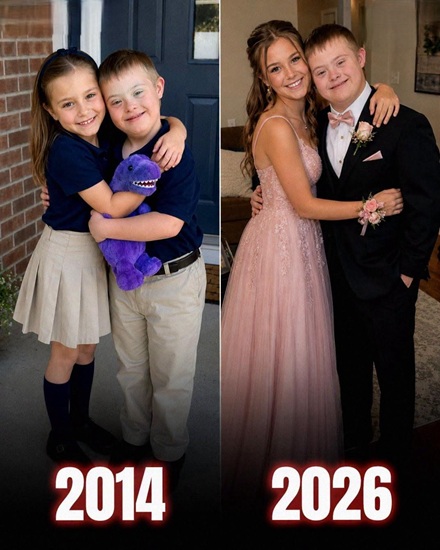
I was six years old when I made Noah a promise that neither of us understood would still matter twelve years later. We met during the first weeks of first grade after discovering two extremely important things about each other: we both hated raisins, and we could talk about dinosaurs for much longer than our teacher considered reasonable. Noah had Down syndrome, but that was simply one part of who he was. To me, he was the boy who laughed louder than anyone else, remembered an unbelievable number of baseball statistics, and never hesitated to tell me when one of my drawings was terrible.
Within months, we were almost impossible to separate. Our friendship became stronger because Noah never treated me as though I needed constant compliments. When I proudly showed him a drawing of two people holding hands, he studied it carefully before announcing that they looked like “potatoes with arms.” I was offended for approximately thirty seconds before we both started laughing. That was Noah. He could be affectionate and thoughtful, but he could also be stubborn, competitive and remarkably direct.
If he thought I was wrong, he told me. If I was upset, however, he was usually one of the first people to notice. The promise about prom began during an ordinary afternoon at school. Our teacher announced that she was getting married, immediately causing the classroom to erupt into questions about dresses, flowers and wedding cake. Noah had strong opinions on all three subjects. His future wedding, he announced, would have chocolate cake, plenty of food and absolutely no slow songs because slow songs were “boring.” Most of us laughed with him. Then a boy sitting across the table made a comment that changed the mood completely.
“Who would marry you?” the boy asked. “Nobody will.”
At six, I did not fully understand what assumptions were behind those words. I only understood their effect. Noah’s enormous smile disappeared, and he stared down at the table. Something about seeing my normally confident friend suddenly become quiet made me angry. I immediately told the other boy he was wrong. Somebody could love Noah, I insisted, because there was nothing about him that made him undeserving of the relationships and happiness everyone else imagined for themselves.
Noah turned toward me with complete seriousness.
“Would you marry me?”
“Maybe,” I answered with the confidence only a six-year-old can possess. “But we have to go to prom first.”
He had no idea what prom was, so I explained that it was a fancy dance people attended when they were almost adults. Noah considered this information carefully before extending his smallest finger toward me.
“Promise?”
I hooked my pinkie around his.
“Promise.”
Most childhood promises disappear almost immediately. Noah remembered ours.
Over the next twelve years, our friendship changed along with us. We were not always in the same classes, and we gradually developed separate interests and groups of friends. Still, Noah remained one of the most consistent people in my life. When my parents divorced, he did not try to give me complicated advice. He simply sat beside me, shared his snacks and told me that adults sometimes made decisions children could not fix. It was surprisingly wise coming from someone who spent the next twenty minutes trying to convince me that baseball was more interesting than every other sport combined.
When I experienced my first serious heartbreak several years later, Noah appeared with ice cream and absolutely no sympathy for my former boyfriend.
“I told you that guy was an idiot,” he announced.
“You said that about every boy I dated.”
“And I was right every time.”
I laughed for the first time in days.
That was why, when senior prom approached, going with Noah did not feel like fulfilling a charitable promise from childhood. He was my best friend. We had grown up together, argued with each other, celebrated birthdays together and supported each other through changes neither of us could have imagined when we were six. When he reminded me about our promise, I did not need time to think.
“Of course we’re going together.”
Prom night arrived faster than expected. I spent most of the afternoon getting ready while my mother moved around downstairs. She had always known Noah and had generally been supportive of our friendship, so I expected nothing unusual when the doorbell finally rang. I heard Mom answer it while I finished putting on my earrings.
Then the house became strangely quiet.
Noah had arrived wearing a dark suit, a carefully chosen bow tie and an expression of enormous pride. He was holding my corsage as though it were something incredibly fragile. Years later, that image would remain one of my clearest memories of the evening.
But my mother’s reaction was completely different.
When she opened the door and saw him, her expression changed. Her smile disappeared. For several seconds she simply stared at Noah, almost as though seeing him dressed for prom had awakened a memory she had spent years trying not to confront.
She eventually smiled again and told him I would be downstairs soon.
Then she came upstairs.
I was standing in front of my mirror when Mom entered my bedroom and quietly closed the door behind her. She locked it.
That immediately caught my attention.
“What’s wrong?”
She didn’t answer right away.
Instead, she sat on the edge of my bed and looked at me with an expression I had rarely seen before.
“You can absolutely go to prom with Noah,” she said. “But there’s one condition.”
I tried to make the moment lighter.
“What? Midnight curfew?”
“No.”
Her hands were trembling.
“You need to know something before you leave tonight.”
My smile disappeared.
“What?”
She looked toward the door and then back at me.
“Something about Noah’s family. And about me.”
For years, I had believed our families became close because Noah and I became friends at school. According to Mom, that was only partly true.
She explained that she had known Noah’s mother before we were born.
They had met years earlier while working at the same community center. Their friendship had been close for a time, but life eventually took them in different directions. They changed jobs, moved to different neighborhoods and gradually lost contact.
Then, shortly before I was born, they unexpectedly encountered each other again.
Mom told me that she had been going through one of the hardest periods of her life. My father was working long hours, money was tight, and she was frightened about becoming a parent. Noah’s mother had already learned that she was expecting a baby as well.
The two women began talking again.
Their pregnancies renewed a friendship that had nearly disappeared.
When Noah was born, his family learned that he had Down syndrome. Mom said she remembered visiting the hospital and watching Noah’s parents absorb an enormous amount of information while simultaneously doing what every new parent does: learning the face, sounds and personality of their newborn child.
Noah’s mother had apparently told her something Mom never forgot.
“I don’t need people to feel sorry for him,” she had said. “I need people to give him the chance to be himself.”
Mom promised she would.
Several months later, I was born.
Our families stayed connected for a while, but another move eventually separated us again. By the time Noah and I started elementary school, Mom had not seen his mother regularly for years.
Then I came home from first grade talking endlessly about my new best friend.
His name was Noah.
Mom realized almost immediately who he was.
I stared at her.
“You knew?”
“From the beginning.”
“Why didn’t you tell me?”
“Because I didn’t want you to think you were supposed to be his friend.”
That answer silenced me.
Mom explained that after realizing Noah was the child of her old friend, she had deliberately stepped back. She wanted whatever friendship developed between us to belong to us rather than becoming an obligation inherited from our mothers.
“I watched you choose each other,” she said. “Again and again.”
I still didn’t understand why she had stopped me on prom night.
Then she explained the part that had been troubling her.
Years earlier, when Noah and I were still children, Mom had overheard another parent describe our friendship as “sweet” because I was supposedly “taking care of him.”
She had hated the comment.
It reduced Noah to someone who existed only to receive kindness and reduced our friendship to an act of charity.
Mom knew that wasn’t true.
She had seen Noah support me through my parents’ divorce. She had watched him defend me when classmates were unkind. She had seen him arrive when I was heartbroken and somehow make me laugh.
Our friendship was reciprocal.
But as prom approached, she became worried that other people might misunderstand it again.
Her condition was therefore not that I reconsider going with Noah.
It was the opposite.
“If anyone tonight treats him like your good deed,” she said, “don’t stay quiet.”
I looked at her.
“That is the condition?”
“Yes.”
Her eyes filled with tears.
“You aren’t taking Noah to prom because you feel sorry for him. You’re going to prom with your best friend. Never let anybody rewrite that relationship for either of you.”
For several seconds, neither of us spoke.
The frightening secret I had imagined when she locked the door turned out not to be some scandal about Noah. It was a history our families had never explained to us and a fear my mother had quietly carried for years.
I hugged her.
Then I went downstairs.
Noah immediately looked at the clock.
“You took forever.”
“My mother was talking.”
“You can talk tomorrow. Prom is tonight.”
Mom laughed from behind me.
Noah carefully placed the corsage on my wrist. Then he looked at Mom.
“Don’t worry. I’ll bring her home.”
Mom smiled.
“I know.”
Prom itself was wonderfully ordinary.
We took too many photographs. Noah complained about the food. I reminded him that he had promised me twelve years earlier that there would be no boring slow songs at his imaginary future wedding, and he informed me that this rule still applied.
When the music started, he dragged me onto the dance floor.
He was not the best dancer in the room.
Neither was I.
That didn’t matter.
At one point, a classmate approached us and mentioned hearing about the promise we had made in first grade.
“That’s so sweet of you,” she told me.
Before I could respond, Noah raised an eyebrow.
“Sweet of her?”
The girl looked confused.
Noah pointed at himself.
“I had other options.”
I burst out laughing.
So did she.
And suddenly I understood exactly what Mom had been trying to tell me.
Noah did not need me to speak for him constantly. He had his own voice, opinions and sense of humor. Being his friend did not mean protecting him from every uncomfortable interaction or treating him as fragile. It meant respecting him enough to stand beside him when necessary and allowing him to stand beside me when I needed the same thing.
Near the end of the evening, the DJ finally played a slow song.
Noah groaned dramatically.
“I told you these were boring.”
“Twelve years and you still hate them?”
“Obviously.”
But he danced anyway.
While everyone around us swayed under the lights, I thought about two six-year-olds sitting at a classroom table discussing dinosaurs and chocolate cake. Neither of us could have understood what twelve years meant. We couldn’t have predicted divorces, heartbreak, changing schools or the hundreds of ordinary days that would gradually turn childhood friendship into something durable.
Yet somehow, Noah had remembered the promise.
After prom, our friendship continued to change as adulthood began. We followed different schedules and developed new responsibilities. We could no longer assume we would see each other every morning the way we had during school.
But the lesson from that night remained with me.
Friendship is not meaningful because one person rescues another.
It becomes meaningful when both people are allowed to contribute, disagree, support, challenge and care for each other as equals.
Noah had done all of those things for me.
I had tried to do the same for him.
His Down syndrome was part of his life, and pretending otherwise would have ignored something real about his experiences. But reducing every friendship, achievement or ordinary moment to that diagnosis would have ignored the rest of him.
He was still the boy who hated raisins.
Still the person who could recite baseball statistics I never asked to hear.
Still the critic who believed most of my childhood drawings resembled vegetables.
And still the friend who remembered a promise made when we were six.
Years later, when I think about prom, I don’t remember it as the night I “took my friend with Down syndrome to a dance.”
I remember Noah arriving at the door looking ridiculously proud of his bow tie.
I remember my mother’s trembling hands.
I remember learning that our families had a history neither of us knew.
And I remember dancing with my oldest friend while he complained about the music.
The promise mattered.
But what happened during the twelve years between making it and keeping it mattered much more.
