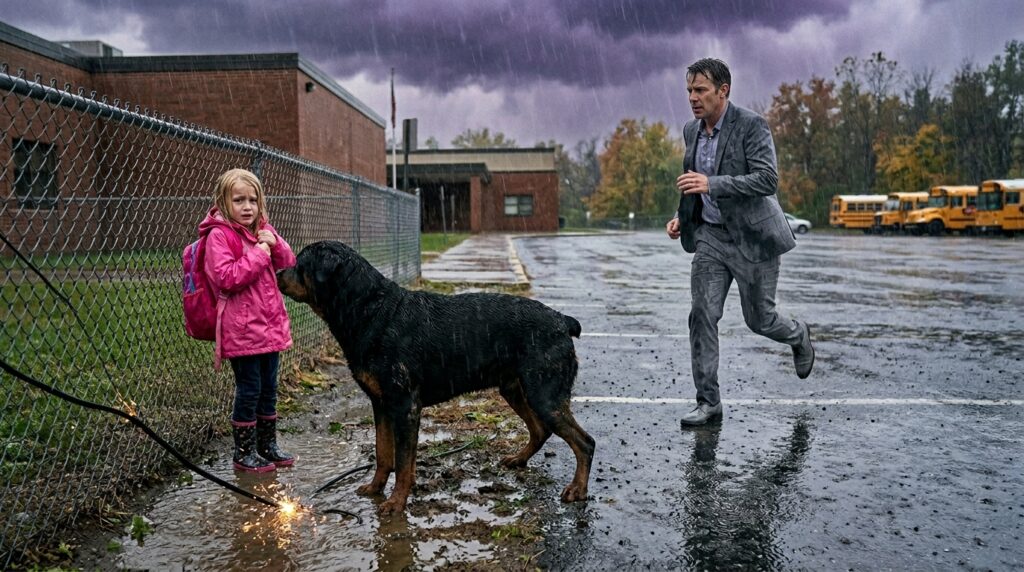
The afternoon began like many others at Oakridge Elementary, a small school located in a quiet Pennsylvania community. Students were finishing their lessons, teachers were organizing classrooms, and parents were preparing to pick up their children before the weather worsened. Throughout the morning, local forecasts had warned residents about an approaching storm system. Dark clouds gathered steadily above the town, and strong winds began moving through the streets long before the first drops of rain arrived.
By early afternoon, the sky had become almost completely covered. The bright summer atmosphere disappeared beneath heavy gray clouds that seemed to stretch endlessly across the horizon. Inside the school, staff members monitored weather updates while encouraging families to leave before conditions became dangerous. Most parents responded quickly, and many students had already departed by the time the storm intensified.
As principal of the school, I had spent more than a decade overseeing daily activities, managing unexpected situations, and ensuring student safety. Yet nothing in my professional experience prepared me for what would happen that day. The rain arrived suddenly. Within minutes, sheets of water were falling from the sky. Thunder echoed across the community, and powerful gusts of wind rattled windows throughout the building.
From my office, I watched the parking lot slowly disappear beneath the downpour. Visibility became increasingly limited as the storm strengthened. While reviewing dismissal reports, a small movement near the edge of the property caught my attention. At first, I assumed it was debris being pushed by the wind. Then I looked closer. Near the outer fence stood a young girl wearing a bright pink jacket. Even through the rain, I immediately recognized her as Lily, a quiet second-grade student known for her kind personality and gentle nature.
My concern grew instantly. Most children had already gone home. Lily should not have been standing alone outside during such severe weather. She appeared frightened and uncertain. Her backpack was pressed tightly against her chest as she stood near a section of fencing that bordered a wooded area beyond the school grounds. I reached for the phone to contact staff members. Before I could speak, another movement captured my attention. Something emerged from the trees. A large dog suddenly appeared and sprinted directly toward Lily.
The animal moved quickly through the rain. Its dark coat was soaked, and visible scars covered portions of its body. From the distance, the scene appeared alarming. My immediate assumption was that the dog intended to attack. Without hesitation, I rushed from my office. Years of training and responsibility left little room for second-guessing. Protecting students was always the priority. I ran through hallways, descended staircases, and pushed through the building’s main entrance despite the heavy rain and strong winds. As I approached the scene, my heart raced.
The dog had already reached Lily. What I witnessed from a distance looked terrifying. The large animal pressed against the child and prevented her from moving forward. Lily appeared frightened, and the situation seemed extremely dangerous.
I expected aggression.
I expected violence.
But when I finally reached them, I realized something entirely different was happening.
The dog was not attacking.
The dog was protecting her.
Only a few feet away, a damaged electrical cable had fallen across the flooded ground. The line snapped and moved unpredictably as wind pushed it through standing water. Bright blue sparks flashed around the cable, creating an extremely dangerous situation. One step in the wrong direction could have resulted in a serious tragedy. Lily had unknowingly stopped near an electrified area. The dog somehow recognized the danger before anyone else. Instead of allowing her to move forward, the animal used its body to keep her away from the hazardous water.
The realization left me stunned. Everything I thought I had witnessed was wrong. The dog’s behavior was not aggressive. It was protective. Every growl, every movement, and every action seemed focused entirely on preventing the child from entering danger. The scarred animal stood between Lily and a potentially life-threatening situation. Rain continued pouring down around us. The cable whipped through the floodwater while sparks illuminated the ground nearby.
The dog remained alert despite obvious discomfort.
Its paws trembled.
Its body shook.
Yet it refused to abandon its position.
For several moments, I simply stared in disbelief.
Animals often display remarkable instincts, but the determination shown by this dog seemed extraordinary.
It was risking its own safety for a child it did not appear to know.
I needed to act quickly.
Searching nearby, I found a wooden plank that I hoped could help move Lily farther from danger.
The situation required caution because any contact with electrified water could create additional risks.
Carefully, I positioned myself and attempted to guide Lily away from the area.
The effort proved more difficult than expected.
Moisture had affected nearly everything around us.
Even the wooden board transmitted a painful shock that traveled through my arms and forced me backward.
Despite the discomfort, the attempt succeeded.
Lily moved away from the most dangerous section of flooded ground and reached a safer location near a gravel surface.
Relief washed over me.
The child was finally out of immediate danger.
Unfortunately, the dog had endured the worst of the situation.
Exhausted and weakened, it collapsed into the mud.
Its body appeared unable to support its weight.
Watching the animal struggle after everything it had done created a deep sense of responsibility.
Leaving it behind was not an option.
The dog had protected one of our students.
Now it needed help.
Using my heavy overcoat, I improvised a way to reach the animal without exposing myself to unnecessary danger.
The process required patience and effort, but eventually the dog responded.
Despite obvious exhaustion, it understood what I was attempting.
Slowly, I guided it toward safer ground.
The task felt endless.
Rain continued falling.
Wind continued howling.
Yet eventually the animal reached a secure area beside us.
Together, Lily, the dog, and I moved toward the nearest school entrance.
Unfortunately, the storm created another obstacle.
Electrical failures had affected portions of the building.
Certain entrances were inaccessible, forcing us to remain under a covered area while awaiting assistance.
Conditions remained difficult.
The temperature dropped noticeably as rain and wind continued affecting the area.
Everyone was cold, tired, and anxious.
Still, we were safe from the immediate threat posed by the damaged cable.
As we waited, emergency responders worked throughout the community addressing storm-related incidents.
Communication delays created uncertainty about how quickly help would arrive.
The dog rested quietly nearby.
Its breathing remained heavy, but it stayed close to Lily.
Remarkably, the child no longer appeared afraid.
Instead, she seemed comforted by the animal’s presence.
Perhaps she understood what had happened.
Perhaps she sensed that the dog had protected her.
Whatever the reason, a bond appeared to form between them during those difficult moments.
Eventually, emergency vehicles arrived.
Flashing lights illuminated the storm-darkened surroundings.
Firefighters, police officers, and utility workers quickly assessed the situation and secured the area.
Medical personnel evaluated both Lily and the dog.
Fortunately, neither suffered life-threatening injuries.
Lily experienced minor exposure-related symptoms and several scrapes.
The dog required veterinary attention, rest, and observation.
Once conditions stabilized, the animal was transported to a veterinary clinic for examination.
The discovery that followed surprised everyone.
Despite its heroic actions, nobody knew where the dog came from.
There was no identification tag.
No microchip information could be located.
No owner came forward.
Veterinarians documented numerous scars that suggested a difficult past.
Yet despite those experiences, the dog demonstrated extraordinary gentleness and loyalty.
News of the incident spread throughout the community.
Teachers discussed it.
Parents discussed it.
Students discussed it.
Many people were moved by the story of an animal that appeared willing to risk its own safety to protect a child.
Over the following weeks, I visited the veterinary clinic regularly.
Each visit reinforced the same conclusion.
The dog possessed an unusually calm and trustworthy temperament.
Eventually, I made a decision.
I adopted him.
After everything that had happened, it felt like the right choice.
The name came naturally.
I called him Shield.
The name reflected exactly what he had done.
He had become a shield between danger and a vulnerable child.
As the months passed, Shield adjusted remarkably well to his new life.
He enjoyed long walks, quiet afternoons, and the simple comforts of a safe home.
The scars remained visible, but they no longer defined him.
Instead, people remembered his courage.
One afternoon, several weeks after the storm, Lily visited the school playground while Shield accompanied me.
The moment she saw him, her face lit up with excitement.
She ran toward him without hesitation.
The dog recognized her immediately.
His tail began wagging, and he gently lowered his head as she wrapped her arms around his neck.
The scene touched everyone present.
It represented gratitude, trust, and a connection formed under extraordinary circumstances.
Watching them together reminded me how easily appearances can be misleading.
At first glance, many people would have seen only a large scarred dog running toward a child.
Few would have imagined that the animal was acting with courage and compassion.
The experience changed my perspective.
For years, I had worked to teach students about character, responsibility, and bravery.
Books, assemblies, and classroom lessons all attempted to communicate those values.
Yet one stormy afternoon provided a lesson more powerful than any speech ever could.
True courage is not always loud.
Sometimes it appears in unexpected forms.
Sometimes it comes from individuals who have endured hardship themselves.
And sometimes it arrives in the form of a scarred dog willing to protect a stranger without expecting anything in return.
Long after the storm passed, the memory remained.
Students continued telling the story.
Parents shared it with their children.
Teachers used it as an example of kindness and selflessness.
For many people, Shield became more than a rescued animal.
He became a symbol of courage.
Most importantly, he reminded everyone that compassion can emerge from the most unexpected places and that true heroes are not always who we expect them to be.
