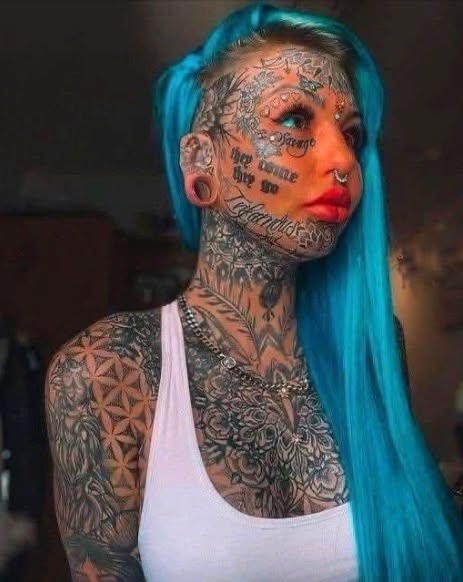
Amber Luke, widely known online as the “Dragon Girl,” has become one of the most recognizable figures in the world of extreme body modification, not simply because of her appearance, but because of the deeply personal story she attaches to every change she has made. From a distance, her transformation may look like pure shock value, but her own explanations reveal a far more complex journey built around identity, mental health, and the search for control over her own body and life.
Over the years, she has openly documented her evolution through tattoos, piercings, and surgical modifications that collectively redefine how she presents herself to the world. Born and raised in Brisbane, Australia, Amber has spoken in interviews and on social media about how her fascination with alternative aesthetics began at a young age. What started as an interest in tattoo culture and nontraditional beauty gradually became something much deeper, forming a central part of how she understood herself.
By her mid-teens, she was already experimenting with body art, but at the time, it was still relatively minimal compared to the extensive work she would later pursue as an adult. Her early life, as she describes it, was marked by emotional struggle and a sense of disconnection from her surroundings. As she grew older, Amber’s transformation accelerated into something far more extreme and intentional.
She eventually covered most of her body in tattoos, each piece contributing to a larger visual identity that she describes as her “dragon” persona. Her ink is not random; it follows a theme that reflects strength, rebirth, and personal evolution. Alongside tattoos, she also underwent procedures such as tongue splitting, a modification that created her signature forked tongue and further reinforced the reptilian aesthetic she embraces. These changes, while visually striking, are part of a long-term commitment to reshaping how she feels inside as much as how she looks outside.
One of the most widely discussed aspects of her journey involves a cosmetic eye tattoo procedure, a highly specialized and risky form of body modification. Amber has publicly stated that during one of these procedures, complications led to a temporary loss of vision, which she described as an extremely intense and frightening experience. While the situation eventually resolved, it became a defining moment in her story, highlighting both the physical risks involved in extreme body art and her determination to continue despite setbacks. She has since acknowledged the seriousness of such procedures while also maintaining that her personal choices remain intentional.
Before her transformation became widely known, photos of Amber from her teenage years show a dramatically different appearance, with a more conventional and natural look. This contrast is often used in media coverage to emphasize the scale of her change, but Amber herself has consistently pushed back against the idea that her transformation was purely cosmetic curiosity. Instead, she explains that her earlier years were emotionally difficult and that she struggled significantly with mental health challenges, including periods of depression and feelings of detachment from herself. These experiences, she says, played a major role in shaping her later decisions.
For Amber, body modification became more than aesthetics; it became a form of personal reclamation. She has described the process of transforming her body as a way of regaining control during a time when she felt powerless internally. Each tattoo, piercing, or modification represented a step away from a version of herself she no longer identified with. Rather than viewing her body as something fixed, she began to see it as a living project that could evolve alongside her emotional state. This perspective helped her build a sense of identity that she felt was authentic to who she was becoming.
Over time, Amber also built a strong online presence, where she shares her journey with a large global audience. Her content often includes discussions about self-expression, mental health, and body autonomy, alongside visuals of her evolving appearance. While she receives significant attention and admiration from followers who appreciate her honesty and confidence, she also faces criticism from those who struggle to understand or accept her choices. This duality has become a constant part of her public life, placing her at the center of ongoing debates about beauty standards and personal freedom.
Despite the intense public scrutiny, Amber has repeatedly stated that she does not regret her transformation. Instead, she frames it as a necessary path that helped her move away from a period of severe emotional distress. According to her, the changes she made to her body were not about pleasing others or seeking attention, but about survival and self-definition. She often emphasizes that happiness and mental well-being matter more to her than social approval, even when that means facing judgment or misunderstanding from the wider public.

Her appearance today, fully covered in tattoos with striking modifications like her forked tongue and heavily stylized aesthetic, continues to provoke strong reactions wherever she goes. Some people view her as an artist using her own body as a canvas, while others see her as an extreme example of body modification culture. Amber, however, maintains that both interpretations miss the most important point: her choices are deeply personal and rooted in her own journey rather than external validation.
In discussions about her life, Amber often returns to the theme of transformation as healing. She describes her body as a reflection of her inner state, suggesting that changing her appearance allowed her to rebuild her identity from a place of emotional pain. While not everyone agrees with or understands her approach, her story has contributed to broader conversations about mental health, coping mechanisms, and the many different ways people seek to recover from difficult experiences.
Ultimately, Amber Luke’s story is not just about tattoos or extreme aesthetics, but about the complicated relationship between identity, trauma, and self-expression. Her journey challenges traditional ideas of beauty and forces people to confront uncomfortable questions about how far someone should be allowed to go in the pursuit of personal truth. Whether viewed as controversial or inspirational, her transformation remains one of the most discussed examples of modern body modification culture, shaped as much by emotional depth as by visual impact.
