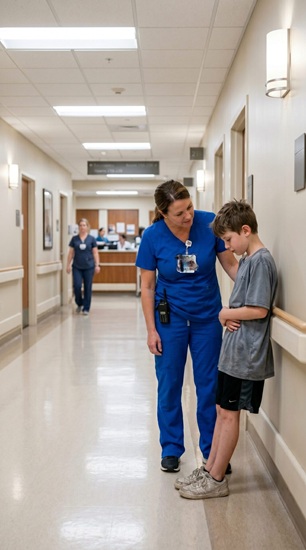
The night Eli walked into Mercy Hill Medical Center alone became more than just another emergency room case. In the hours that followed, it slowly revealed itself as a story that would stay with every person who encountered him. The quiet hum of machines, the soft footsteps of nurses, and the distant sounds of monitors created a strange contrast to the child’s fragile presence. He was so small against the brightness of the hospital lights, yet his arrival filled the space with an unspoken urgency. No one in the room treated it as routine.
Something about him demanded attention that went far beyond medicine alone. Nurse Claire Dawson was the first to reach him, and from the very beginning she sensed that this was not an ordinary situation. The boy’s posture, the way he held himself as if bracing against invisible pain, suggested a life far heavier than his years should have carried. When she knelt beside him, she did not rush her questions. Instead, she softened her voice, trying to create a space where fear might loosen its grip.
Eli’s answers were minimal, but his silence spoke even louder. It carried exhaustion, caution, and a deep familiarity with being unheard. Dr. Nathan Whitaker’s arrival brought structure to the moment, but not comfort. He had seen countless emergencies, yet something about Eli’s condition unsettled him in a way he could not immediately define.
The boy’s symptoms were physical, but the emotional weight in the room was undeniable. As questions were asked and gently repeated, it became clear that Eli was not resisting help out of defiance. He simply did not know how to trust it. Every movement, every glance, suggested a child who had learned to survive by expecting very little from others.
When the scan results finally appeared, the atmosphere in the room shifted. The discovery inside Eli’s stomach stunned the entire medical team into silence. It was not just the medical concern that struck them, but the meaning behind it. Coins and small objects told a story no child should ever have to live.
Claire instinctively turned away for a moment, overwhelmed by the realization of what desperation can push someone so young to do. Dr. Whitaker’s response remained controlled, but even he paused before giving instructions, carefully choosing each word as if the wrong tone might break something fragile.
After the procedure, when Eli finally began to recover, the focus of the room shifted from urgency to understanding. The hospital staff moved more slowly around him, as if afraid that sudden movements might reopen unseen wounds. Claire stayed near even when she was off duty, drawn by a responsibility that felt both professional and deeply personal. When Eli finally spoke his name, it felt like a small but significant step toward reclaiming something he had long kept hidden. The name carried weight, as though it had not been spoken freely in a very long time.
As the days passed, Eli’s story began to emerge in fragments. Each detail uncovered through careful conversation painted a picture of instability and quiet abandonment. There were no dramatic revelations, only a steady accumulation of absence. Missing protection, missing guidance, missing permanence. He had learned to move through the world without expecting stability, adapting to uncertainty as a constant companion. Even the way he spoke about survival carried a calm acceptance that deeply affected those listening.
The hospital staff did not treat Eli’s situation as gossip or spectacle. Instead, it became a shared responsibility that quietly connected them. Meals were brought with extra care, blankets were adjusted more gently, and voices softened instinctively whenever someone entered his room. Small gestures began to accumulate into something resembling safety. For Eli, however, trust was not immediate. Every offer of kindness was met with careful observation, as if he were still waiting for it to disappear. Slowly, though, repetition began to reshape his expectations.
One of the most powerful moments came during a simple meal. Eli’s hesitation before eating revealed more than words could express. It was not the food itself that unsettled him, but the fear that it might not remain his. Claire’s reassurance did not instantly erase that fear, but it introduced a new possibility. That he could receive something without losing it moments later. For a child accustomed to instability, even that idea required time to accept. Yet he continued eating, and that continuation mattered more than speed or certainty.
Social worker Marissa Lane’s involvement added another layer to the unfolding situation. Her approach was not to interrogate but to listen, allowing Eli to speak at his own pace. What emerged was a life shaped by gaps in care rather than a single defining event. Temporary shelters, moments of fleeting safety, and long stretches of uncertainty formed the structure of his world. He had not chosen isolation, but had adapted to it as a necessity. Understanding this changed how everyone in the room viewed his behavior and his silence.
As more details became clear, one truth stood out above all others. Eli had not stopped believing in safety. He had simply stopped expecting it from others. That distinction reshaped how the hospital team responded to him. It was no longer about fixing a single incident, but about rebuilding a sense of trust that had been gradually eroded over time. Each interaction became an opportunity to show consistency rather than intensity. And slowly, those repeated moments began to accumulate into something new.
The day Eli received a small stuffed dog marked a turning point that was quiet but meaningful. It was not the object itself that mattered most, but the fact that it remained with him. Ownership, something so ordinary for most children, had been uncertain in his life for far too long. Holding onto something without fear of it being taken created a shift that was almost invisible but deeply significant. That night, his sleep changed, becoming less guarded and more open to rest.
When the time came for placement decisions, uncertainty lingered in Eli’s mind. Change, even positive change, carried the risk of unfamiliar loss. Yet the presence of consistent care from the hospital staff helped him understand that transition did not have to mean abandonment. The words spoken to him were simple but powerful, reminding him that safety was not something he had to earn through perfection. It was something he was allowed to receive simply by being a child who needed it.
On the day he left Mercy Hill, the atmosphere was different from the night he arrived. The same doors that had once opened to reveal a frightened, exhausted child now framed a quieter, steadier moment. Eli was still cautious, still uncertain, but no longer alone in the same way. The people who had cared for him stood nearby not as rescuers of a single moment, but as witnesses to a longer process of recovery. His steps forward were slow, but they were no longer isolated.
As he walked outside into the morning light, the world ahead of him remained uncertain, but it was no longer defined by survival alone. There was space now for something different to exist alongside his past. Stability was not yet complete, but it had begun. And for a child who had once believed he had to hide even his smallest possessions to keep them safe, that shift represented something profound. A beginning that did not erase the past, but moved beyond it.
