After my wife Sarah died, I honestly believed that part of my life was over forever. I had loved her deeply, and losing her only hours after the birth of our daughter changed everything about the future I thought we had. For a long time, I could not imagine another person entering that space. My entire world became our daughter, Ari, and the challenge of learning how to raise her while carrying grief that felt far too heavy to explain. Sarah never had the chance to truly know our little girl, and that fact stayed with me every single day.
Sarah had recorded a lullaby during the final month of her pregnancy. It was not polished or professional. She forgot part of the lyrics, hummed through another section, and laughed once because the baby had kicked while she was recording. Somehow, that imperfect little recording became one of the most valuable things I owned. Whenever Ari cried in the middle of the night, I sometimes played it, and she would often calm down almost immediately. I would hold her close, whisper that the voice belonged to her mother, and then wait until the song ended before allowing myself to cry.
The first two years after Sarah’s death passed in a blur. I was learning how to become a father while trying to survive grief at the same time. My mother helped enormously, especially during the months when I barely knew what day it was. I returned to work because bills did not stop simply because life had fallen apart. There were mornings when exhaustion made ordinary tasks ridiculous. Once, I poured cereal into the refrigerator and put the milk in a kitchen cabinet. I laughed when I realized what I had done, then cried because Sarah would have found it hilarious.
I kept photographs of Sarah throughout the house because I wanted Ari to grow up knowing that her mother had existed and had loved her before she was even born. When Ari became old enough to point at the pictures, she started asking questions. She wanted to know who Sarah was, what she sounded like, whether she was funny, and whether she could hear her voice. Sometimes I played the lullaby. Other times I told myself Ari was too young to understand. The truth was that I was the one who was not ready to talk about Sarah for very long.
When Ari was two, I decided her birthday deserved something special, so I took her to a children’s toy store without any real idea what I was looking for. I stood in front of shelves packed with toys while Ari wrapped both arms around my leg. That was when Claire approached us. Instead of speaking loudly or immediately trying to win Ari’s attention, she crouched behind the counter and slowly raised a stuffed rabbit above the edge. She made the rabbit whisper silly things and pretend to fall over. Within minutes, Ari was laughing and making the rabbit hop across the counter herself.
Claire understood something about my daughter almost instantly. Ari was not really shy; she simply needed time before she felt comfortable. Claire gave her that time without making a big deal about it. Before we left, she slipped a little rainbow sticker into Ari’s bag. A week later, we returned because Ari insisted that the stuffed rabbit probably missed us. Claire laughed when she saw us again, and that second meeting gradually turned into coffee, dinners, weekend walks, and eventually something neither of us wanted to end.
I told Claire about Sarah early in our relationship. I told her about the hospital, the lullaby, the grief, and the guilt I still carried whenever I felt happy. I expected her to say that I needed to move on, because that was what most people told me. Instead, Claire reached across the table and said, “You don’t have to stop loving Sarah.” I remember staring at her because nobody had ever put it that way before. She did not ask me to leave my past behind. She simply made room for it.
That was probably the moment I realized I was falling in love again. It terrified me because part of me felt that loving someone new meant betraying Sarah. Claire never encouraged that idea. She reminded me through her actions that one relationship did not have to erase another. When she began spending more time with Ari, she moved slowly. She colored beside her, read books only when Ari brought them over, and learned that every dinosaur needed its own voice. She never asked Ari to call her Mom and never tried to remove Sarah’s photographs.
When Claire eventually moved into our home, she asked whether I wanted Sarah’s pictures left exactly where they were. I was surprised by the question because I had prepared myself for the possibility that she might feel uncomfortable. Instead, she looked genuinely confused by my concern. “They’re part of your family,” she said. That sentence meant more to me than I could explain. She did not treat Sarah like competition. She treated her as someone whose place in our history mattered.
After more than two years together, Claire and I married in a small garden ceremony surrounded by close family. There was no huge celebration, just sunshine, a few white flowers, and Ari proudly throwing flower petals in the wrong direction. Everyone laughed. For the first time since Sarah died, I allowed myself to believe that happiness was not something I had stolen from the past. Maybe it was simply something new that life had unexpectedly given us.
After the wedding, Claire fit naturally into our routines. She packed Ari’s lunches, danced badly while making pancakes, and somehow convinced our picky eater that broccoli was made of “tiny superhero trees.” The house became noisier, and after years of silence, I welcomed every sound. My parents noticed the change too. My mother once looked around the room and quietly said that she had almost forgotten what laughter sounded like in our house.
Still, I began noticing small things that I could not explain. Whenever Claire and Ari shared an especially happy moment, Ari sometimes became quiet afterward. One morning, Claire braided her hair, and later I found Ari standing silently in front of Sarah’s photograph. Another evening, Claire tucked her into bed, but five minutes later Ari came into my room carrying her blanket and asked if Mommy could sing. I knew immediately that she meant Sarah, so I played the lullaby.
The same pattern repeated several times. Ari seemed to search for Sarah whenever she became especially close to Claire. Claire noticed too and worried that she had done something wrong. I told her Ari was simply adjusting. Neither of us understood that Ari was not pulling away from Claire because she disliked her. She was afraid of something far more complicated.
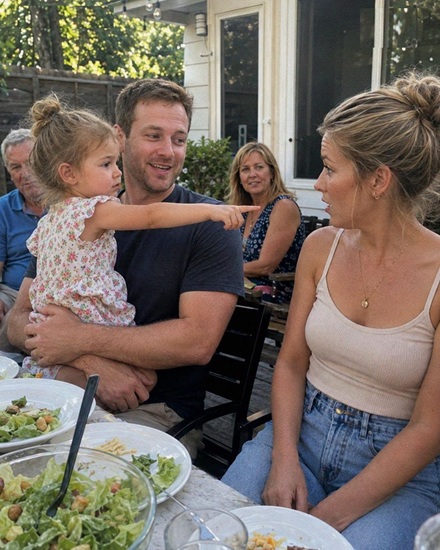
A few weeks after the wedding, I invited my parents and younger sister over for dinner. Claire spent most of the afternoon cooking, and the house smelled like roasted chicken, fresh bread, and apple pie. Ari insisted on setting the table, even though half the forks ended up in the wrong place. Claire quietly corrected them without making her feel embarrassed. When my family arrived, the house immediately filled with laughter, conversation, and the kind of comfortable noise I had once thought we would never have again.
During dessert, my mother became emotional. She looked at Claire and told her how grateful she was that Ari and I had someone kind in our lives. She carefully said that nobody could ever replace Sarah, and Claire immediately agreed. Then my mother added that she thought Sarah would be at peace knowing we were not alone anymore. For a few seconds, the room was completely quiet.
Then Ari suddenly pushed her chair back.
She stood up, pointed directly at Claire, and said, “She’s a monster.”
Every person at the table froze. My sister stopped moving. My father stared at Ari. Claire went completely still with one hand around her coffee cup. I tried to keep my voice calm and asked why she would say something like that.
Ari’s eyes filled with tears. She looked at Claire, then at Sarah’s photograph on the mantel. “Because when I love Claire, Mommy starts disappearing,” she whispered. The words hit me harder than I expected. Ari explained that when Claire brushed her hair, she could no longer imagine Sarah doing it. When Claire hugged her, she worried she was forgetting what her mother’s hugs were supposed to feel like.
Then she said something that broke my heart completely. “When people say Claire is my new mommy, my real mommy goes away forever.” She started crying and added that in stories, monsters make people disappear. Suddenly, every strange moment made sense. Every time Ari asked for the lullaby after a happy day with Claire, she had been trying to hold on to Sarah. Every time she stared at photographs, she was making sure her mother had not been erased.
I realized that I had accidentally contributed to her fear. Ari had asked me questions about Sarah for years, and I had often shortened the conversations because remembering hurt too much. I thought I was protecting my daughter from grief. Instead, I had made Sarah feel distant and fragile, almost like a memory that could disappear if we stopped talking about her.
Claire stood up quietly and walked into the living room. For a moment, I worried that Ari’s words had broken her heart. Then she returned carrying Sarah’s framed photograph. She placed it on the empty chair beside Ari and said gently, “Your mommy gets a seat too.” She pulled her own chair slightly farther back and told Ari that she had never wanted Sarah’s place.
Then Claire asked, “Would you tell me something about your mommy?”
Ari looked down and whispered, “I don’t know enough.”
That sentence changed everything.
I started telling stories. I told her that Sarah was terrible at making blueberry muffins the first time she tried because she forgot the sugar. My mother laughed and admitted that the second batch had been much better. My father reminded everyone that I had still eaten three of the terrible ones. Ari laughed. Then one story became another. We talked about Sarah singing off-key while cleaning, crying during animal rescue commercials, and talking to Ari while she was still pregnant because she believed babies recognized voices.
For the first time since Sarah died, we did not avoid her name. We brought her back into the conversation as naturally as if she belonged there, because she did. Claire listened to every story. She laughed at the funny ones and cried during the tender ones. She never tried to interrupt or prove that she belonged more than Sarah did.
Eventually, Ari climbed onto Claire’s lap.
“You still love me?” she asked.
“Very much,” Claire answered.
“Even if Mommy stays?”
Claire kissed the top of her head. “I hope she always stays.”
Ari looked confused and asked, “Then where do you go?”
Claire smiled. “I don’t need your mommy’s place. I’d like my own place.”
For a four-year-old, that seemed to make perfect sense.
The following morning, Claire found an old recipe box in the back of a cabinet. It had belonged to Sarah. Inside were handwritten recipes, and right on top was the blueberry muffin recipe. Claire held it up and asked what I thought. I understood immediately. She was not trying to become Sarah. She was inviting Sarah’s memory back into our daily life.
We made the muffins together. Ari cracked eggs with more enthusiasm than accuracy, flour covered the counter, and batter landed on Claire’s sleeve. Half the muffins rose crooked, and one burned around the edge. Ari looked at them proudly and declared that they were perfect.
While they cooled, I reached for my phone and found Sarah’s lullaby. For years, I had often left the room after pressing play because hearing her voice hurt too much. This time, I stayed. Sarah’s voice filled the kitchen, still imperfect, still forgetting half the lyrics, still laughing at the same place.
It hurt.
But it also felt comforting.
Ari listened quietly, then climbed down from her chair and picked up Sarah’s photograph. There were three napkins on the breakfast table. Ari carefully placed a fourth one beneath the picture. Claire carried over the muffins and placed the least-burned one beside Sarah’s photograph.
Then Ari slipped her hand into Claire’s.
Not because she had forgotten her mother.
Because she finally understood that she never needed to.
That dinner taught me something I wish I had understood earlier. Children can interpret change in ways adults never expect. To Ari, every comment about Claire being a wonderful new mother sounded like proof that Sarah was being replaced. Nobody meant to send that message, but intentions do not always determine how a child understands something.
Claire’s response mattered because she never competed with Sarah. She did not tell Ari that the past had to disappear before the future could begin. She simply made room for both.
Sarah remained Ari’s mother.
Claire became someone different.
Someone important in her own way.
Our family did not heal because one woman replaced another. It began healing when we stopped believing that anyone needed to be replaced at all.
Now our kitchen holds both old and new memories. Sarah’s handwritten recipe still sits in the tin. Her lullaby is still saved on my phone. Her photographs remain throughout the house. Beside them are newer pictures of Claire and Ari baking, laughing, and building a life together.
None of those memories erase the others.
That may be the most important thing we learned.
Grief does not need to disappear for happiness to return. Loving someone new does not mean loving someone from the past any less. And a child should never have to believe that opening her heart to someone who is present means closing it to someone who is gone.
This is a fictional narrative created for storytelling purposes and should not be presented as a verified real-life event or local news report.
