The call came while I was standing at the kitchen sink, rinsing out Letty’s cereal bowl and pretending I wasn’t staring at the empty hook where Jonathan’s keys still hung in memory more than in reality. The sound of the phone made everything in the house feel sharper, like even the air knew something was about to break again. When I answered, the principal’s voice was tight in a way I had learned to fear over the past three months. Nothing good ever came in that tone anymore. It always carried weight, always carried consequence.
“Piper?” he said carefully, like he was stepping around something fragile. I immediately asked about Letty before he could say anything else, because my life had narrowed down to that question alone. His response was too quick, too rehearsed, and that alone told me everything was already wrong. Then he said it—six men at the school, asking for my daughter by name. My hand slipped against the sink, the bowl cracked, and for a moment I couldn’t tell if the sound came from porcelain or from inside me.
The principal explained that Letty had refused to leave the office when she heard Jonathan’s name mentioned. That detail hit harder than anything else. Jonathan wasn’t just a memory to her—he was still present in the way she reacted to the world, in the way grief had settled into her bones without ever fully leaving. I grabbed my coat without thinking. The house suddenly felt too small to contain what was happening outside its walls, and I already knew that whatever those men wanted, it was tied to something I hadn’t yet understood.
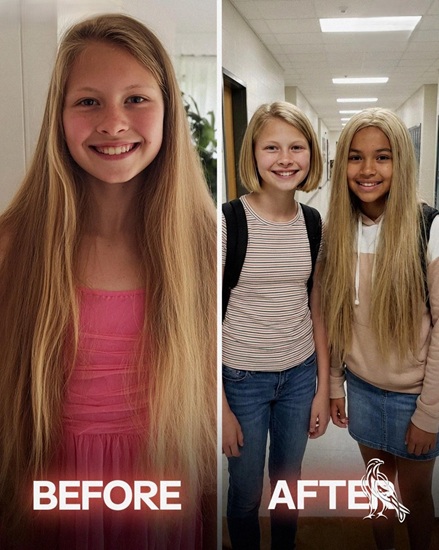
That night had already left its mark on us before the call even came. I had found Letty in the bathroom holding a ribboned bundle of hair she had cut herself with kitchen scissors. Her hands had been shaking, but her eyes were steady in a way that terrified me more than anything else. She wasn’t acting out—she was acting forward, like she had made a decision too big for her age but too sincere to undo.
She told me about a girl at school who was losing her hair during cancer treatment, about laughter in a classroom that followed that girl into silence, and about a bathroom where she had cried alone so no one would see. Letty had listened to all of it, absorbed it, and then quietly decided that her own hair could become something else in someone else’s life. She didn’t present it as heroism. To her, it was just logic.
When I asked her what she thought she was doing, she simply said she didn’t want someone else to feel alone the way she had seen it happen. That was Jonathan in her voice. That was exactly how he used to talk about people—like distance didn’t justify indifference. I wrapped her in my arms before I could overthink it, because in that moment I understood something painful and beautiful at the same time: she hadn’t lost him. She had inherited him.
We went to Teresa’s salon the next morning to fix what scissors and emotion had done. Letty sat under the cape like she was entering another version of herself, while Teresa muttered under her breath about children and impulsive bravery. Luis walked in halfway through and stopped when he saw the hair on the counter. The room changed instantly when he said Jonathan’s name. It was like the air itself had recognized it.
They spoke about him in fragments—work shifts, broken jokes, quiet generosity that nobody had fully noticed until he was gone. Letty listened carefully, absorbing every word like she was trying to reconstruct someone from scattered pieces. For her, Jonathan wasn’t an absence. He was a pattern she was still learning to recognize in other people.
By the time the wig was ready, something had already shifted. It wasn’t just about hair anymore. It was about recognition—about a child choosing compassion when it would have been easier not to notice. I thought the hardest part would be school that day, but I was wrong. The hardest part was arriving and realizing the world had already started responding to something we didn’t fully understand yet.
When I reached the principal’s office, I found Letty standing with a girl I didn’t recognize at first. Then I saw the wig. The transformation wasn’t just physical—it was emotional. The girl looked less like someone being observed and more like someone being seen. Her mother was crying quietly, and Letty stood beside her like she had been there all along.
On the desk sat Jonathan’s old hard hat.
I froze.
Seeing his name inside it again pulled something open in me I thought had already been sealed. The principal tried to explain, but the explanation didn’t matter yet. Not when memory was sitting in the center of the room like it had never left. Letty turned toward me slowly, her eyes already full of questions she didn’t know how to ask.
That was when the men from Jonathan’s old plant stepped forward. Six of them, all carrying the weight of shared history. They didn’t speak loudly. They didn’t need to. Their presence alone carried enough truth to change the atmosphere of the room. One of them placed an envelope on the desk with Jonathan’s handwriting on it.
My name was written there.
Piper.
The room went still in a way I can still feel even now. Marcus, Jonathan’s old supervisor, finally explained what the envelope meant. Jonathan had been quietly building something long before we understood it—a fund for families struggling under medical costs. Not something official or structured. Something human. Something personal. Something that lived in the spaces between paychecks and conversations.
They called it the Keep Going Fund.
And somehow, through grief and time and distance, it had found its way back to us.
Letty looked between all of them like she was trying to understand how her father could still be affecting the world without being here to see it. I realized then that grief wasn’t just about absence. It was also about continuation. About things that refuse to stop moving even when the person who started them is gone.
And in that office, surrounded by strangers who weren’t really strangers at all, I finally understood something Jonathan had always known better than I did:
People don’t disappear completely.
They leave direction behind.
