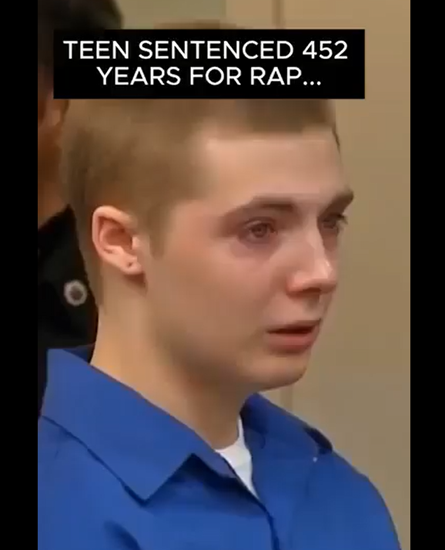
A courtroom scene that circulated widely online has continued to spark debate due to the extraordinary length of a sentence handed down to a teenage defendant. According to reporting and public court commentary, the moment unfolded in a formal judicial setting where the defendant stood quietly as the judge delivered a cumulative sentence totaling 985 years in prison. The figure itself drew immediate attention, not only from those present in the courtroom but also from viewers who later encountered the footage online.
Where it spread rapidly and fueled widespread discussion. The case behind the sentence involved multiple serious violent offenses presented during trial proceedings. Prosecutors outlined a pattern of escalating criminal conduct, supported by evidence and testimony from victims and witnesses.
These accounts described significant harm, both physical and emotional, leaving lasting consequences for those involved. In court, the presentation of these details framed the sentencing phase as one centered heavily on accountability and the cumulative impact of each individual charge.
According to the judge’s explanation during sentencing, the unusually high number was the result of consecutive sentencing rules applied to multiple convictions. Each charge carried its own penalty, and under the applicable legal framework, those penalties were required to be added together rather than served concurrently. This legal structure produced a total that, while symbolic in its magnitude, reflected the stacking of separate sentences rather than a single fixed term.

Public reaction to the sentence was immediate and sharply divided. Some observers expressed support for the outcome, arguing that severe crimes require equally serious consequences. From this perspective, the emphasis was placed on justice for victims and recognition of the harm they experienced. Supporters also argued that the age of the defendant did not eliminate responsibility, particularly in cases involving repeated and deliberate violent acts.
Others, however, questioned the practicality and meaning of a sentence extending nearly a millennium. Critics noted that no human lifespan could accommodate such a punishment, raising concerns that the figure functioned more as symbolism than a realistic penal outcome. For them, the sentence raised broader ethical questions about whether justice is best served through maximum punishment or through a system that still allows room for proportionality and potential rehabilitation.
Legal scholars and psychologists also contributed to the discussion, pointing to established research on adolescent development. Studies in neuroscience and behavioral psychology have long suggested that teenagers may not yet possess fully developed impulse control or long-term decision-making capacity. These findings have influenced sentencing reforms in many jurisdictions, particularly regarding life sentences for juveniles, where courts are often encouraged to consider age as a mitigating factor.
At the same time, legal experts emphasized that the structure of sentencing laws in many systems requires judges to apply penalties for each individual offense independently. In cases involving multiple victims or multiple counts, this can lead to extremely long aggregate sentences even when no single sentence alone is extraordinary. As a result, outcomes like this are often described as legal arithmetic rather than a single discretionary decision.
The viral spread of the courtroom footage added another layer to the public response. Social media users focused not only on the length of the sentence but also on the defendant’s visible reaction as the decision was read aloud. That moment of silence, widely shared and replayed, became a focal point for emotional interpretation, with viewers projecting different meanings onto the scene depending on their views about justice and punishment.
For victims and their families, however, public discussion often centered on recognition rather than symbolism. Many supporters of the sentence emphasized that each count represented an individual harm, and that combining them into a large total reflected the seriousness and scope of the crimes. From this perspective, the length of the sentence was less about practicality and more about acknowledging the full extent of suffering described in court.
The case has since been referenced in broader debates about criminal justice policy, particularly regarding the treatment of juvenile offenders in serious cases. It highlights ongoing tensions between two competing principles: accountability for severe harm and the possibility of rehabilitation for young defendants. These tensions are not easily resolved and often resurface in high-profile cases involving lengthy sentences.
Ultimately, the image of a teenager facing a sentence measured in centuries continues to resonate far beyond the courtroom in which it was delivered. It serves as a point of reflection on how legal systems translate multiple convictions into punishment, and how societies interpret those outcomes. Whether seen as a necessary application of the law or as a symbolic gesture that challenges conventional ideas of proportional justice, the case remains part of a larger and ongoing conversation about how justice should be defined and applied.
