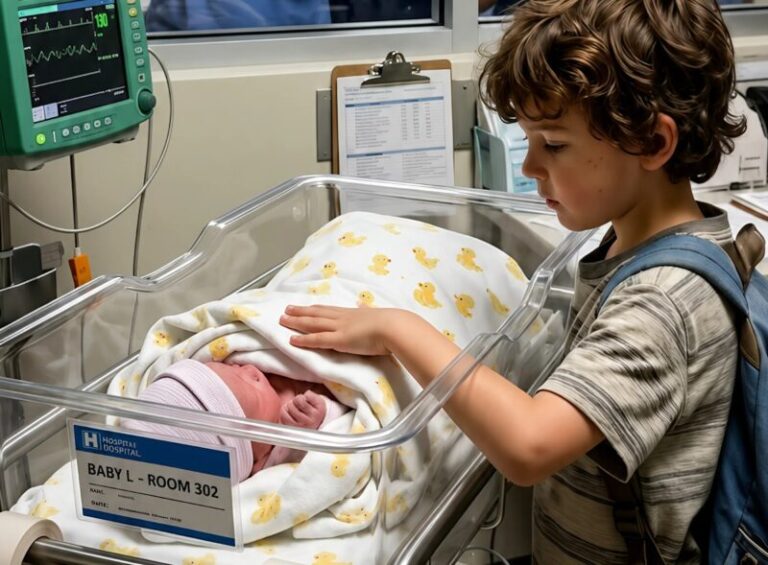
A tense silence filled the pediatric emergency unit of a large hospital as a team of experienced doctors worked urgently to stabilize a five-month-old baby named Alex. The atmosphere was heavy, filled with the soft beeping of monitors, the distant sound of medical equipment, and the controlled urgency of professionals trying everything within their knowledge. Despite their efforts, the baby’s breathing remained unstable, and the exact cause of the airway obstruction was still unclear even after multiple scans and diagnostic tests.
Alex’s parents, Daniel and Evelyn Reed, stood nearby in visible distress. Evelyn sat in a corner of the room, holding her face in her hands as tears fell silently, while Daniel remained frozen near the incubator, trying to stay strong but visibly shaken. The medical team had already performed emergency oxygen support, imaging tests, and airway examinations, yet nothing definitive appeared on the results.
The chief pediatric specialist eventually admitted that whatever was affecting the baby was extremely small or unusually difficult to detect through standard imaging. The situation became increasingly critical as minutes passed. Doctors discussed possibilities ranging from infection to rare airway obstruction, but none of the explanations fully matched the symptoms.
The uncertainty weighed heavily on everyone in the room, creating a sense of frustration mixed with helplessness. For a brief moment, even the most experienced professionals in the room had no clear direction forward.
At that exact moment, the hospital room door quietly opened. A young boy named Noah entered hesitantly, wearing a simple worn jacket and carrying a small backpack. He appeared out of place in the highly controlled medical environment and immediately drew the attention of hospital staff. A security guard stepped forward to ask why he was there, assuming he had entered by mistake. Noah calmly explained that he had come to return a wallet he had found earlier in the day.
Daniel immediately recognized the wallet as his own and was momentarily stunned. Earlier that day, Noah had found it near a busy parking area outside a commercial center. Inside were important documents, cards, and cash. Despite his modest background and limited resources, Noah had chosen to spend hours traveling across the city to return it to its rightful owner without taking anything from it.
Noah had been raised by his grandfather in a modest neighborhood near old railway tracks. His upbringing had been shaped by simple but powerful lessons about honesty, awareness, and attention to detail. His grandfather often told him that small things in life could sometimes determine very big outcomes, and that carefully observing one’s surroundings was a valuable skill. That lesson stayed with Noah and influenced the way he viewed the world around him.
While still inside the hospital room, Noah overheard fragments of conversation about the baby’s condition. Curious and concerned, he slowly approached the incubator area despite being told to stay back by hospital staff. As he looked at the baby, he became unusually focused on a specific area around the child’s neck. After a few moments, he pointed out a very small and subtle irregularity that most adults in the room had not noticed.
At first, the medical staff assumed it was simply a child’s imagination or misunderstanding. However, Noah insisted that he had seen something similar before when his grandfather once experienced a choking incident involving a small object. He suggested that the problem might not be visible in standard scans if the material was difficult to detect. His comment prompted one of the doctors to re-examine the imaging results more carefully.
After reviewing the scans again with a different focus and angle, the medical team discovered something they had previously overlooked. A very small, nearly transparent fragment was lodged in the baby’s airway. It was later identified as a piece of soft plastic, likely from a baby pacifier. Its size and material made it extremely difficult to detect through initial imaging techniques.
Once the obstruction was identified, the medical team immediately resumed emergency procedures. Carefully and with precision, they worked to remove the object while continuously monitoring the baby’s breathing and oxygen levels. The room remained tense as everyone waited for signs of improvement.
After several critical moments, the baby’s condition began to stabilize. The oxygen levels improved, and the monitor displayed a more regular and steady rhythm. Relief slowly spread across the room as the doctors confirmed that the airway was clear and the immediate danger had passed. Evelyn broke down in tears of relief, while Daniel stood silently overwhelmed by gratitude.
The medical staff, despite their experience, were visibly affected by how close the situation had come to a tragic outcome and how a small overlooked detail had been the key factor. Daniel then turned to Noah and thanked him sincerely for his unexpected role in helping save his son’s life.
When asked why he returned the wallet despite its contents, Noah simply replied that it did not belong to him. His answer was short but deeply meaningful, reflecting the values he had been taught since childhood.
The room grew quiet once again, but this time the silence carried a different feeling—one of reflection rather than tension. What had begun as a critical medical emergency had transformed into a powerful reminder of awareness, kindness, and human intuition. It highlighted how even in environments filled with advanced technology and expertise, unexpected insight can come from the most unlikely source.
For the Reed family, the experience became a lasting memory tied not only to fear and relief but also to the young boy whose careful observation made a life-saving difference.
