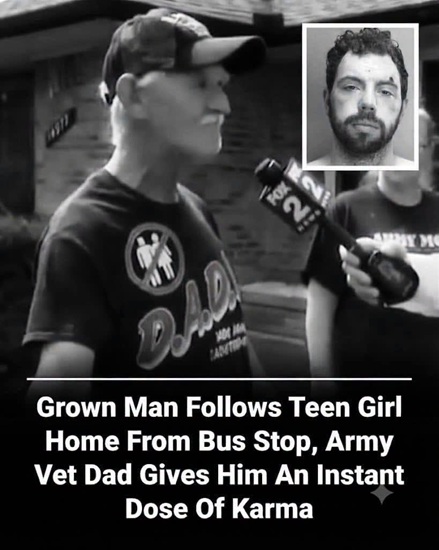
A frightening incident in Livonia, Michigan, drew attention in September 2019 after a teenage girl was followed home from her school bus stop by an adult man who then entered her house, according to police and contemporary local reporting. The girl’s father, Mike Oliver, an Army veteran, was at home when the encounter unfolded. What followed involved a confrontation, a neighborhood search and a rapid police response that ended with the suspect being taken into custody. Some online retellings have exaggerated parts of the story, so the documented details are important.
Oliver’s daughter was 15 years old and a 10th-grade student at Franklin High School at the time. On Monday afternoon, she got off her school bus and began walking toward her home in Livonia. Police said a man later identified as David Roberts followed the teenager toward her residence. The ordinary walk from a neighborhood bus stop therefore became a situation that understandably alarmed both the girl and her family.
According to WXYZ’s report based on information from Livonia police and the school district, Roberts followed the girl onto the porch and asked whether her parents were home. Police said he then followed her into the house. That detail is more specific than some later versions claiming he merely remained outside or followed her from a distance. The teenager was fortunate that her father was already inside the residence.
Oliver later told FOX 2 Detroit that he got up and found the man at or near his doorway. He immediately confronted him about why he was there. According to police and news reports, Roberts then fled from the house rather than remaining to explain himself. The situation quickly moved from inside the residence to the surrounding neighborhood.
Oliver pursued him and later described physically struggling with Roberts. He told FOX 2 that he grabbed the fleeing man by the hair and that Roberts twisted away during the confrontation. Roberts then continued running around the neighborhood. The father’s military background was mentioned prominently in contemporary coverage, but there is no need to embellish it by claiming that he used specialized combat techniques or was carrying out a military-style operation.
The pursuit did not become the dramatic vehicle chase portrayed in some online retellings. FOX 2 reported that Oliver got into his truck and continued following the man through the neighborhood, while WXYZ reported that Roberts jumped a backyard fence and attempted to hide. Oliver, his son and a neighbor helped keep track of the suspect’s approximate location while emergency services were contacted.
Both the teenager and her father called 911, according to police reporting. That decision became crucial because it allowed trained officers to take over rather than leaving family members to continue confronting the suspect themselves. Livonia police officers arrived and searched the immediate area using information provided by the family and neighbors.
Roberts was eventually located in a nearby backyard and taken into custody. Reports described multiple officers arriving within minutes. Contrary to more sensational versions of the story, there is no reliable evidence in the sources reviewed that officers staged a dramatic roadblock around Roberts’ vehicle or that an extended car pursuit occurred. The documented arrest took place after he fled on foot and hid in the neighborhood.
The legal allegations also need to be described accurately. Roberts was charged with breaking and entering and assaulting a police officer, according to local news reports. His bond was set at $100,000, with 10 percent required. Although his alleged conduct toward the teenager naturally led many people online to describe the incident as “stalking,” the contemporary reports reviewed here did not say he was formally charged with stalking in this case.
That distinction matters whenever criminal cases are retold years later. Following someone can be described factually when police say it happened, but describing a particular offense as a formal criminal charge requires confirmation from court or police records. In this case, the documented charges in the immediate aftermath were breaking and entering and assaulting a police officer.
Oliver later reflected on just how differently the encounter might have ended. His comments suggested that he understood the danger involved in physically confronting a stranger. Rather than presenting the confrontation simply as revenge, his remarks emphasized that the situation could have become much worse. That is an important distinction, because confronting a potentially dangerous person can create additional risks even when the instinct to protect a family member is understandable.
For the teenager, the consequences extended beyond the arrest. Her mother, Cindy Oliver, told FOX 2 that her daughter had been doing well in school but became afraid to return after the incident because she feared for her safety. The emotional impact of being followed into one’s own home can understandably continue after the immediate danger has ended.
That part of the story is sometimes overshadowed by headlines celebrating what the father did. The arrest resolved the immediate threat, but it did not automatically restore the teenager’s previous sense of safety. A neighborhood route she had probably regarded as ordinary had suddenly become associated with fear, and her own home had briefly ceased to feel entirely secure.
Livonia Police Captain Ronald Taig used the incident to remind young people to remain aware of their surroundings. The Livonia school district similarly advised students and parents to take suspicious encounters seriously. WXYZ reported guidance including walking with friends or groups when possible, informing an adult when something appears suspicious and running to safety and contacting 911 when someone feels threatened.
Those recommendations are more useful than turning the story into a lesson about personally chasing suspicious strangers. If someone believes they are being followed, reaching a safe and populated location, alerting trusted people and contacting emergency services are generally safer actions than trying to physically confront the person alone.
The Livonia Police Department also provides broader information about stalking behavior. Its public guidance notes that concerning behaviors can include repeatedly following someone, appearing at a person’s home or workplace, entering or remaining on someone’s property and making unwanted contact. The department emphasizes that circumstances differ and that there is no single response suitable for every situation.
The 2019 case demonstrates the value of paying attention when something feels wrong. The teenager reached home, her father was present, additional relatives and neighbors became aware of what was happening, and police were provided enough information to locate the suspect nearby.
It also demonstrates why community involvement can matter without turning neighbors into vigilantes. Oliver, his son and a neighbor helped officers understand where Roberts had gone. Their observations contributed to the police search, but law enforcement ultimately made the arrest.
Years later, sensational versions of the incident have added details about a prolonged “high-stakes pursuit,” tactical maneuvering, police cars boxing in a truck and a long list of criminal charges. Those claims are not supported by the strongest contemporary reports reviewed here.
The real sequence was already serious enough.
A 15-year-old girl walked home from her bus stop.
Police said an adult man followed her onto her porch and into her house.
Her father confronted him.
The man fled.
The father, a brother and a neighbor helped track his movements while 911 was contacted.
Police located him nearby and arrested him.
Roberts then faced charges of breaking and entering and assaulting a police officer.
The most responsible way to remember the case is therefore not as a fantasy of “instant karma,” but as an example of a frightening situation in which a teenager reached safety, family members reacted quickly and police were able to locate a suspect soon afterward.
For parents, the story also offers a practical reason to speak with children and teenagers about what to do if they believe they are being followed. Having a simple plan—go toward other people, contact a trusted adult, avoid isolated locations and call emergency services when necessary—can be more useful than expecting someone to improvise while frightened.
For young people, another important lesson is that instinctive concern should not automatically be dismissed as embarrassment or overreaction. If someone’s behavior makes a person genuinely fear for their safety, getting to a secure place and asking for help is appropriate.
The teenager in Livonia did exactly that.
And while her father’s response attracted most of the headlines, the outcome ultimately depended on several people doing different things: the girl getting home, family members recognizing the danger, neighbors remaining alert and officers responding quickly.
What began as an ordinary Monday afternoon ended as a criminal investigation that shook one family’s sense of security. But the documented story is compelling without exaggeration—and keeping those details accurate ensures that a real teenager’s frightening experience is not transformed into something it never was.
