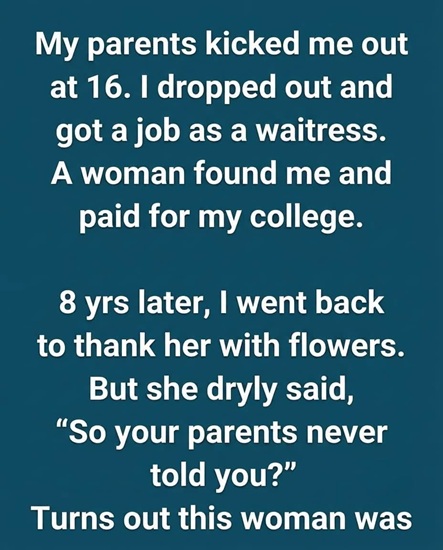
I stood frozen in place, my hands trembling slightly as I clutched a small bouquet of flowers. The room felt heavier than air itself, as if every breath carried the weight of years I thought I understood. Across from me stood a woman I had always known as a family friend, someone who had quietly existed on the edges of my life for as long as I could remember. But that day, as she began to speak, her voice carried a truth that shattered everything I believed about my past.
For two decades, I had lived with a story that defined my identity. I believed I had been abandoned as a child by my biological mother, left behind in a world that forced me to grow up carrying questions with no answers. That belief shaped my emotions, my fears, and even the way I trusted people. I had built an entire life on the assumption that I had been unwanted, forgotten, and discarded.
But as she continued speaking, something inside me began to collapse. Her words did not simply add information—they rewrote my entire history. The woman I had thought of as a distant benefactor, a kind stranger who occasionally appeared in moments of need, was not a stranger at all. She was the same person I had blamed for my pain. She was the same mother I had spent years mourning.
The realization hit me like a physical force. My mind struggled to reconcile two opposing realities: the image of a mother who had abandoned me, and the woman who had quietly supported my life from behind the scenes. Every memory I thought I understood suddenly shifted into a new, unsettling perspective. Nothing was what it seemed, yet somehow everything made a painful kind of sense.
She told me how young she had been when she made the decision that changed both of our lives. She had been barely more than a teenager herself, overwhelmed by poverty, fear, and the belief that she had nothing stable or meaningful to offer a child. In her mind, giving me away was not an act of rejection, but an act of survival—an attempt to give me a chance at a better life than the one she feared she could provide.
Her voice trembled as she described the night she signed the papers that legally separated us. It was not a decision made lightly or without pain. According to her, it was the most difficult moment of her life, one that stayed with her every day afterward. She did not walk away because she did not care. She walked away because she believed it was the only way to protect me from a future she thought would be filled with hardship.
As she spoke, fragments of my past began to realign. Memories I had never fully understood suddenly gained new meaning. The anonymous support I had received over the years, the unexpected financial help during school, the quiet presence at important milestones—all of it now pointed to a truth I had never been able to see.
She had been there all along.
Not openly, not in the way I expected a mother to be present, but silently, consistently, and carefully. She had watched from a distance, ensuring I was safe, supported, and able to move forward in life without knowing the identity of the person guiding me. Every achievement I celebrated had, in some way, been quietly witnessed by her.
The emotional weight of this realization was overwhelming. I had spent years feeling abandoned, only to discover that I had been observed, protected, and loved in silence. The pain of perceived rejection did not disappear instantly, but it began to transform into something far more complex—confusion, grief, and a fragile sense of understanding.
There was a deep sadness in recognizing how much time had been lost between us. Years that could have been filled with honesty were instead shaped by distance and silence. We had lived parallel lives, always close enough to affect each other, yet never fully connected in truth. That loss could not be undone, no matter how much clarity the present brought.
Still, beneath the sorrow, there was something else emerging. A strange and fragile form of connection. I began to see her not as the figure from my childhood pain, but as a human being who had made an impossible decision and carried its consequences alone for years. She had lived with guilt, love, and fear all at once, never fully able to step forward, yet never fully able to walk away.
The more she spoke, the more I understood that her silence had not been absence. It had been a different form of presence—one built on sacrifice rather than visibility. She had chosen invisibility so that my life could appear stable, even if it meant erasing herself from the role she once held.
When she finally fell silent, the room felt suspended in time. Neither of us moved for a moment. It was as if both of us were trying to process not only what had been revealed, but what it meant for everything that would come after. The truth had not simplified our relationship—it had made it infinitely more complicated.
I looked at her differently then. Not as the distant figure I had once resented, nor as the invisible force behind my upbringing, but as a woman who had lived with a silent, enduring form of love. A love that had expressed itself through absence, sacrifice, and quiet protection rather than presence and words.
As I stepped closer, the distance between who I thought she was and who she truly was began to close. It was not an easy reconciliation. Nothing about that moment felt simple or resolved. But it felt real in a way nothing before it had been.
The flowers in my hands suddenly felt heavy, almost symbolic of everything unsaid between us. I didn’t know what to say, and perhaps there were no perfect words for a moment like that. Instead, I simply stood there, facing the truth of a past that had been rewritten in a single conversation.
For the first time in my life, I began to understand that family is not always defined by clarity or continuity. Sometimes it is defined by sacrifice, silence, and decisions made in impossible circumstances. And sometimes, the people we believe have left us are the same ones who never truly stopped watching over us.
What remained between us was not a perfect reunion, nor a simple resolution. It was something more fragile, more honest—a beginning built on truth rather than illusion. And as overwhelming as that truth was, it marked the first moment we were both truly seen.
