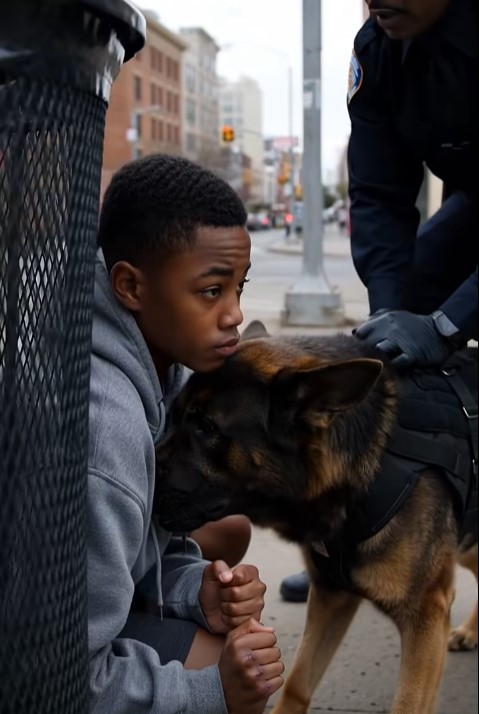
Officer Greg Miller had worked enough years in law enforcement to understand that silence was never truly harmless. On the surface, Oak Creek Park looked calm that evening, with dim streetlights reflecting off empty walking paths and a cold wind moving through the trees. His K9 partner, Buster, rested quietly in the back of the cruiser, as they had done on countless patrols before. Buster, a highly trained German Shepherd, had served beside Greg for years, responding to calls ranging from simple disturbances to high-risk operations.
Their bond was built on trust, repetition, and instinct. On nights like this, Greg often used the calm to observe, knowing that experience had taught him how quickly peace could change into urgency. When Instinct Breaks the Silence. As Greg stepped out for a routine walk near the restrooms, Buster’s behavior changed almost immediately. The dog, usually calm and controlled, began to shift his focus toward a hidden area near the edge of the park. His body language tightened, signaling alertness rather than aggression.
Instead of responding to typical patrol patterns, Buster moved with unusual urgency toward a narrow space behind trash bins. Greg followed, sensing that something was wrong even before he saw it. In training environments, such reactions often indicate distress or an unfamiliar scent pattern, something beyond routine activity.
A Frightened Child in the Shadows
What Greg discovered behind the concrete wall changed the entire nature of the patrol. A young boy, no older than eleven, was crouched tightly in the corner, trying to make himself invisible. His clothing was oversized and worn, and his posture suggested fear rather than curiosity.
The child immediately reacted to Greg’s presence, pulling back as though expecting harm. His breathing was uneven, and visible marks on his wrists suggested he had been through something troubling. Greg maintained distance, lowering his voice to avoid increasing the child’s fear, while Buster remained unusually calm beside him.
The Unexpected Role of the K9 Partner
In many training scenarios involving K9 Police Training, dogs are taught to assist in detection, tracking, and controlled engagement. However, Buster’s reaction that night was different. Instead of maintaining standard positioning, he moved closer to the child and lowered himself calmly, as if attempting to communicate safety.
The boy hesitated, then slowly reached toward the dog. That moment shifted the emotional tone of the encounter. The fear did not disappear, but it softened slightly, allowing Greg to attempt communication. The interaction demonstrated how trained police dogs can sometimes serve as emotional stabilizers in unpredictable situations.
A Growing Sense of Danger
As Greg tried to gather information, the boy struggled to respond clearly. He appeared to be hiding something beneath his jacket, holding it tightly against his chest. Before Greg could ask further questions, headlights from a nearby vehicle illuminated the area, breaking the fragile calm.
A dark car entered the park without warning and stopped nearby. The presence of the vehicle immediately changed the atmosphere. The boy reacted with visible fear, retreating behind Buster, while Greg shifted into protective positioning. The situation was no longer just about a lost child—it had become something more complex.
Confrontation in the Park
A man stepped out of the vehicle and identified the boy as his son, demanding immediate compliance. His tone was firm, and his behavior suggested control rather than concern. Greg requested clarification about the child’s condition and visible injuries, but the man dismissed the questions and focused only on retrieving the boy.
As tension escalated, nearby witnesses began observing the interaction. The park, once quiet, now felt tense and unstable. It was at this point that the boy’s jacket opened, revealing a small injured puppy held carefully against his chest in a makeshift sling.
The Hidden Truth Revealed
The presence of the injured puppy shifted the entire situation. The child appeared emotionally attached to the animal, refusing to let go despite visible distress. He explained through fragmented words that he believed the puppy needed protection and that it had been hurt.
In animal welfare contexts, such situations often raise concerns about neglect or misunderstanding rather than simple ownership disputes. The emotional bond between the child and the animal suggested that his actions were driven by fear and protection rather than defiance.
The Role of Authority and Judgment
Greg found himself in a difficult position, balancing procedure with the immediate emotional reality in front of him. Law enforcement protocols require careful assessment, yet situations involving minors and animals often require additional sensitivity and evaluation.
Buster, meanwhile, positioned himself protectively between the child and the adult figure, reinforcing Greg’s growing concern that the situation involved more than a routine family matter. The behavior of trained service dogs in such contexts is often studied in behavioral response training environments, where instinct and conditioning intersect.
A Decision That Changes Everything
As pressure increased, Greg made a decision that would later define the outcome of the case. Instead of escalating confrontation, he directed the child toward a nearby safe location while he attempted to manage the situation. This decision created tension within official protocol expectations but prioritized immediate safety.
The aftermath of that choice would later become a point of internal review and conflict within the department. However, at that moment, Greg prioritized protection over procedure, while Buster remained at his side throughout the unfolding situation.
The Broader Implications of the Incident
What began as a simple patrol in Oak Creek Park evolved into a complex scenario involving child safety, animal welfare, and institutional accountability. Situations like these highlight the unpredictable nature of fieldwork in law enforcement and the importance of adaptive decision-making under pressure.
The involvement of a K9 unit added another dimension to the case, demonstrating how trained animals can influence both emotional outcomes and situational awareness. In many documented training studies, K9 units are recognized for their heightened sensitivity to stress and environmental changes.
Conclusion: Loyalty, Instinct, and Responsibility
By the end of the night, Oak Creek Park was no longer just another routine patrol location. It became a reminder of how quickly situations can shift when instinct, observation, and human emotion intersect.
Greg Miller and Buster returned to duty, but the events of that evening left a lasting impression. The child and the injured puppy represented vulnerability, while the response highlighted the complexity of making decisions under uncertain conditions.
In the end, the story reflects a larger truth often seen in both real-life policing and training environments: outcomes are not always determined by procedure alone, but by the ability to recognize when something feels wrong and respond with awareness, caution, and humanity.
