People often imagine courage as something loud, visible, and immediately recognizable. They picture heroic actions, dramatic rescues, or moments that change everything in an instant. But sometimes, courage appears in its quietest form, in places where no one expects it, carried not by strength or age, but by instinct and humanity. For seven-year-old Elliot Harper, courage did not feel like something extraordinary. It began as confusion, then fear, and finally responsibility.
It happened on a late afternoon when the sky was fading into the soft colors of evening, and the world around a quiet trailer park felt heavier than usual. Elliot had not intended to go far. He was simply trying to escape the tension he felt at home, where silence sometimes carried more weight than words. The woods behind the trailer park had always seemed like a safe boundary between noise and calm, a place where he could breathe without explanation or expectation.
He followed small distractions at first, like the movement of a frog along the dirt path or the rustling of leaves carried by the wind. But slowly, without realizing it, he moved deeper into the trees. The familiar sounds of distant voices and passing cars faded, replaced by stillness that felt both peaceful and unfamiliar.
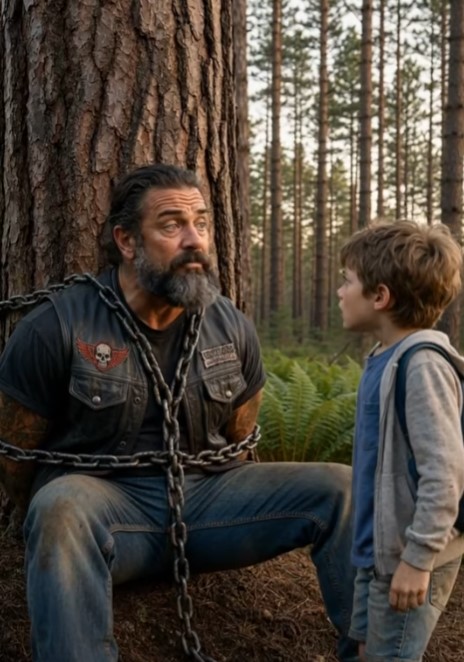
At some point, Elliot realized he was no longer sure of the way back. The forest around him had changed, growing denser and darker, with shadows stretching longer between the trunks of tall pines. That was when he noticed something unusual near the base of one tree—a faint metallic reflection that did not belong to the natural surroundings.
At first, he thought it might be discarded trash or broken equipment left behind. But as he stepped closer, the shape became clearer. It was not just metal—it was part of something larger, tangled and pressed against the ground in an unnatural way. And beside it was a man.
The man was slumped against the tree, injured and barely moving. A damaged motorcycle lay nearby, partially hidden by brush and leaves. Everything about the scene suggested an accident that had gone unnoticed. Elliot froze, unsure of what he was seeing or what he should do next.
The man slowly opened his eyes. His face was marked by exhaustion and pain, and his voice, when it came, was weak but deliberate. He told Elliot to leave. Not because he was angry, but because he understood how dangerous the situation might look to a child alone in the woods.
But Elliot did not leave. Something about the man’s condition stopped him from turning away. Fear was present, but it was joined by something else—concern, confusion, and a growing sense that someone needed help immediately.
He tried to help in the only ways he knew how. He looked for ways to move or loosen the metal, using sticks and small rocks he could find nearby. His hands shook, and he struggled with the weight of what he was trying to do. The forest offered no answers, only silence and resistance.
The man, who later introduced himself simply as Sam, watched the boy struggle. Despite his own pain, he told Elliot that most adults would have walked away already. But Elliot did not feel like he had done enough. To him, trying and failing still felt incomplete.
Sam realized the situation required outside help. With effort, he gave Elliot instructions, speaking slowly and carefully so the boy could remember every detail. He told him to find a nearby roadside bar and ask for a man named Jax. The message was simple, but important, and Elliot repeated it several times to ensure he would not forget.
With that, Elliot began his journey back through the forest. The path that had once felt curious and calm now felt endless and unfamiliar. Every sound seemed louder. Every shadow felt closer. His legs ached, and his breathing became uneven, but he continued forward.
The road eventually came into view, but reaching it did not bring relief. It brought uncertainty. The bar he had been told to find was filled with unfamiliar adults, loud conversations, and an atmosphere that made him feel even smaller than before. Standing in the doorway, he hesitated for only a moment before stepping inside.
The room went quiet as people noticed the young boy covered in dirt and leaves, visibly shaken. Elliot scanned the room until he found the person he believed matched the name he was given. With a trembling voice, he delivered the message exactly as Sam had instructed him to remember.
The atmosphere in the bar changed immediately. The seriousness of the message was understood without explanation. The people inside moved quickly, gathering supplies, making calls, and preparing to respond. Elliot, still overwhelmed and exhausted, was placed somewhere safe while the group organized a search.
The return to the forest was urgent. Flashlights cut through the growing darkness as voices called out into the trees. Elliot stayed close to the group, his fear returning with every unfamiliar sound. Time felt stretched, and each passing minute increased the uncertainty of what they might find.
Then, from a distance, a voice called out that someone had been located. The tension shifted instantly. Movement became faster, more coordinated. And then confirmation came—Sam had been found alive.
The rescue was careful and controlled. The metal that had trapped him was removed, and emergency services were called. Despite his condition, Sam was conscious enough to recognize Elliot when he was brought closer. In that moment, the emotional weight of everything that had happened seemed to settle over everyone present.
Sam spoke to Elliot quietly. He told him that he had done well, better than most people would have in the same situation. Elliot admitted he had been scared the entire time. Sam’s response was simple but powerful: courage was never about the absence of fear, but about acting despite it.
In the days that followed, the story spread through the community connected to Sam. A group of riders and local supporters gathered to acknowledge what had happened, not as a celebration, but as a moment of gratitude. They came not to create attention, but to recognize the child whose actions had changed the outcome of a dangerous night.
Sam, recovering but present, stood before Elliot and thanked him personally. He reinforced the lesson that had already begun to take shape in the boy’s mind—that bravery does not require size, strength, or age, only the willingness to act when it matters most.
For Elliot, life slowly returned to normal, but something within him had changed. The woods behind the trailer park no longer represented only fear or escape. They became a reminder of responsibility, awareness, and the unexpected weight of choice.
What had begun as a moment of fear had transformed into something lasting. Elliot had not lifted the metal or solved the problem alone, but he had carried the message that made rescue possible. And in doing so, he discovered something many adults spend years trying to understand—that even the smallest voice can change the outcome of a life.
