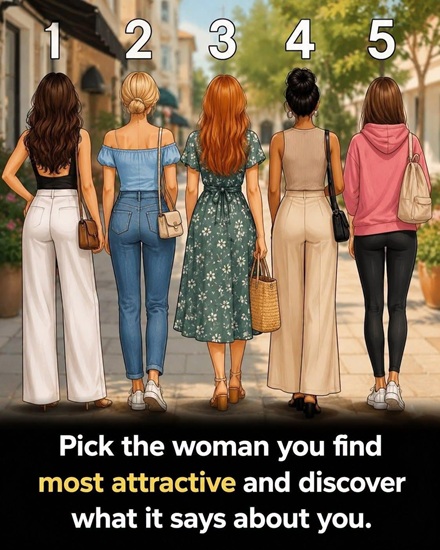
Five women are standing with their backs turned. You cannot see their faces.
You know almost nothing about them. All you have are a few visual clues.
Their clothing.
Their posture.
Their hairstyles.
And the way each person presents herself.
Now comes the question.
Which woman do you imagine will be the most attractive when she turns around?
Try choosing one before reading any further.
Do not spend too much time analyzing every detail.
Simply notice which figure attracts your attention first.
Have your answer?
Now the interesting part begins.
First, an important reality check
Visual personality challenges like this can be entertaining ways to think about personal preferences.
But they are not scientifically validated personality assessments.
Choosing one illustration cannot determine whether someone is confident, romantic, intelligent, introverted or emotionally sensitive.
Nor can it reveal someone’s psychological health.
Attraction itself is highly individual.
Personal experiences, culture, mood, expectations and simple aesthetic preferences can all influence what catches someone’s attention.
So the interpretations below should be treated as playful prompts for reflection.
Not diagnoses.
With that in mind, your choice can still raise an interesting question.
What qualities were you responding to?
Woman No. 1 — confidence and boldness
The first woman immediately stands apart because of her red dress.
Red is visually striking.
In many cultural and artistic contexts, the color has been associated with ideas such as passion, energy, romance and confidence.
Her upright posture adds to that impression.
If you selected her, perhaps you were drawn to the sense of presence created by the illustration.
You may appreciate people who seem comfortable being noticed.
Confidence might be one of the qualities you find appealing.
You may also enjoy people who communicate openly and bring energy into social situations.
But there could be another reason.
Perhaps you simply like red.
That possibility is important because no single visual choice can reliably establish a personality trait.
Still, as a playful interpretation, Woman No. 1 represents boldness.
And for some viewers, that is difficult to overlook.
What attraction may mean to you
If confidence was the feature that captured your attention, appearance may be only part of what you find attractive.
Perhaps presence matters.
Someone can enter a room without saying anything and still seem self-assured.
Some people naturally respond to that energy.
They appreciate decisiveness.
Expression.
Enthusiasm.
A willingness to stand apart.
If those qualities resonate with you, your first choice may make sense.
But another viewer may want almost the opposite.
That brings us to Woman No. 2.
Woman No. 2 — relaxed and authentic
The second figure presents a much more casual image.
Her clothing is relaxed.
There is less formality.
The overall impression is everyday comfort rather than dramatic presentation.
If she caught your attention first, you may simply prefer a more natural or casual style.
Within the playful interpretation of the puzzle, this option represents simplicity and authenticity.
Perhaps you value people who seem approachable.
You may prefer relaxed conversations to highly formal situations.
Maybe you appreciate relationships where nobody feels pressured to perform or impress.
Comfort can itself be attractive.
For some people, the ability to be completely at ease around another person matters more than glamour.
And that may explain why this figure stands out.
There is another side to simplicity
A casual appearance does not tell us anything certain about the actual person.
Someone wearing jeans or shorts can be ambitious, shy, outgoing, serious or spontaneous.
Clothing alone cannot establish character.
But the viewer’s reaction to the illustration can still be interesting.
What did you imagine?
Did the casual style make the person seem more approachable?
Did it suggest freedom?
Comfort?
Authenticity?
If so, the choice may say more about the qualities you were projecting onto the image than about the fictional woman herself.
And that is arguably where these games become most interesting.
The third figure creates a completely different impression.
Woman No. 3 — romance and creativity
The third woman is holding flowers and wearing a light, elegant dress.
Flowers are often used symbolically in celebrations, romance and gestures of appreciation.
That immediately gives the illustration a different emotional tone.
If Woman No. 3 was your choice, perhaps those details caught your attention.
Within the game’s interpretation, this option represents romance, imagination and emotional connection.
Maybe you enjoy meaningful gestures.
Perhaps you appreciate art, music or storytelling.
Or you might simply find the combination of flowers and elegant clothing visually appealing.
The original interpretation also connects this option with creativity and emotionally rich experiences.
Again, this should not be treated as psychological evidence.
But it can provide an interesting prompt.
When you imagine an attractive person, how important is emotional connection?
For some people, it changes everything.
Attraction can extend beyond appearance
A face may create an initial impression.
But long-term attraction usually involves much more.
Humor can matter.
Kindness can matter.
Shared interests can matter.
Values, communication and emotional compatibility can matter.
That is why a question based entirely on five illustrated backs has no scientifically correct answer.
The viewer is filling in information that the picture does not provide.
And perhaps that is the real game.
You are not actually choosing between five known people.
You are choosing between five visual suggestions.
Woman No. 4 offers yet another one.
Woman No. 4 — elegance and structure
The fourth woman appears more formal.
Her hairstyle and dress create the impression of someone prepared for an evening event or special occasion.
If this figure immediately stood out, elegance may be part of what attracted your attention.
The playful interpretation associates this choice with appreciation for discipline, sophistication, ambition and self-improvement.
Perhaps you admire people who take pride in presenting themselves carefully.
Organization might appeal to you.
So might maturity.
Achievement.
Or a sense of purpose.
You may enjoy being around people who know what they want and are willing to work toward it.
But remember the limitation.
The illustration cannot tell us whether Woman No. 4 actually possesses any of those qualities.
They are impressions created by visual cues.
And impressions can be powerful.
Then comes Woman No. 5
The fifth figure is casual too.
But her presentation creates a different impression from Woman No. 2.
She is shown in jeans and a hoodie, standing in a relaxed way.
If she was your immediate choice, the playful interpretation connects that preference with independence, authenticity and quiet confidence.
Perhaps you appreciate people who do not need to be the loudest person in the room.
Maybe individuality matters to you.
You might value thoughtful conversations and people who seem comfortable following their own path.
The source interpretation also connects this option with personal growth, honesty, integrity and appreciation for time alone as well as social connection.
But once again, those are themes for reflection.
They are not measurements of personality.
And that distinction leads to the most interesting part of the challenge.
What were you really choosing?
Go back to the original question.
Which woman will be most attractive when she turns around?
There is actually no way to know.
You cannot see their faces.
You do not know their personalities.
You do not know how they speak.
You know nothing about their interests, humor, kindness or values.
The question asks your imagination to complete the missing information.
That is what makes the game work.
Each outfit and posture provides a small cue.
Then your mind builds a larger story around it.
One person sees confidence.
Another sees elegance.
Someone else sees warmth.
Another viewer imagines independence.
The illustrations remain unchanged.
The interpretations happen in the viewer.
Your answer does not lock you into a personality type
Perhaps you chose Woman No. 1 today.
Tomorrow you might choose No. 3.
Your preferences can change depending on context, mood and what happens to catch your attention.
That is another reason visual personality games should not be presented as scientific tests.
Real personality assessment is considerably more complicated.
Psychologists studying personality use validated measures involving multiple questions and carefully tested methods.
One picture cannot provide that level of information.
But a playful visual question can still encourage reflection.
And sometimes the reflection is more interesting than the “result.”
Look at your choice one more time
Was it really the woman you selected?
Or was it what her image represented to you?
Confidence.
Simplicity.
Romance.
Elegance.
Independence.
Perhaps that is the more useful question.
The first woman may remind you of bold energy.
The second may suggest comfort and authenticity.
The third can evoke romance and creativity.
The fourth presents elegance and discipline.
The fifth can suggest individuality and quiet confidence.
None is objectively better.
And none is objectively more attractive.
Different people value different things.
The real reveal
The woman you chose cannot scientifically reveal your personality.
But your reasoning can still tell you something interesting about your preferences.
Maybe you immediately noticed a bold color.
Perhaps flowers captured your attention.
Maybe casual clothing seemed more approachable.
Or perhaps elegance stood out before anything else.
Those reactions are personal.
They are also allowed to change.
So rather than asking whether the test “got you right,” try another question.
Why did that particular woman catch your attention?
The answer may have nothing to do with a hidden psychological trait.
It may simply reveal what you found appealing in that moment.
And perhaps that is enough.
After all, the most interesting part of this visual challenge was never discovering which woman would actually be the most attractive when she turned around.
We could never know that from the picture.
The interesting part was discovering what you imagined before she did.
