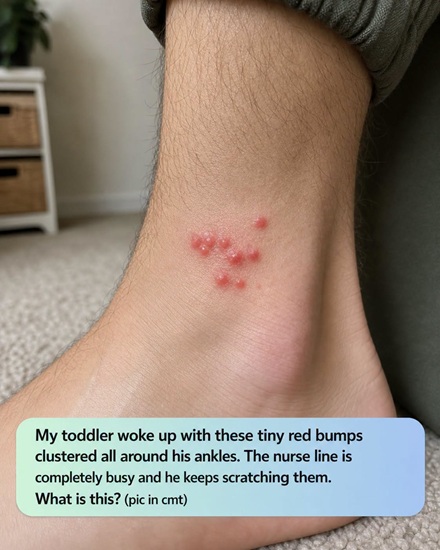
A toddler goes to bed looking completely fine. By morning, something has changed. Small red bumps have appeared around the ankles, and the child cannot seem to stop scratching.
For a worried parent, the first question is obvious. What caused them?
Clusters of itchy bumps around the ankles can be consistent with flea bites, particularly when there has been possible exposure to pets or an environment where fleas may be present.
But there is an important warning before trying to identify them at home.
A photograph, location or pattern alone cannot confirm the cause of a child’s rash.
And several other conditions can look surprisingly similar.
Why fleas may come to mind
Flea bites commonly affect the lower legs and feet.
The bites can appear as small, itchy red bumps, sometimes occurring in groups or clusters.
That makes the ankles an area where people may first notice them.
A household with cats or dogs can provide another clue because pets can carry fleas.
But having a pet does not prove that fleas caused the rash.
And not having a pet does not completely rule out environmental exposure either.
The appearance of the skin is only one part of the story.
What happened before the bumps appeared matters too.
Look at the child, not only the rash
Before focusing on exactly what each bump looks like, consider how the child is behaving.
Are they playing normally?
Are they drinking?
Do they have a fever?
Does the skin seem painful rather than simply itchy?
Are the bumps remaining in one area, or are new ones appearing elsewhere?
Those details can help a healthcare professional assess what might be happening.
It is also useful to remember when the rash first appeared.
If possible, take a clear photograph.
A second photograph later can help show whether the appearance is changing.
But photographs should document the problem.
They should not replace medical assessment when one is needed.
Flea bites are only one possibility
Many skin reactions can resemble insect bites.
Other insects can leave itchy marks.
Contact with an irritating substance can cause a rash.
Eczema and other inflammatory skin conditions can sometimes produce redness and itching.
Certain infections can also cause skin changes.
That is why statements such as “red bumps around the ankles always mean fleas” are too absolute.
They do not.
Location can provide a clue.
Pattern can provide a clue.
Exposure history can provide a clue.
But clues are not the same as a diagnosis.
And with a young child, that distinction deserves particular attention.
What can help with discomfort
If the child otherwise seems well and there are no emergency symptoms, simple measures may help reduce discomfort while appropriate medical advice is being obtained.
Gently cleaning the skin can remove potential irritants.
A cool, clean compress may help soothe itching.
Keeping the child’s fingernails short can also reduce skin damage caused by scratching.
Scratching matters because repeatedly breaking the skin can increase the risk of a secondary bacterial infection.
Try to discourage vigorous scratching when possible.
But medication requires more care.
Be cautious with creams and medicines
It can be tempting to reach for whatever anti-itch cream happens to be in the medicine cabinet.
With toddlers, that is not always appropriate.
Products can have age restrictions.
Some should not be applied to certain parts of the body.
Damaged or infected skin may also change what is appropriate.
A pharmacist, pediatrician or other qualified clinician can advise whether a particular product is suitable for the child’s age and symptoms.
Follow the instructions for the specific medicine.
Do not assume that a product intended for an adult is automatically safe for a toddler.
And avoid combining multiple creams or medications simply because the itching is persistent.
More treatment is not necessarily better treatment.
When the pattern suggests checking the home
If fleas remain a realistic possibility, investigating the environment can be useful.
Pets can be checked for evidence of fleas.
A flea comb may help identify fleas or flea debris in an animal’s coat.
Pet bedding and household areas where animals spend time may also need attention.
Vacuuming carpets, upholstered furniture and other relevant areas can help as part of flea control.
Wash suitable bedding and fabrics according to their care instructions.
But there is another important precaution.
Do not start spraying pesticides around a toddler simply because the rash looks like insect bites.
Pest-control products have specific safety instructions.
Some require children and pets to stay away from treated areas for a period of time.
Never apply a household pesticide directly to a child’s skin.
Follow the product label and, when appropriate, obtain advice from a veterinarian or qualified pest-control professional.
Treating pets requires the right product too
If a pet has fleas, treating the animal may be an important part of breaking the flea life cycle.
But pet treatments are not interchangeable.
Products intended for dogs may be dangerous to cats.
Dosage can depend on an animal’s species, age and weight.
A veterinarian can recommend an appropriate flea-control plan.
Treating only the visible adult fleas may also be insufficient because eggs and immature stages can remain in the environment.
That is one reason flea problems can persist even after the first cleaning.
Still, the household investigation should not distract from the most important question.
How is the child doing?
Watch for signs that need medical attention
A few itchy bumps in a child who otherwise seems completely well are different from a rash accompanied by significant illness.
Seek medical advice if the rash is getting worse, spreading unexpectedly or not behaving like a simple insect-bite reaction.
Increasing redness, warmth, swelling, tenderness or drainage can suggest infection, particularly if the child has been scratching.
Fever or a child becoming generally unwell also changes the situation.
If you cannot reach the usual pediatrician or nurse line, another appropriate medical service, pharmacist or urgent-care provider may be able to advise you depending on where you live.
But some symptoms should not wait for a routine callback.
Know the emergency warning signs
A severe allergic reaction can develop rapidly.
Difficulty breathing requires emergency attention.
So can significant swelling involving the mouth, tongue or throat.
Fainting, collapse or a child becoming unusually limp or unresponsive are also reasons to seek emergency help immediately.
Those symptoms should not be monitored at home while waiting to see whether they improve.
Call the appropriate emergency medical service where you are.
Fortunately, most ordinary insect bites do not lead to such reactions.
But knowing the difference between routine itching and an emergency is important.
Avoid another common mistake
Online photographs can be useful for learning what different skin conditions sometimes look like.
They can also create false confidence.
Two rashes with very different causes can appear remarkably similar in photographs.
Lighting changes color.
Camera quality changes detail.
Skin tone affects appearance.
And a photograph cannot show a clinician how the area feels, how quickly it developed or how the child is behaving.
So an online picture that looks “exactly the same” should never be treated as proof of a diagnosis.
Use it as general information.
Not confirmation.
Give the clinician useful details
If medical advice is needed, a few observations can make the conversation more useful.
Explain when the bumps first appeared.
Mention whether new ones are continuing to develop.
Describe whether they itch, hurt or feel warm.
Mention fever or other symptoms.
Tell the clinician about new soaps, detergents, lotions or other products that recently touched the child’s skin.
Relevant travel or known insect exposure can matter as well.
If there are pets, mention them — especially if fleas have actually been found.
These details can be more informative than simply saying, “It looks like flea bites.”
The most important takeaway
Clusters of small itchy bumps around a toddler’s ankles can fit the pattern of flea bites.
That makes fleas a reasonable possibility.
But reasonable is not the same as certain.
The safest approach is to separate two tasks.
First, care for the child.
Keep the skin clean, try to limit scratching and obtain appropriate advice about any medication or cream.
Second, investigate possible environmental causes without exposing the child to unnecessary chemicals.
If fleas are found, address both pets and the household environment using appropriate methods.
If the pattern does not fit, the rash changes or the child seems unwell, seek professional medical advice rather than forcing the symptoms to fit an insect-bite explanation.
Most importantly, pay attention to the child rather than becoming fixated on naming the bumps.
Sometimes the location and appearance offer useful clues.
But the clue that matters most may be something else entirely.
How the child is feeling.
