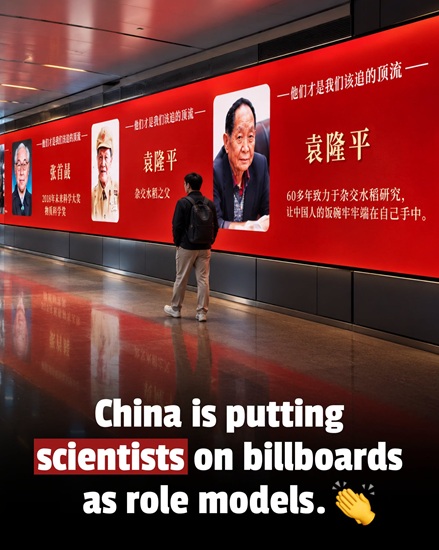
Shopping malls are designed to capture attention. Their largest screens and most visible exterior walls usually advertise clothing, electronics, cosmetics, restaurants or major consumer brands.
That is why one enormous display in eastern China looked so unusual. There was no product. No sale.
No celebrity endorsement. Instead, shoppers looking toward the exterior of a mall in Shandong saw the face of scientist Qian Xuesen.
And the display was difficult to miss.
It measured 7.8 meters high and 5.6 meters wide.
What began with one prominent advertising space soon attracted widespread attention online.
Then other locations started doing something similar.
It began in Shandong
In August 2026, a large illuminated portrait of Qian Xuesen appeared on the exterior of the Inzone shopping mall in Shanxian County, Heze, Shandong Province.
The location had previously been used for commercial advertising.
This time, however, the mall used it for a public-interest display honoring a scientist.
The portrait showed a younger Qian Xuesen and included a quotation associated with him about perseverance and not losing confidence.
When photographs and video of the display appeared online, many viewers initially wondered whether the enormous image was real.
The mall confirmed that it was.
It was not an AI-generated mock-up.
Workers had physically installed the illuminated display on the building.
And according to the mall’s management, it was intended as a public-interest tribute rather than a commercial advertisement.
But the reaction did not end with that single mall.
Other displays began appearing
After the Shanxian installation attracted attention, reports emerged of other commercial properties displaying portraits of prominent scientists.
Additional shopping centers in Heze participated.
Similar displays were also reported elsewhere in Shandong.
Then the idea moved beyond the province.
Shopping centers in Inner Mongolia and Anhui were reported to have displayed rotating portraits of notable Chinese scientists on outdoor LED screens.
The names appearing on those displays represented different areas of science and medicine.
Among them were Qian Xuesen, Yuan Longping, Tu Youyou and Nan Rendong.
Each had a very different career.
And each became known for a very different contribution.
Qian Xuesen and aerospace research
Qian Xuesen was one of the most influential figures in the development of China’s missile and aerospace programs.
Born in 1911, he studied in the United States and became an accomplished aerodynamicist.
He worked at institutions including the California Institute of Technology before returning to China in the 1950s.
There, he played an important role in the country’s development of rockets, missiles and aerospace technology.
His career eventually made him one of the best-known scientists in modern Chinese history.
Decades after his death in 2009, his portrait was now occupying a space normally reserved for commercial marketing.
But he was far from the only scientist being highlighted.
Yuan Longping and hybrid rice
Another frequently displayed figure was Yuan Longping.
His field was completely different.
Yuan was an agricultural scientist known internationally for his pioneering work on hybrid rice.
Beginning in the 20th century, Yuan and his research teams helped develop high-yield hybrid rice varieties.
The work contributed to improvements in rice production and food security.
Yuan continued working into old age and became one of China’s most recognizable agricultural scientists before his death in 2021.
His achievements concerned something extraordinarily ordinary.
Food.
Yet their impact reached millions of people.
Then there was a scientist whose research helped transform the treatment of a deadly disease.
Tu Youyou’s malaria breakthrough
Tu Youyou became internationally renowned for research that led to the discovery of artemisinin.
The compound became an essential treatment for malaria.
Her work drew on both historical Chinese medical texts and modern scientific methods as researchers searched for substances capable of fighting malaria parasites.
The result eventually changed malaria treatment around the world.
In 2015, Tu received the Nobel Prize in Physiology or Medicine, sharing the award with William C. Campbell and Satoshi Ōmura.
The Nobel committee recognized her discoveries concerning a novel therapy against malaria.
Unlike many internationally famous figures, Tu’s recognition came primarily from laboratory research rather than entertainment or popular culture.
That contrast became particularly noticeable when portraits like hers appeared on large commercial screens.
But another name represented a completely different kind of scientific ambition.
Nan Rendong looked toward the universe
Nan Rendong was an astronomer closely associated with one of the world’s most remarkable radio telescopes.
He played a leading role in the conception and development of China’s Five-hundred-meter Aperture Spherical Radio Telescope, commonly known as FAST.
The enormous telescope was built in Guizhou Province.
FAST allows astronomers to detect extremely faint radio signals from space and has been used for research involving pulsars and other astronomical phenomena.
Nan spent years helping move the project from an ambitious idea toward reality.
He died in 2017.
His scientific legacy, however, remained closely connected with the giant instrument he helped bring into existence.
Agriculture.
Medicine.
Aerospace engineering.
Astronomy.
The scientists appearing on the public displays represented very different disciplines.
But the setting connected them.
Why the location mattered
A portrait of a scientist inside a university or science museum would hardly be surprising.
A portrait covering prime space on the outside of a busy shopping center is different.
Commercial spaces compete intensely for people’s attention.
Large exterior screens and billboards are valuable precisely because thousands of people may see them.
They are normally used to encourage consumption.
Buy something.
Visit a store.
Try a product.
Follow a brand.
The scientist displays temporarily changed that message.
Instead of asking viewers to purchase something, they asked people to notice a person and a scientific contribution.
That contrast helped explain why photographs of the displays attracted attention online.
Then the concept expanded beyond shopping centers.
Science entered other public spaces
Reports and public campaigns in China have also featured scientists and science-related material in transportation environments and other heavily traveled public spaces.
Metro systems, railway environments and other public venues have long been used for educational and public-interest messaging alongside ordinary advertising.
The 2026 shopping-mall displays became particularly noticeable because of their scale and their location in highly commercial environments.
But it is important not to exaggerate what happened.
China did not eliminate commercial advertising.
Shopping malls did not suddenly stop promoting products.
Instead, specific malls and commercial properties voluntarily dedicated some prominent advertising spaces to public-interest displays celebrating scientists.
That distinction matters.
The story is interesting enough without making it larger than the evidence supports.
One display became many
The original Shandong poster attracted attention partly because it seemed unexpected.
Then came the follow-up.
Other malls in Heze displayed scientists.
Reports documented similar displays elsewhere in Shandong.
Commercial properties in Inner Mongolia and Anhui also joined in.
Some used physical posters.
Others used large LED screens capable of rotating through portraits of multiple scientists.
The list expanded beyond the four most frequently mentioned names.
Displays reportedly included other prominent figures from medicine, physics, engineering and scientific research.
For a period, familiar commercial screens were being used to tell a very different kind of story.
And that may be the most interesting part of the entire episode.
Attention itself has value
Modern public spaces contain an enormous competition for attention.
Brands want it.
Entertainment wants it.
Social media platforms want it.
Advertisers pay for it.
A large screen on the side of a busy shopping center has value because people look at it.
Usually, that attention is converted into commercial opportunity.
These displays temporarily redirected it elsewhere.
Toward an aerospace scientist.
An agricultural researcher.
A pharmaceutical discovery.
An astronomer.
The screens remained advertising infrastructure.
But what they were “advertising” was different.
They were drawing attention to scientific work and historical contributions.
A simple idea with an unusual visual effect
Nothing technologically complicated was required.
There was no new invention behind the campaign.
No elaborate interactive system.
The concept was remarkably simple.
Take a space people already look at.
Place a scientist there.
Add information about what that person accomplished.
And allow thousands of people passing through an ordinary commercial environment to encounter a scientific figure they might otherwise see only in textbooks, documentaries or museums.
That simplicity may help explain why the idea traveled.
Other properties did not need to reproduce the original display exactly.
LED screens could show multiple scientists.
Different cities could choose different figures.
The basic concept remained recognizable.
More than one definition of visibility
The story also raises an interesting question without requiring a political answer.
Who gets displayed in the most visible parts of everyday life?
Commercial advertising naturally prioritizes products, brands and recognizable public figures.
Museums and educational institutions prioritize history and knowledge.
The 2026 displays briefly brought those worlds together.
Scientific figures appeared in places built around shopping and entertainment.
People walking into a mall could unexpectedly encounter Qian Xuesen.
Or Yuan Longping.
Or Tu Youyou.
Or Nan Rendong.
The scientists had not become celebrities in the conventional entertainment sense.
The space around them had simply changed.
What actually happened is striking enough
It would be easy to exaggerate the story by saying that China “replaced advertising with scientists.”
That did not happen nationally.
Commercial advertising remains everywhere.
The documented story is more specific.
One shopping mall in Shanxian replaced a prominent commercial advertisement with a 7.8-by-5.6-meter public-interest portrait of Qian Xuesen.
The display attracted substantial online attention.
Other shopping centers followed with portraits of Qian and additional scientists.
Similar displays were subsequently documented in several regions.
That is what can be supported.
And it creates a striking image without embellishment.
In places where giant screens normally tell people what to buy, some of them temporarily told people who helped advance aerospace engineering, agriculture, medicine and astronomy.
No product was necessary.
No discount was being offered.
For a moment, the valuable commodity being promoted was simply recognition.
And the faces looking down from those enormous screens belonged to people whose work had already left its mark far beyond the walls of any shopping mall.
