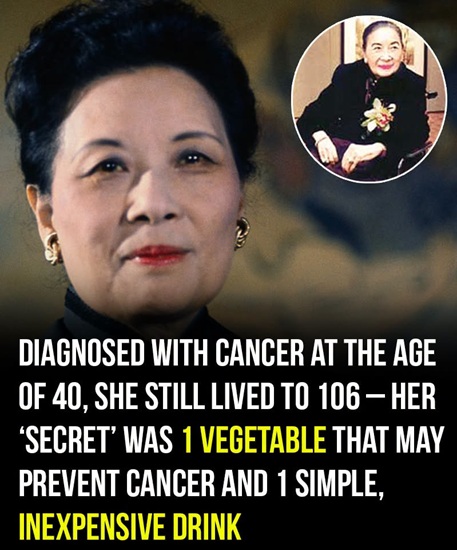
Soong Mei-ling lived long enough to witness almost an entire century transform around her. She saw wars redraw political boundaries.
She watched governments change. She witnessed enormous advances in medicine, transportation and communication.
And for part of that history, she was not simply watching from the sidelines.
Known internationally as Madame Chiang Kai-shek, she became one of the most recognizable Chinese political figures of the 20th century.
She met world leaders.
She addressed American lawmakers.
She supported wartime relief efforts.
And she became an important international advocate for the Chinese Nationalist government led by her husband, Chiang Kai-shek.
Then there was another remarkable part of her story.
Her age.
When Madame Chiang died in New York in 2003, she was 105 years old.
Her longevity later inspired stories claiming that particular foods or carefully followed routines explained her exceptionally long life.
The reality is less simple.
And her actual story is much more fascinating.
Her journey began in Shanghai
Soong Mei-ling was born in Shanghai in 1898.
She belonged to the prominent Soong family, whose members would become deeply connected with modern Chinese political history.
Her father, Charlie Soong, was a businessman and Christian missionary who valued education.
Mei-ling was sent to the United States while still young.

That decision would shape the rest of her life.
She studied in America and eventually attended Wellesley College in Massachusetts.
In 1917, she graduated with honors.
Her studies included English literature and philosophy.
More importantly for her future public role, years spent in the United States gave her an exceptional command of English and familiarity with American culture.
Those abilities might have seemed merely educational at the time.
Years later, they became political assets.
A marriage changed her public role
In 1927, Soong Mei-ling married Chiang Kai-shek.
Chiang was one of the most important political and military figures in China and would lead the Nationalist government.
The marriage placed Mei-ling at the center of major historical events.
But she did not remain simply a ceremonial spouse.
Her language skills allowed her to communicate directly with foreign officials, journalists and audiences.
She became an interpreter, adviser and public advocate.
She also participated in charitable and educational initiatives.
Then China entered one of the most devastating periods in its modern history.
War with Japan brought enormous suffering.
And Madame Chiang’s international role became increasingly important.

America became an important stage
During World War II, China was one of the Allied powers fighting Japan.
The Nationalist government needed international assistance.
Madame Chiang was particularly well positioned to make that case to American audiences.
She understood the country.
She spoke fluent English.
And she knew how to communicate effectively with Western media and political leaders.
In 1943, she traveled through the United States.
Her appearances attracted enormous attention.
She gave speeches.
She participated in public events.
She appealed for greater support for China’s war effort.
Then came one of the defining moments of her public life.
On February 18, 1943, Madame Chiang addressed members of the United States Congress.
It was an extraordinary platform for a foreign woman at the time.
Her speech helped reinforce her international image as a persuasive representative of wartime China.
For a period, she became one of the world’s most visible Chinese public figures.
But the political landscape was about to change dramatically.
Victory did not bring lasting peace
Japan surrendered in 1945.
World War II was over.
China’s internal conflict, however, was not.
The civil war between Chiang Kai-shek’s Nationalists and Mao Zedong’s Communist forces resumed.
In 1949, the Communist Party established the People’s Republic of China on the mainland.
Chiang Kai-shek’s government withdrew to Taiwan.
Madame Chiang continued supporting the Nationalist government and became a prominent anti-communist advocate during the Cold War.
That part of her legacy remains politically complex.
Supporters regarded her as an effective diplomat and international spokesperson.
Critics viewed her through the record of the Nationalist government and its authoritarian rule.
A historically accurate account needs room for both realities.
She was influential.
She was controversial.
And she occupied a remarkable position during some of the century’s most consequential events.
Her life gradually became quieter
Chiang Kai-shek died in 1975.
In the years that followed, Madame Chiang increasingly spent time in the United States.
Eventually, New York became her primary home.
She had experienced health problems during her long life and received treatment for serious illnesses, including cancer.
Yet she continued living for decades.
As her direct political role diminished, other interests remained.
One of them was art.
Madame Chiang practiced traditional Chinese painting and calligraphy.
Her artistic work became another important part of her later years.
Even as the political world that had defined her earlier life changed, she continued pursuing intellectual and creative interests.
Then her extraordinary age began attracting attention of its own.
People wanted to know her “secret”
Whenever someone lives beyond 100, a familiar question tends to appear.
What was the secret?
People naturally want a simple explanation.
Perhaps it was one particular breakfast.
Maybe a favorite drink.
A specific vegetable.
A precise bedtime.
Madame Chiang became the subject of similar stories.
Online accounts have attributed her longevity to practices including drinking lemon water, eating small meals and consuming celery regularly.
Some versions go even further, suggesting celery was a central reason she reached 105.
That is an appealing story.
But there is a problem.
There is no reliable evidence demonstrating that celery — or any single food — caused Madame Chiang’s longevity.
Human lifespan does not work that simply.
Longevity has many influences
Scientists know that longevity can be influenced by numerous factors.
Genetics plays a role.
Lifestyle can matter.
Nutrition matters.
Physical activity matters.
Smoking and alcohol use can affect health.
Access to healthcare can be important.
Environmental and socioeconomic circumstances also influence outcomes.
And chance remains part of the equation.
That makes it impossible to look at one exceptionally long-lived person, identify a favorite food and conclude that the food explains the lifespan.
Madame Chiang lived to 105.
That is documented.
Exactly why she lived that long cannot be reduced to a single dietary ingredient.
But what about celery itself?
There is still plenty worth knowing.
Celery is nutritious without being miraculous
Celery can be a healthy addition to a balanced diet.
It contains a large amount of water and provides dietary fiber along with nutrients such as vitamin K and folate.
It also contains naturally occurring plant compounds.
One of those compounds is apigenin, a flavonoid researchers have studied for its biological effects.
Laboratory research has produced interesting findings involving inflammation and cancer cells.
Animal studies have also investigated possible effects of apigenin.
But this is where careful wording becomes essential.
Results in cells or laboratory animals do not prove that eating celery prevents or cures cancer in humans.
They are different levels of evidence.
Much more clinical research would be required before such findings could support medical treatment claims.
So celery deserves a place at the dinner table.
It does not deserve to be described as a cancer cure.
And it cannot reliably explain why one woman lived for more than a century.
The more interesting habits may not involve food
Rather than searching for one miracle ingredient, another part of Madame Chiang’s later life may be more interesting.
She remained intellectually and creatively engaged.
She read.
She painted.
She practiced calligraphy.
She maintained interests beyond politics.
Remaining mentally and socially engaged can be part of a healthy lifestyle, although no single activity guarantees longevity.
The distinction matters.
Healthy habits can improve the odds of better health.
They cannot promise a particular lifespan.
Madame Chiang also had access to resources and medical care unavailable to many people of her generation.
That context should not be ignored when discussing her remarkable age.
More than a longevity story
Focusing too heavily on Madame Chiang’s diet can obscure what actually made her historically significant.
Her life intersected with major events across decades.
She lived through the final years of imperial China.
She experienced the upheavals of the early Chinese Republic.
She witnessed war with Japan.
She played an international role during World War II.
She saw the Chinese Civil War reshape the country’s political future.
She experienced the Cold War.
And she lived long enough to see the beginning of the 21st century.
Few people occupied such a visible position across so much history.
Her final years
Madame Chiang spent her later years largely outside the political spotlight.
She continued living in New York and maintained her interest in art.
On October 23, 2003, Soong Mei-ling died in Manhattan.
She was 105 years old.
By then, the world was almost unrecognizable compared with the one into which she had been born in 1898.
Her husband had been gone for nearly three decades.
Many of the political figures she once knew had become names in history books.
Yet Madame Chiang had lived on.
That longevity is undeniably remarkable.
But it does not require a miracle-food explanation to make it interesting.
The real takeaway
There is nothing wrong with eating celery.
It is a nutritious vegetable that can fit comfortably into a varied, balanced diet.
There is also nothing wrong with developing healthy routines, remaining physically active or finding creative activities that keep life interesting.
Those are sensible choices.
The mistake comes when one person’s exceptional lifespan is presented as proof that a particular food can make everyone else live longer or protect them from serious diseases.
Science cannot support that conclusion.
Madame Chiang’s life offers something more substantial than a dietary shortcut.
She was educated across cultures.
She became an unusually influential woman in international politics.
She advocated for causes she believed in.
She survived serious illness.
She remained connected to intellectual and artistic pursuits.
And she lived to 105.
Perhaps the most extraordinary thing about those 105 years is not what she supposedly ate.
It is how much history they contained.
Soong Mei-ling’s life stretched from the world of the 19th century into the digital age.
She watched enormous historical transformations unfold.
At several crucial moments, she participated in them.
That is a legacy far larger than any single vegetable could ever explain.
