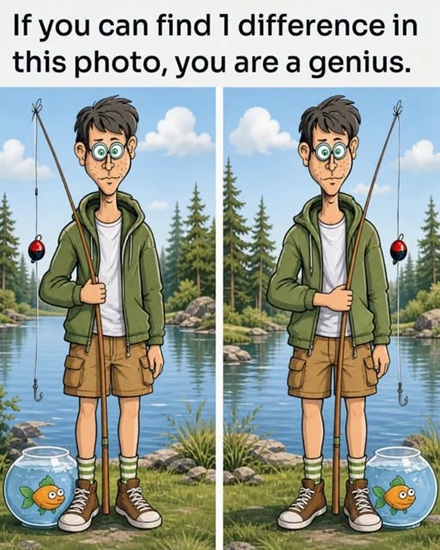
At first glance, the two cartoon images appear to be exactly the same.
The same young fisherman stands in both pictures.
His glasses look identical.
His hairstyle appears unchanged.
The fishing rod is in the same position.
The fish, clothing, and surrounding objects also seem to match.
Nothing immediately looks wrong.
And that is exactly why the puzzle can be so difficult.
Somewhere inside the two drawings, one small detail is different.
The challenge is simple.
Find it.
But after a few seconds of searching, many viewers may begin wondering whether there is really a difference at all.
That is when the puzzle becomes interesting.
The first look can be misleading
When people look at two nearly identical images, the larger features are usually noticed first.
The face.
The glasses.
The clothes.
The fishing equipment.
Once those major elements appear to match, the brain can quickly form the impression that the entire image is the same.
But the puzzle depends on that assumption.
The hidden difference is usually much smaller than the features that attract attention first.
It may involve a missing line.
A slightly altered shape.
A tiny color change.
Or one detail that appears in one picture but not the other.
The rest of the illustration is designed to look familiar.
That makes the mismatch much easier to overlook.
The search gets harder the longer it continues
At first, most people scan the obvious areas.
They may compare the boy’s face.
Then the hair.
Then the glasses.
Next comes the fishing rod.
After that, attention may shift toward the fish or the surrounding objects.
Everything still seems correct.
So the viewer starts looking again.
And again.
That repetition can create a strange effect.
The more familiar the picture becomes, the easier it may be to keep overlooking the same tiny detail.
The answer is still there.
It has not moved.
But attention keeps passing over it.
One small change can control the entire puzzle
The most effective spot-the-difference challenges usually do not depend on dramatic alterations.
If one picture had a completely different background or if the fisherman were wearing a different shirt, the answer would be obvious.
Instead, the difference is often tiny.
That forces the viewer to stop thinking about the picture as one complete scene.
The image has to be broken into smaller areas.
One section at a time.
That change in approach can make all the difference.
A better way to search
Looking randomly around the picture can work.
But it can also lead to checking the same areas repeatedly.
A more organized method is often easier.
Start at the top.
Compare the hair.
Then the glasses.
Then the eyes, nose, and mouth.
Move down to the clothing.
Check the hands.
Then examine the fishing rod and line.
Finally, compare the fish and the background details.
This method does not guarantee an instant answer.
But it makes it less likely that one small area will be skipped completely.
And sometimes, that is exactly where the hidden clue is waiting.
Why the answer can feel invisible
The strange thing about these puzzles is that the difference is visible from the very beginning.
Nothing is actually hidden behind another object.
There is no trick animation.
The missing or altered detail is right there on the screen.
Still, the surrounding similarities make it easy to ignore.
When most of the image matches perfectly, the viewer may assume the rest matches too.
That assumption can be stronger than the actual visual evidence.
Then one small detail suddenly breaks the pattern.
And everything changes.
The moment the answer appears
One of the most satisfying parts of a spot-the-difference challenge is the instant when the hidden detail finally becomes obvious.
A viewer may stare at the same section several times without noticing anything unusual.
Then, on the next glance, the difference seems to jump out.
Nothing in the image has changed.
Only the viewer’s attention has.
That sudden shift is what makes these puzzles so enjoyable.
Before the discovery, the difference may feel almost impossible to see.
Afterward, it can become difficult to understand how it was ever missed.
A time limit adds pressure
Many versions of these puzzles challenge viewers to find the difference in ten seconds.
That makes the game more exciting.
It can also make it harder.
When people feel rushed, they often scan faster.
That may help if their eyes happen to land on the correct area immediately.
But moving too quickly can also cause small details to be skipped.
The countdown creates pressure.
The pressure encourages speed.
And speed does not always help with a challenge built around careful observation.
Sometimes slowing down works better.
Taking longer does not mean failing
A spot-the-difference puzzle is not a serious test of intelligence or ability.
It is simply a visual challenge.
Some people find the answer almost immediately.
Others may need much longer.
That difference can happen for many simple reasons.
One viewer may happen to look at the correct section first.
Another may begin on the opposite side of the image and spend more time checking details that are completely identical.
Neither approach says much about the person.
It only changes how quickly the answer is found.
So if ten seconds pass and the difference is still hidden, the puzzle is still working exactly as intended.
Small details become important
Once the obvious areas have been checked, the search usually becomes more precise.
Viewers begin comparing individual lines.
Edges.
Shapes.
Tiny marks.
The position of objects.
Even small gaps between parts of the drawing.
This is where the challenge becomes more engaging.
The question is no longer simply, “Do these pictures look the same?”
It becomes, “Which exact detail does not match?”
That is a very different kind of search.
Why people keep trying
Even when the puzzle becomes frustrating, many people continue looking.
The reason is simple.
The answer feels close.
The image is small.
The difference must be somewhere inside it.
That creates the feeling that one more careful scan might finally reveal everything.
The viewer checks the glasses again.
Then the hair.
Then the rod.
Then the fish.
Each failed comparison eliminates another possibility.
Instead of ending the challenge, that often makes the search more compelling.
The mystery becomes smaller.
But the solution still has not appeared.
The answer looks easier afterward
After the difference is found, perception changes immediately.
The altered detail suddenly seems impossible to miss.
A viewer can return to the picture minutes later and spot it almost instantly.
That is one of the funniest parts of the experience.
Before discovery, the answer seemed hidden.
After discovery, it can seem almost obvious.
The image did not become easier.
The viewer simply learned where to look.
That small change in attention completely transforms the puzzle.
A brief break from everything else
Part of the appeal of these challenges may also come from their simplicity.
There are no complicated instructions.
No long list of rules.
No large amount of information to remember.
For a few moments, the task is extremely clear.
Find one difference.
That simplicity can make the puzzle an easy way to focus on a single activity.
The viewer can ignore everything else and concentrate on one small image.
Sometimes that is enough to make the challenge enjoyable even before the answer is found.
The best strategy may be patience
If the difference still refuses to appear, staring harder at the entire image may not help.
Instead, divide it into sections.
Compare one small area.
Then move to the next.
Avoid jumping back and forth randomly.
And do not assume that the most obvious objects must contain the answer.
The hidden detail may be somewhere the eyes have been treating as unimportant.
That is usually the trick.
The part that seems least interesting can suddenly become the most important piece of the entire puzzle.
One final look
So take another look at the two cartoon fishermen.
Do not scan the whole picture at once.
Check each part separately.
The glasses.
The hair.
The face.
The clothing.
The hands.
The fishing rod.
The fish.
The smaller lines and shapes around them.
One of those details does not match.
And once you see it, the puzzle will feel completely different.
What looked impossible a moment earlier may suddenly seem simple.
That is the small trick behind a good spot-the-difference challenge.
The answer is not really hidden.
It is simply waiting for your attention to land in exactly the right place.
