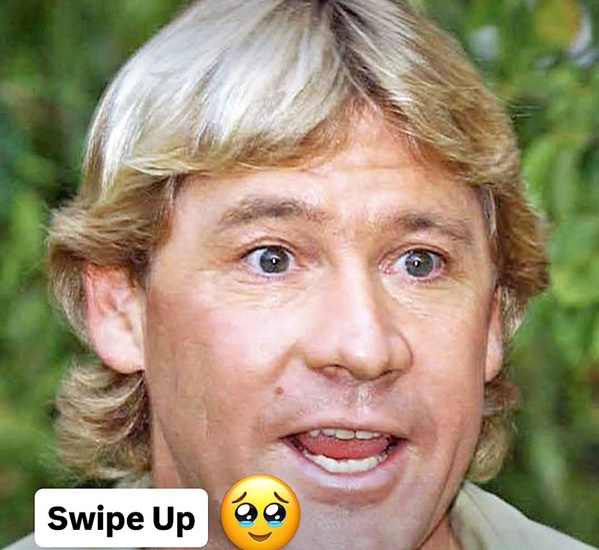
Twenty years have passed since Steve Irwin died.
For people who grew up watching him leap toward crocodiles, handle snakes, and shout “Crikey!” with almost impossible enthusiasm, that number can be difficult to process.
The television personality they remember still seems permanently energetic.
Always moving.
Always talking.
Always trying to convince the person behind the camera that the animal in front of him deserved respect rather than fear.
But on September 4, 2006, that life ended with shocking speed.
Irwin was 44.
He was filming in the waters off Far North Queensland when a stingray struck him in the chest.
The injury was catastrophic.
And one of the world’s most recognizable wildlife presenters was gone.
The circumstances have remained part of public memory ever since.
But two decades later, Steve Irwin’s family has increasingly emphasized something else.
Not the final seconds.
The life that came before them.
To understand why, it helps to return to that September morning.
Irwin was working on a wildlife documentary titled Ocean’s Deadliest.
The production was taking place around the Great Barrier Reef.

Weather conditions had affected the planned filming.
Instead of simply abandoning the day, Irwin and members of the crew continued looking for wildlife that could be filmed safely in shallower water.
That was consistent with how he worked.
Wildlife was everywhere.
And almost any encounter could become an opportunity to explain an animal to viewers.
Eventually, the crew encountered a large stingray.
Stingrays are generally not animals known for aggressively hunting people.
They usually attempt to move away from threats.
Their defensive barb becomes dangerous when the animal feels threatened or trapped.
Irwin approached the animal while cameraman Justin Lyons filmed.
What happened next lasted only seconds.
According to Lyons’ later account, the stingray reacted suddenly and struck repeatedly with its tail.
The barb penetrated Irwin’s chest.
The crew immediately realized the situation was extremely serious.
They moved him toward the inflatable boat.
Lyons later described trying to keep Irwin conscious.
The team told him to think about his children.
They urged him to hold on.
Then came the words that would later become one of the most painful details of the story.
Irwin looked toward Lyons and said:
“I’m dying.”
Lyons has described those as Irwin’s final words.
The crew continued CPR and rushed him toward medical help.
It was not enough.
The incident had been filmed.
That fact has fueled curiosity for years.
But the recording has never been publicly released.
Producer and longtime collaborator John Stainton saw the footage and has spoken about how confronting it was.
Terri Irwin has said she never needed to watch it.
She already knew what happened to her husband.
That decision has helped keep the most traumatic moments of Steve Irwin’s death away from public spectacle.
And perhaps that matters more now than it did then.
Because the world had already seen almost everything else.
Irwin had spent years placing himself directly in front of cameras.
He handled crocodiles.
Moved venomous snakes.
Crawled through swamps.
Entered rivers.
Jumped from boats.
And spoke about animals with the kind of excitement that made even viewers who feared reptiles stop and listen.
He did not merely want people to watch wildlife.
He wanted them to care.
That mission had started long before global fame.
Steve Irwin was born on February 22, 1962.
His parents, Bob and Lyn Irwin, were deeply involved with wildlife.
In 1970, the family moved to Beerwah, Queensland, and opened the Beerwah Reptile Park.
That facility would eventually develop into Australia Zoo.
Steve essentially grew up around animals.
Crocodiles were not mysterious creatures he encountered for the first time as an adult television presenter.
They were part of his environment from childhood.
He learned animal handling.
Wildlife rescue.
And the practical realities of caring for species many people considered frightening.
Those early experiences shaped the personality audiences would later recognize instantly.
Then television changed everything.
The Crocodile Hunter introduced Steve and his wife Terri to viewers around the world.
The series combined wildlife education with something television had rarely seen in quite the same form.
Steve himself.
He was loud.
Physical.
Emotional.
And completely unembarrassed by his enthusiasm.
When he saw an extraordinary animal, he reacted as though it were the greatest thing he had ever seen.
Then another animal appeared.
And somehow that became the greatest thing too.
It could seem exaggerated.
But people close to him repeatedly said the enthusiasm was genuine.
He truly loved wildlife.
That sincerity helped the program work.
Viewers could sense that the animal mattered more to him than the performance.
The show became internationally successful.
Steve became known far beyond Australia.
His khaki clothing became instantly recognizable.
So did his accent.
His expressions.
And his willingness to get closer to dangerous animals than most people would consider reasonable.
But behind the entertainment was a consistent conservation message.
Animals should not be destroyed simply because people fear them.
Habitats matter.
Species matter.
Human beings have a responsibility to protect the natural world.
Steve repeated those ideas constantly.
Sometimes while holding a snake.
Sometimes standing beside a crocodile.
Sometimes speaking directly into the camera.
The presentation changed.
The message did not.
That is the part his family has continued.
After Steve’s death, Australia Zoo remained at the center of the Irwin family’s lives.
Terri continued working there.
So did Bindi and Robert as they grew older.
The children were extremely young when their father died.
Bindi was eight.
Robert was two.
For Bindi, the memories were direct.
For Robert, many of them had to be carried through photographs, video, stories, and the work his father left behind.
Two decades later, both are adults.
And both remain deeply connected to wildlife conservation.
Robert has become known for wildlife photography as well as his work with animals.
He continues participating in conservation activities and research associated with Australia Zoo.
Bindi has also remained closely involved with the zoo and conservation programs.
The work did not end when Steve did.
That continuity became especially visible during the 20th anniversary of his death.
On September 4, 2026, Terri, Bindi, and Robert each shared new tributes.
Terri reflected on the grief that has remained with her across two decades.
She also remembered the final weeks the family spent together before Steve’s death.
They had been on a crocodile research expedition.
The family had time together.
Steve climbed trees with the children.
Built swings.
And simply existed as a father away from the dramatic television moments.
Terri described those weeks as something like a long goodbye, even though they could not know it at the time.
That reflection changes the way the final day looks.
The public remembers the stingray.
Terri remembers the weeks before it.
The family remembers ordinary moments.
A father playing with his children.
Time spent together.
Conversations nobody filmed for television.
Those memories are quieter.
They may also matter more.
Bindi’s tribute focused on something similar.
She wrote that for years she believed her father’s greatest legacy was wildlife conservation.
Then, with time, she began seeing it differently.
His legacy was also love.
Love for the planet.
Love for wildlife.
And love for the people around him.
That idea became even more powerful after Bindi became a mother herself.
Her daughter Grace Warrior was born in 2021.
Grace never met Steve.
But she knows exactly who he is.
Bindi has said Grace watches her grandfather’s documentaries frequently.
She calls him “Grandpa Crocodile.”
To a five-year-old child in 2026, the man on the screen is not primarily an international television icon.
He is family.
A grandfather she knows through recordings, photographs, and stories.
Bindi said Grace feels loved by him even though they never met.
That may be one of the most unusual consequences of Steve’s enormous television archive.
Millions of strangers can still watch him.
So can his granddaughter.
Robert marked the anniversary too.
His tribute was shorter.
But the central message was clear.
His father’s legacy continues.
Robert has spent his adult life following many of the same interests.
Wildlife.
Photography.
Conservation.
Crocodile research.
In September 2026, he was also involved in the continuing crocodile research work tied to the Steve Irwin Wildlife Reserve, including the tagging of the project’s 300th crocodile.
The work Steve cared about did not remain frozen in 2006.
It kept developing.
New animals were studied.
New habitats were protected.
New audiences were reached.
That may be the clearest measure of a conservation legacy.
Not how many old episodes remain online.
What people continue doing because of them.
Steve’s television career made wildlife entertaining.
The conservation work gave that entertainment a purpose.
Australia Zoo’s history reflects that connection.
The facility began with Steve’s parents.
Steve and Terri expanded its reach.
And today the Irwin family continues running the zoo and supporting wildlife projects.
The institution has become inseparable from the family’s identity.
There is also another side to Steve’s legacy.
His style of wildlife television influenced how an entire generation encountered animals.
A crocodile was no longer simply a monster waiting in a river.
A snake was not automatically something to kill.
A spider could be fascinating.
A lizard could become the star of an episode.
Steve repeatedly encouraged viewers to look closer.
Understand the animal first.
Then decide how to respond.
That philosophy sounds simple.
But fear has enormous power over the way people treat wildlife.
Animals perceived as dangerous often suffer precisely because people do not understand their behavior.
Steve believed education could change that.
His approach was unconventional.
Critics sometimes questioned how close he got to animals.
Some of his choices created controversy.
But his conservation message was unusually consistent.
Wildlife deserved protection.
And enthusiasm could make people care.
The evidence of that influence still appears today.
Young wildlife presenters cite him.
Conservationists remember growing up with The Crocodile Hunter.
Fans travel to Australia Zoo.
And children born long after 2006 recognize his voice.
That is unusual longevity for any television personality.
Especially one whose career ended so suddenly.
The circumstances of his death also created a misunderstanding that conservationists have sometimes tried to correct.
Stingrays are not generally aggressive toward humans.
Fatal incidents are extremely rare.
Steve’s death was an extraordinary accident.
The animal was responding defensively.
It was not hunting him.
That distinction fits strangely well with the message Steve spent his career promoting.
Do not turn an animal into a villain because of fear.
Even the species involved in his death should not be treated that way.
Nature does not operate according to human ideas of blame.
Animals react.
Humans sometimes enter those environments.
And on very rare occasions, the result is catastrophic.
That is what happened on September 4, 2006.
But twenty years of retelling can distort a life.
One dramatic moment begins overshadowing everything before it.
The stingray becomes the headline.
The final words become the hook.
The unseen footage becomes the mystery.
Eventually, a man who spent decades talking about wildlife can become remembered mainly for how he died.
That is exactly what his family appears determined to resist.
They do not deny the circumstances.
They do not erase the tragedy.
But they return attention to everything else.
The crocodile research.
The wildlife hospital.
The zoo.
The television work.
The conservation campaigns.
The family.
And the millions of people who learned to care about unfamiliar animals because Steve made them exciting.
That is where the delayed payoff begins to emerge.
The most haunting detail of Steve Irwin’s story may be his final sentence.
But the most important words were probably spoken long before that day.
The countless times he told people to care for wildlife.
To protect habitats.
To stop destroying animals simply because they frightened us.
To become what he called wildlife warriors.
Those words had time to spread.
The final ones did not.
They belonged to a terrible private moment between a dying man and the people trying to save him.
Perhaps that is why the footage has remained unseen.
The public already received the part of Steve Irwin that mattered most.
His life.
There is another reason the anniversary feels different now.
Twenty years is long enough for an entire generation to grow up.
Bindi is now older than Steve was during some of the early years of The Crocodile Hunter.
Robert is an adult.
Grace is old enough to watch her grandfather on television.
Terri has lived two decades beyond the day she lost her husband.
The family did not remain frozen in grief.
They carried it forward while continuing the work.
That is something Terri’s anniversary message emphasized.
Grief changes.
It may become more familiar.
But it does not necessarily disappear.
At the same time, memory changes too.
The shock of the final day gradually shares space with other moments.
Tree climbing.
Crocodile research.
Family time.
Laughter.
Ordinary days nobody outside the family witnessed.
Those details become more valuable as the years pass.
And perhaps that is why Bindi’s description of Steve’s legacy has shifted.
Conservation remains obvious.
It is measurable.
Projects exist.
Animals are protected.
Research continues.
But love is harder to measure.
It appears in what people continue doing after someone is gone.
A daughter teaching her child about the grandfather she never met.
A son pursuing wildlife photography and crocodile conservation.
A widow continuing a shared mission.
A zoo carrying the family name and philosophy forward.
Those things are not memorial statues.
They are living consequences.
That may be the more meaningful definition of legacy.
Steve Irwin died at 44.
His conservation message did not.
The television programs still exist.
The zoo continues.
The family continues.
Wildlife projects continue.
And his granddaughter now knows him through the same footage that introduced him to millions of viewers.
That is an extraordinary circle.
Steve once used television to make strangers feel emotionally connected to wildlife.
Now the same television footage helps his own granddaughter feel connected to him.
Twenty years later, that may be the quietest and most powerful part of the story.
People remember the khaki shirt.
They remember “Crikey!”
They remember crocodiles.
They remember the shocking news from September 2006.
Some remember the reported final words.
But his family keeps pointing toward something larger.
Do not remember only the day he died.
Remember why he lived the way he did.
Steve Irwin wanted people to care.
About wildlife.
About the planet.
And, according to the family who knew him away from the cameras, about one another.
The footage of his final moments may remain locked away forever.
Perhaps it should.
Because twenty years later, the image worth preserving is not Steve Irwin dying beside a reef.
It is Steve Irwin alive.
Running toward the next animal.
Talking too loudly.
Smiling at the camera.
And trying, one more time, to convince the world that whatever creature stood in front of him was worth protecting.
