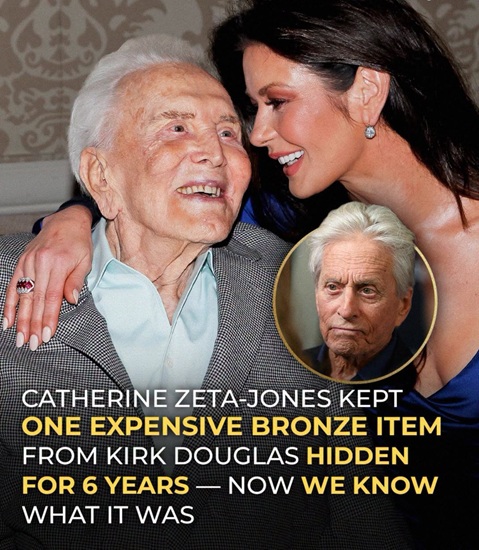
Kirk Douglas spent more than seven decades building a life that became inseparable from Hollywood history.
There were legendary films.
There were major awards.
There was art collected over a lifetime.
And there were objects that carried memories no amount of money could reproduce.
When Douglas died in 2020 at the age of 103, much of the attention naturally focused on the extraordinary career he left behind.
But years later, newly reported trust documents offered another look at his legacy.
This time, the story was not about box-office success or famous performances.
It was about what Kirk and his wife, Anne Douglas, wanted the people closest to them to keep.
And one particularly thoughtful object was reserved for Catherine Zeta-Jones.
At first glance, it seemed less impressive than an Oscar or presidential honor.
Its meaning, however, was something very different.
Kirk and Anne Built a Life Filled With History
Kirk Douglas died on February 5, 2020.

He was 103 years old.
His widow, Anne Buydens Douglas, died the following year at 102.
The couple had spent more than six decades together.
During that time, they accumulated an extraordinary collection of art, awards, memorabilia and deeply personal possessions.
Many of those objects reflected Kirk’s career.
Others reflected their marriage.
And some represented decades of friendships, travel and collecting.
When details from their trust became public in August 2026, it became clear that many of those belongings had been distributed very deliberately.
This was not simply an estate filled with valuable objects.
It was a family archive.
Michael Douglas Received an Impressive Art Collection
Michael Douglas inherited several artworks and sculptures.
According to the trust documents reported by TMZ, his share included a rectangular wooden work and several outdoor pieces.
Among them were sculptures depicting a tall bronze woman, a young girl with braids and two children.
But perhaps the most recognizable artistic name attached to Michael’s inheritance was Marc Chagall.
Michael received 19 lithographs from Chagall’s Bible Series.
For collectors, Chagall’s name alone carries major artistic significance.

For the Douglas family, however, the works also represented something more personal.
They were pieces Kirk and Anne had chosen to live with.
Now they would remain within the family.
But Michael did not receive one of his father’s most famous awards.
That went elsewhere.
Joel Douglas Received Kirk’s Honorary Oscar
Kirk Douglas never won a competitive Academy Award despite earning three Best Actor nominations during his career.
But the Academy eventually honored his enormous contribution to cinema.
At the 1996 Academy Awards ceremony, Douglas received an honorary Oscar recognizing roughly 50 years as a creative force in the film industry.
Decades later, the physical statuette was designated for his son Joel Douglas.
Joel also received a three-dimensional miniature arrangement depicting Kirk and Anne, along with paintings.
The Oscar carried obvious Hollywood significance.
It represented a lifetime of performances.
Films such as Champion, The Bad and the Beautiful, Lust for Life and Spartacus had made Kirk one of the defining actors of his generation.
Now that symbol of his career would remain with his family.
Peter Douglas, meanwhile, received another collection of paintings.
And the three surviving sons were offered an additional opportunity.
Michael, Joel and Peter Could Choose More Memorabilia
The trust documents reportedly allowed Michael, Joel and Peter to select up to $100,000 worth of memorabilia each.
That provision offered something different from receiving a predetermined object.

They could choose.
For a family whose history stretched across generations of Hollywood, the possibilities were potentially extensive.
Movie-related keepsakes.
Personal objects.
Items connected to Kirk and Anne’s long life together.
Each selection could carry a different meaning depending on who chose it.
Even people outside the immediate family were remembered.
Anne’s Household Staff Received an Unusual Opportunity
After Anne’s death, members of the household staff were reportedly permitted to select personal belongings from her closets and drawers.
On paper, that might appear like a relatively minor provision compared with artwork or major awards.
Emotionally, it could mean much more.
People who had worked closely with Anne were given an opportunity to keep something associated with her.
A piece of clothing.
An accessory.
An everyday object.
Not every meaningful inheritance needs to carry a large financial value.
Sometimes familiarity is what creates the value.
And that same idea becomes even more apparent when looking at what Kirk’s grandchildren received.
Public Honors Passed to a New Generation
Some of Kirk Douglas’s most significant recognitions went to his grandchildren.
Cameron Douglas, Michael’s son, received Kirk’s Presidential Medal of Freedom.
President Jimmy Carter presented Douglas with the honor in 1981.
It represented recognition extending beyond his film career.
Another grandson was designated to receive Kirk’s 1983 Jefferson Award.
Other awards were distributed among additional grandchildren.
A granddaughter received jewelry from Anne.
In that sense, the estate plan spread different parts of Kirk and Anne’s lives across several generations.
One person received Hollywood history.
Another received national recognition.
Another received art.
Another received jewelry.
Then there was Catherine Zeta-Jones.
Her gift did not look like any of those.
Catherine Was Left a Bronze Sculpture
According to the trust documents, Catherine Zeta-Jones was designated to receive a work called The Friendship Bench.
It was created by sculptor John Kennedy.
The title immediately makes the gift stand out.
Not Achievement.
Not Victory.
Not something explicitly connected to Hollywood success.
The Friendship Bench.
That distinction becomes more interesting when looking at Kennedy’s work.
John Kennedy Used Body Language Instead of Faces
John Kennedy lived from 1931 to 2004.
He became known for graceful, elongated bronze figures.
His sculptures often contain little or no facial detail.
Instead, emotion comes through posture.
A tilt of the head.
A body leaning toward another.
Two figures positioned close together.
Kennedy believed the human body could communicate affection, intimacy and emotional connection without relying on detailed facial expressions.
The Friendship Bench follows that artistic language.
CODA Gallery identifies it as a bronze measuring 54.5 by 40 by 28.5 inches.
The figures sit together, their relationship communicated largely through their physical positioning.
Kennedy’s work attracted prominent collectors.
One of them was Kirk Douglas.
That means Catherine was not simply left a random sculpture from the house.
She received a work by an artist her father-in-law personally collected.
The Sculpture Had a Public History Too
The Friendship Bench was among Kennedy works associated with a 1998 public arts installation in Brea, California.
CODA Gallery’s biography of Kennedy lists it alongside works including Sympatico, Girl Reminiscing and Iron Bench as part of that public installation.
The same gallery continues to list The Friendship Bench among Kennedy’s works.
Kennedy’s sculptures can also be found in major public spaces.
Perhaps his best-known work is Spirit of Audrey, honoring Audrey Hepburn and located near UNICEF headquarters in New York.
He also created The Entertainer, a sculpture associated with the Palm Springs International Film Festival.
But Kennedy’s path toward sculpture was anything but conventional.
Kennedy Lived Several Careers Before Becoming a Full-Time Sculptor
Kennedy was born in Rangoon, Burma, now Yangon, Myanmar.
His father was Scottish, while his mother was Burmese.
During World War II, he spent time in northern Burma.
His childhood experiences later influenced the distinctive proportions of his sculptures.
He eventually served in the British Merchant Navy.
Then came journalism.
Kennedy worked as a photojournalist and opened an international news and photography agency on Fleet Street in London.
He later moved into other business ventures before eventually devoting himself more fully to sculpture.
After relocating with his family to Palm Springs in 1980, art became increasingly central to his life.
His work focused heavily on human connection.
Love.
Friendship.
Closeness.
Family.
Those themes make the sculpture left to Catherine particularly intriguing.
Catherine’s Relationship With Kirk Was Publicly Affectionate
Catherine married Michael Douglas in 2000.
That made Kirk her father-in-law.
But their public relationship rarely looked especially formal.
Catherine affectionately referred to him as “Pappy.”
Photographs over the years showed an easy familiarity between them.
She celebrated his birthdays publicly.
She expressed affection openly.
And one photograph from Kirk’s final birthday became particularly memorable.
Kirk Turned 103 in December 2019
On December 9, 2019, Kirk celebrated his 103rd birthday.
Catherine marked the occasion with a playful photograph.
The legendary actor was sitting on her lap.
The image was humorous because Kirk, despite being 103, looked completely comfortable participating in the joke.
But Catherine’s message accompanying the photograph was deeply affectionate.
She wished “Pappy” a happy birthday and made clear how deeply she loved him.
Less than two months later, Kirk died.
That transformed the photograph.
What had originally been a funny birthday moment became one of the final public images documenting their relationship.
And years later, the title of Catherine’s inheritance gave that memory another layer.
“The Friendship Bench” Suddenly Felt Different
There is no evidence in the trust documents showing that Kirk explicitly explained why Catherine was assigned that particular sculpture.
That distinction is important.
It would therefore be inaccurate to claim that he definitely intended the piece as a coded final message.
But the documented facts allow for a much more careful observation.
He owned works by John Kennedy.
Catherine was assigned The Friendship Bench.
And the two had publicly demonstrated a warm relationship over many years.
That combination gives the gift an emotional resonance even without inventing a private explanation.
Sometimes the title is enough to make people pause.
Other Family Members Received Symbols of Achievement
Joel received an Oscar.
Cameron received a Presidential Medal of Freedom.
Michael received Chagall lithographs and sculptures.
Other grandchildren received awards.
Those objects naturally recall Kirk Douglas the public figure.
The actor.
The Hollywood legend.
The nationally honored celebrity.
Catherine’s bronze speaks in a quieter language.
Two figures.
A bench.
A title about friendship.
That is why the gift stands apart.
Kirk’s Life Was Much Larger Than His Film Career
Douglas was born Issur Danielovitch in 1916.
He grew up in a poor immigrant family in Amsterdam, New York.
His rise to Hollywood stardom was extraordinary.
He became one of cinema’s most recognizable leading men.
His performance as Vincent van Gogh in Lust for Life became one of his most celebrated.
Paths of Glory became a landmark antiwar film.
Spartacus became inseparable from his screen legacy.
Douglas also played a significant role as a producer.
And famously, his decision to publicly credit blacklisted screenwriter Dalton Trumbo on Spartacus became part of the history surrounding Hollywood’s blacklist.
But Kirk’s later years increasingly involved philanthropy.
Much of the Douglas Wealth Was Directed Toward Charity
Kirk and Anne became major philanthropists.
Their Douglas Foundation supported a wide range of causes.
That charitable record helps explain why focusing only on who received which valuable household object gives an incomplete picture of their estate planning.
The personal possessions went to family members and people close to them.
But much of their financial legacy was connected with charitable giving.
The estate was therefore not simply about distributing wealth.
It was also about deciding which physical pieces of a long life should remain with particular people.
That is where Catherine’s sculpture becomes especially interesting.
A Price Cannot Explain the Meaning
Artwork can be valued financially.
Auction houses and galleries can attach numbers to paintings and sculptures.
But inherited objects operate differently.
Their value depends on history.
Who owned them.
Where they stood.
What they represented.
And who decided that another person should have them.
The Friendship Bench is a significant bronze by a recognized sculptor.
Yet even if its market value were known precisely, that would not necessarily explain why it might matter to Catherine.
The important detail is who left it to her.
Catherine Had Already Said Goodbye to “Pappy”
When Kirk died in February 2020, Catherine publicly mourned him.
The loss came only weeks after that joyful 103rd birthday photograph.
By then she had been part of the Douglas family for nearly 20 years.
Kirk was not simply one of Hollywood’s most famous actors.
He was part of her family.
That personal relationship is what makes an inherited work centered on friendship feel so different from an award.
Awards celebrate accomplishments.
Personal objects preserve relationships.
Then Comes the Real Payoff
At first, Catherine’s inheritance may sound modest beside some of the other items.
An honorary Oscar went to Joel.
A Presidential Medal of Freedom went to Cameron.
Marc Chagall lithographs went to Michael.
Those objects carry instantly recognizable prestige.
Then there is a bronze bench.
But look more closely.
The artist built his career around expressing human relationships.
Kirk personally collected his work.
The sculpture’s title is The Friendship Bench.
And it went to the daughter-in-law who publicly called Kirk “Pappy,” celebrated him with affection and remained close to him during the final years of his life.
Again, the documents do not tell us Kirk’s private reasoning.
They do not need to.
The contrast between the gifts already tells an interesting story.
Some Heirlooms Remember a Career
Kirk’s Oscar remembers Hollywood.
His Medal of Freedom remembers national recognition.
The Chagall works remember a serious art collection.
Other memorabilia preserve decades of filmmaking.
But The Friendship Bench represents something less public.
Connection.
That makes it a fitting object to remain inside a family whose history is already filled with trophies, photographs and famous names.
An Estate Can Become a Map of a Life
Trust documents are normally legal records.
They describe property.
Beneficiaries.
Administrators.
Distribution.
But when the person involved lived for 103 years and spent much of that life at the center of Hollywood, those lists become something else.
They become a map.
Artwork shows what Kirk and Anne collected.
Awards show what Kirk achieved.
Jewelry preserves Anne’s personal belongings.
Memorabilia preserves the career.
And individual gifts reveal which objects were intended to continue with particular family members.
Not every choice can be interpreted with certainty.
But some are difficult not to notice.
Catherine’s Gift Was Never About Being the Biggest
It was not the Oscar.
It was not the presidential medal.
It was not a stack of famous lithographs.
Instead, Catherine was assigned a sculpture about two people sharing a bench.
Perhaps that simplicity is what gives the gift its power.
Kirk Douglas spent a lifetime accumulating honors most actors could only dream of receiving.
Yet when parts of that life were distributed to the next generation, one of the objects that remained was not about achievement at all.
It was about closeness.
And that is why, among an estate filled with Hollywood history, The Friendship Bench may be one of the pieces that feels most personal.
