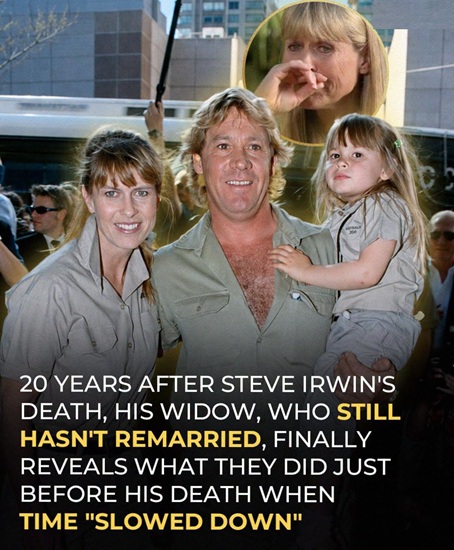
For millions of people around the world, Steve Irwin was the energetic wildlife expert who seemed incapable of standing still.
He wrestled crocodiles.
He handled snakes.
He spoke about animals with an enthusiasm so intense that even viewers who had never cared about reptiles could suddenly find themselves fascinated.
But to Terri, Bindi and Robert Irwin, he was something much more personal.
He was a husband.
He was a father.
And 20 years after his sudden death, the family he left behind is still discovering new ways in which his presence continues to shape their lives.
The most powerful part may not be what Steve accomplished during his lifetime.
It may be what happened after he was gone.
Steve Irwin Became a Global Wildlife Icon
Stephen Robert Irwin was born on February 22, 1962, in Victoria, Australia.
His connection with wildlife began early.

His parents, Bob and Lyn Irwin, eventually established a wildlife park in Queensland, creating an environment where Steve could grow up surrounded by animals.
Reptiles quickly became a particular passion.
He developed an unusual confidence around crocodiles and snakes while also learning to treat dangerous animals with respect.
That combination of knowledge, courage and unmistakable enthusiasm eventually became his signature.
Then television brought Steve’s personality to the rest of the world.
The Crocodile Hunter Changed Everything
Steve and Terri Irwin became internationally recognized through The Crocodile Hunter and related wildlife programs.
The series showed far more than dramatic encounters with crocodiles.
Steve used television as a way to make people emotionally invested in wildlife.
He could move from excitement to seriousness almost instantly.
One moment he was shouting with enthusiasm.
The next, he was explaining why an animal deserved protection.

His energetic delivery sometimes made him seem like an entertainer first.
But conservation was always at the center of what he was doing.
Australia Zoo says Steve and Terri ultimately worked on hundreds of episodes across The Crocodile Hunter and related programs, reaching audiences around the world.
And as his public profile grew, so did his ambitions for wildlife conservation.
Australia Zoo Became Part of the Mission
The wildlife park established by Steve’s parents eventually grew into Australia Zoo.
Under Steve and Terri, it became much more than a tourist attraction.
Conservation programs expanded.
Wildlife rescue became increasingly important.
The Australia Zoo Wildlife Hospital was created to treat injured native animals.
Steve also used income generated through television and merchandise to support conservation efforts.
His goal was not simply to make people watch wildlife.
He wanted them to care about it.
That mission became inseparable from his public identity.
But while the world saw the Crocodile Hunter, Steve was also building a family.
Terri Became His Partner in Every Sense
Steve met American-born naturalist Terri Raines in 1991.
They married in 1992.

Their relationship soon became part of Steve’s television story as Terri joined him in wildlife work and filming.
In 1998, their daughter Bindi was born.
Their son Robert followed in 2003.
Steve’s children quickly became central to his life.
Photographs and footage from those years often show a man whose famous intensity around wildlife was matched by his excitement about fatherhood.
He imagined a future in which conservation would continue through another generation.
Then everything changed.
September 4, 2006
Steve was filming the documentary Ocean’s Deadliest near Australia’s Great Barrier Reef when he encountered a stingray.
During the encounter, the stingray’s barb struck Steve in the chest.
The injury was fatal.
Steve Irwin died on September 4, 2006.
He was 44 years old.
Terri had lost her husband.
Eight-year-old Bindi had lost her father.
Robert was only two.
The news spread quickly around the world.
For viewers who had watched Steve repeatedly interact with animals many people would never dare approach, his death was difficult to comprehend.
But for the Irwin family, there was little time to think only about his public reputation.
They had to continue living.
And eventually, they faced another question.
What should happen to Steve’s work?
The Family Chose to Continue
Terri, Bindi and Robert did not allow Australia Zoo or Steve’s conservation mission to become simply a memorial to the past.
They continued the work.
Australia Zoo expanded.
Wildlife rescue programs continued.
The family remained active in conservation education.
Bindi grew into a public wildlife advocate.
Robert developed the same enthusiasm for animals and conservation that audiences had recognized in his father.
Terri remained deeply involved in maintaining the family’s broader mission.
Australia Zoo now spans more than 700 acres and employs hundreds of people while continuing conservation and wildlife-care programs.
Yet Steve’s public recognition also continued growing after his death.
One particularly emotional moment arrived in Hollywood.
Twelve Years Later, Hollywood Honored Him
On April 26, 2018, Steve Irwin received a posthumous star on the Hollywood Walk of Fame.
It was the 2,635th star on the famous walkway and was awarded in the television category.
Terri, Bindi and Robert attended the ceremony.
So did longtime Australia Zoo colleague Wes Mannion.
Even a South American green anaconda named Angelina was present.
It was exactly the kind of unusual detail that seemed appropriate for an event honoring Steve.
But behind the celebration was an unavoidable sadness.
He was not there to see it.
Bindi Could Hardly Believe What Her Father Had Achieved
Bindi spoke during the ceremony about how extraordinary the recognition felt.
Her father had spent much of his life getting dirty, working with animals and encouraging people to care about wildlife.
Now his name was permanently represented on one of Hollywood’s most famous landmarks.
For the family, the star was not simply recognition of a television career.
It symbolized how far Steve’s conservation message had traveled.
A wildlife enthusiast from Australia had somehow become an international cultural figure.
The Hollywood Chamber of Commerce formally recognized him for his contribution to television and his ability to educate and entertain audiences through his knowledge of animals.
Terri used the occasion to talk about something Steve had taught her.
Do not keep waiting to live.
Terri Remembered Steve’s Approach to Life
One of the lessons Terri has repeatedly associated with Steve was his willingness to act rather than postpone meaningful things.
People often wait for the right moment.
They wait until work becomes quieter.
They wait until the children are older.
They wait until retirement.
Sometimes they simply wait for the weekend.
Steve’s philosophy was different.
If something mattered, he wanted to do it.
That approach applied to conservation.
It applied to adventures.
And according to Terri, it influenced how she approached life with him.
But 2018 was still only 12 years after his death.
Another milestone was waiting.
And when it arrived in September 2026, the tone was much more personal.
Twenty Years Without Steve
September 4, 2026 marked exactly two decades since Steve died.
Bindi was now 28.
Robert was 22.
The children Steve had left behind were adults.
Bindi was also a mother herself.
That meant Steve now had a granddaughter he had never met.
Yet according to Bindi, five-year-old Grace already feels deeply connected to him.
And that is where Steve’s legacy took on a different meaning.
Grace Knows Her Grandfather Through the Screen
Bindi shared an emotional remembrance for the 20th anniversary of her father’s death.
She reflected on the way her understanding of Steve’s legacy had changed.
For years, it seemed obvious that his legacy was conservation.
After all, wildlife protection had defined his career.
But Bindi came to see something else.
Love.
Her daughter Grace watches Steve’s documentaries and recognizes him as her grandfather despite being born years after his death.
Bindi explained that Grace watches the programs regularly and feels loved by the grandfather she never had the opportunity to meet in person.
That detail gives old footage a completely different purpose.
For millions of viewers, the documentaries are wildlife television.
For Grace, they are family videos.
Robert Shared a Much Simpler Message
Robert marked the anniversary too.
He shared an image connecting him with his father and reflected on Steve’s continuing influence.
His message was brief.
The idea behind it was not.
Steve’s legacy is still present.
Robert was barely old enough to form extensive memories when his father died.
Yet he grew up surrounded by Steve’s work, stories and values.
Today, Robert’s career revolves heavily around wildlife conservation, photography and public education.
His resemblance to Steve has frequently attracted attention.
But carrying a parent’s legacy involves more than looking like them.
Robert has built his own public identity while continuing the mission Steve began.
Bindi responded to his tribute with a reminder that Steve remains with them.
Then Terri added something even more emotional.
Terri Remembered Their Final Six Weeks
Of all the anniversary tributes, Terri’s looked furthest into the past.
She reflected on grief that had not simply disappeared after two decades.
For her, time had changed grief rather than eliminated it.
She remembered the family’s final extended period together.
They had been on a crocodile research expedition.
At the time, nobody knew those weeks would become their last as a complete family.
Steve spent time with his children.
There were ordinary family activities.
Trees.
Swings.
Moments together outdoors.
Nothing about those experiences would necessarily have seemed historic when they happened.
Only later did their importance become clear.
That may be one of the hardest realities of loss.
The last ordinary day rarely announces itself.
Steve Could Not Know Which Memories Would Matter Most
Steve’s career involved spectacular moments.
Close encounters with crocodiles became television history.
Millions watched him handle wildlife.
His conservation campaigns reached audiences around the world.
He eventually received a Hollywood star.
But Terri’s memories of their final weeks were not centered on television ratings or celebrity.
They were centered on family.
Steve playing with his children.
Steve building things with them.
Steve simply being there.
Those moments gained enormous significance only afterward.
And 20 years later, they help explain why the family continues to speak about him with such emotional immediacy.
His Legacy Became Larger Than The Crocodile Hunter
The easiest way to describe Steve Irwin’s legacy is conservation.
That description is accurate.
Australia Zoo continues the work.
Wildlife Warriors continues conservation initiatives.
Bindi and Robert continue educating people about animals.
The Australia Zoo Wildlife Hospital continues treating native wildlife.
His television programs remain available to new generations.
But the Irwins themselves increasingly describe something broader.
Steve taught them how to approach life.
With enthusiasm.
With compassion.
With urgency.
And with love.
That is something a television rating cannot measure.
The Hollywood Star Was Only One Kind of Memorial
Steve’s Hollywood Walk of Fame star remains a permanent public tribute.
Visitors can see his name on Hollywood Boulevard.
It recognizes the television career that introduced him to millions of people.
But perhaps the more meaningful memorial exists thousands of miles away.
It is visible at Australia Zoo.
It is visible when Bindi teaches her daughter about wildlife.
It is visible in Robert’s conservation work.
And it is visible in Terri’s determination to continue the mission she shared with Steve.
No single monument could capture all of that.
The Family Never Tried to Replace Him
Continuing Steve’s mission did not mean pretending the loss had stopped hurting.
Terri’s anniversary tribute made that especially clear.
Twenty years is a long time.
Children can grow into adults.
Families can change.
Careers can begin.
A new generation can be born.
But grief does not necessarily follow a calendar.
Terri described it as something that still remains with her.
At the same time, love remains too.
That balance helps explain how the Irwins have approached Steve’s legacy.
They did not move on by forgetting him.
They moved forward while carrying him with them.
Then Came the Unexpected Payoff
When Steve died in 2006, Robert was two years old.
Bindi was eight.
There was no way to know what their adult lives would become.
There was certainly no way Steve could know that one day he would have a granddaughter named Grace.
Yet in 2026, that granddaughter sits down and watches him.
She hears his voice.
She watches his excitement.
She sees him interact with animals.
And somehow, through recordings made decades earlier, she has developed a relationship with a grandfather she never met.
That may be the most unexpected form of legacy.
Steve originally made those programs to teach strangers about wildlife.
Twenty years after his death, the same programs are helping teach his granddaughter who he was.
A Legacy That Crossed Generations
Steve Irwin spent his life trying to convince people that animals deserved care and protection.
Television gave him an enormous platform.
Australia Zoo gave him a place to put his ideas into practice.
His family gave him something even more important.
A reason for the mission to continue beyond his own lifetime.
Twenty years later, Terri is still protecting that work.
Bindi is raising another generation with the same appreciation for wildlife.
Robert continues bringing conservation to audiences of his own.
And five-year-old Grace knows the man the rest of the world called the Crocodile Hunter simply as Grandpa Crocodile.
That is why Steve’s story did not end on September 4, 2006.
The television programs remained.
The zoo remained.
The conservation work remained.
Most importantly, the family remained.
And two decades later, what once looked like the legacy of one extraordinary wildlife presenter has become something much larger.
It became a family mission passed from one generation to the next.
The Hollywood star honors what Steve achieved.
Australia Zoo continues what he started.
But the clearest evidence of what he left behind may be something far less public.
A little girl watching an old documentary and feeling that the grandfather she never met somehow still knows her.
For Bindi, that realization changed the meaning of her father’s legacy.
It was always about wildlife.
But underneath everything else, it was also about love.
