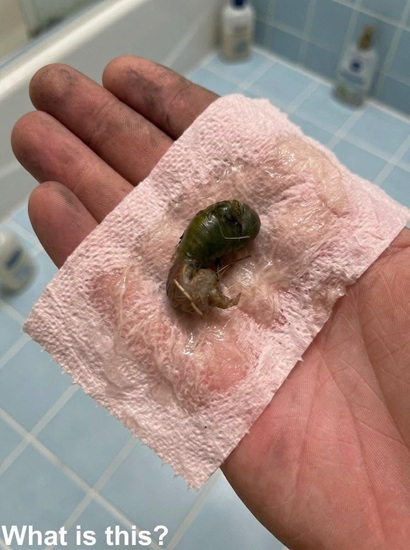
It started with something so small that, under normal circumstances, we probably would not have given it a second thought.
But there it was.
Right in the middle of the bathroom floor sat a bright green object neither my husband nor I immediately recognized.
It was smooth.
It looked slightly soft.
And because we had no idea where it had come from, my imagination immediately started working against me.
For a few moments, the bathroom no longer felt completely ordinary.
I simply wanted to know one thing.
What was it?
Our First Reaction Was Fear
My husband noticed the object too.
Neither of us wanted to touch it directly.
He eventually picked it up with a tissue while we examined it from a safe distance.
The more closely we looked, the less certain we became.
It was small enough to fit easily in his hand.
Its bright green color made it look artificial.
But its texture was unusual enough that I could not immediately rule out the possibility that it had once been alive.
That thought was enough to make the situation feel considerably more serious.
Was it some kind of insect?
A strange egg?
Something that had come through the drain?
The possibilities became more dramatic the longer we stared.
And we still had no answer.
I Asked My Sister the Next Morning
By the following day, curiosity had replaced some of the initial fear.
I took a photograph and sent it to my sister.
My message was simple.
What is this?
I expected her to recognize it immediately.
She did not.
Her uncertainty somehow made the mystery worse.
If another person looked at the same object and had no obvious explanation, perhaps we were not being ridiculous after all.
So I tried another approach.
I posted the photograph online.
That was when the theories really began.
Social Media Had Plenty of Ideas
Responses arrived quickly.
One person thought the green object might be a slug without a shell.
Another suggested that it could be sea glass.
Someone else thought it looked like an unusual soap sample.
Another commenter proposed that it might be some type of stone or geode-like object.
The suggestions were creative.
The problem was that none of them seemed completely convincing.
A slug might explain the soft appearance.
But the object did not look obviously alive.
Sea glass might explain the color.
But the texture did not seem right.
Soap was possible.
Still, why would a single piece of unfamiliar soap suddenly appear in the middle of our bathroom floor?
Every theory seemed to answer one question while creating another.
So the mystery continued.
The Object Did Not Behave Like a Stone
That was one of the first clues.
The green object looked solid from a distance.
But once we examined it more carefully, it did not have the hardness or weight I would have expected from glass or stone.
It was smoother.
Softer.
Almost waxy.
That made some of the more dramatic theories feel less likely.
But it also did not explain where the object had come from.
Our bathroom had not suddenly changed overnight.
There was no broken container nearby.
Nothing appeared to have leaked.
There were no obvious signs of insects or pests.
And the object remained alone.
That should have been reassuring.
Instead, my brain continued supplying increasingly strange possibilities.
Then I Called My Mother
Eventually, I sent the photograph to the person who often seems to recognize ordinary household things before anyone else.
My mother.
Her reaction was completely different from ours.
She laughed.
To her, the mystery was not much of a mystery at all.
She believed the object was a bath bead.
The kind designed to be dropped into warm bathwater, where the outer coating dissolves and releases scented oil.
According to her, it was probably something as simple as that.
I almost felt disappointed.
A bath bead?
After all the theories?
After wondering whether something had crawled out of a hidden corner?
The explanation seemed almost too ordinary.
Fortunately, it was also easy to test.
I Looked Under the Sink
That was the moment the entire mystery began falling apart.
Behind the bottles and other bathroom products was a small mesh bag.
Inside were colorful bath beads.
And among them were several bright green ones.
They looked exactly like the object we had found on the floor.
Same shape.
Same texture.
Same color.
There was no creature.
No mysterious stone.
No strange material coming from the plumbing.
The object was simply a bath product that had somehow escaped from the bag.
At least one mystery was solved.
But there was still another.
How had it ended up in the middle of the floor?
We Had Not Used the Bath Beads
That was what confused us.
Neither my husband nor I remembered opening the bag.
We had not taken one out.
We certainly had not left one lying on the bathroom floor.
So even after identifying the object, there was still a small gap in the story.
Someone had moved it.
Or something had.
For a brief moment, the mystery returned.
Then we started thinking about who else had been in the bathroom.
The answer was much closer to home.
Our Daughter Had Been Playing There
After a little household detective work, we remembered that our youngest daughter had been in the bathroom earlier.
She had apparently found the mesh bag.
Like many children faced with something colorful and unfamiliar, she had taken a closer look.
At some point, she removed one of the beads.
Then another distraction came along.
A cartoon.
A toy.
Something more interesting.
The green bead was dropped and forgotten.
Later, I walked into the bathroom without any of that context.
I saw only the mysterious object.
And my imagination filled in everything else.
Suddenly the entire story made sense.
Our Minds Had Done Most of the Scary Work
The object itself had never been particularly frightening.
What made it frightening was uncertainty.
I saw something unfamiliar.
I did not know where it came from.
So my brain tried to create explanations.
And the first explanations were not ordinary ones.
They were parasites.
Strange eggs.
Something from a drain.
Something alive.
Something potentially dangerous.
Only much later did “forgotten bath product” make the list.
That reaction is surprisingly common.
When people lack information, they naturally try to complete the picture.
Unfortunately, dramatic explanations are often easier to imagine than boring ones.
The Internet Can Make the Mystery Bigger
Posting an unidentified object online can be useful.
Someone may recognize it instantly.
But crowdsourcing can also produce dozens of competing explanations.
The unusual suggestions are often the ones people remember.
A simple piece of soap attracts little attention.
A strange creature gets everyone talking.
That does not mean people are deliberately being misleading.
They are often just making guesses based on a single photograph.
And a photograph does not always reveal texture, smell, weight or where the object was found.
Those missing details matter.
In our case, the most useful clue was not online at all.
It was sitting underneath the bathroom sink.
Context Changed Everything
When the green bead was isolated on the floor, it looked strange.
Inside a mesh bag filled with identical colorful beads, it looked completely ordinary.
Nothing about the object had changed.
Only the context had.
That was probably the biggest lesson from the entire experience.
Ordinary household objects can become surprisingly difficult to identify when removed from the place where we expect to see them.
A piece of soap can resemble something organic.
Dried glue can look like an insect nest.
Food can resemble a strange growth.
Mineral residue can look like eggs or mold.
The unfamiliar does not automatically mean dangerous.
Still, caution is sensible.
Unknown Objects Should Not Be Handled Carelessly
Our green object turned out to be harmless.
That does not mean every unidentified object should immediately be picked up with bare hands.
If something could be sharp, chemical, biological or alive, avoiding direct contact is the safer approach.
Children and pets should also be kept away until the object is identified.
Taking clear photographs can help.
Multiple angles are better than one.
Including something familiar for scale can make identification easier.
And before assuming the worst, checking nearby drawers, cabinets, shelves and containers can save a surprising amount of worry.
That was certainly true for us.
Look for Supporting Evidence
One unexplained object does not necessarily indicate a larger problem.
If an insect infestation is present, there may be repeated sightings, droppings, damage or other signs.
A plumbing issue may involve leaks, odors, stains or recurring material near drains.
A household product may have matching pieces nearby.
Looking at the wider environment can help distinguish between a genuine concern and an isolated mystery.
Our bathroom showed no evidence of anything unusual.
No damaged food.
No repeated objects.
No strange movement.
No leaks.
No unexplained smell.
There was simply one green item on the floor.
That should have been our first clue.
Sometimes Professional Help Is Appropriate
There are situations where guessing online is not enough.
If an unknown substance appears chemical, potentially toxic or repeatedly returns, professional advice may be necessary.
A plumber can investigate possible drain or water issues.
A pest-control professional can identify signs of insects or rodents.
Building management may need to investigate structural concerns.
And appropriate poison or emergency services can advise when an unidentified material could present a genuine risk.
The point is not to panic.
It is to match the response to the evidence.
Fortunately, our situation never reached that level.
We Did Not Need an Exterminator After All
There was no infestation.
There was no plumbing emergency.
There was no mysterious organism living under the floor.
The answer had been sitting a few feet away the entire time.
A small bag beneath the sink contained every clue we needed.
The bright green object was simply one of the scented bath beads that had fallen from it.
And the person responsible was not a mysterious intruder.
It was our daughter.
Once we knew that, the whole episode became funny.
The Scariest Explanation Was the One We Invented
Looking back, almost nothing about the original discovery was actually threatening.
The object never moved.
There were no additional signs of trouble.
Nothing else unusual appeared.
But because we could not identify it immediately, uncertainty turned an ordinary bathroom product into a miniature household mystery.
Our daughter had taken out the bead.
She dropped it.
She forgot about it.
Hours later, I found it without knowing any of those details.
The missing information allowed my imagination to do the rest.
And imagination can be remarkably convincing.
The Green Bead Became a Family Joke
Eventually, the strange object stopped being frightening altogether.
It became something we laughed about.
Whenever an unfamiliar household item appeared afterward, there was an obvious reference waiting to be made.
Maybe it was another “mysterious green creature.”
Maybe we should check beneath the sink first.
The joke stuck because the original fear had felt so real.
But the explanation had been almost comically simple.
That contrast made the story memorable.
The Answer Had Been Ordinary All Along
In the end, the biggest surprise was not what the object turned out to be.
It was how easily a missing piece of information changed our perception.
A green bath bead in a bag is completely unremarkable.
The same green bath bead sitting alone on a bathroom floor can suddenly become anything.
A pest.
A strange egg.
A piece of glass.
Something from the drain.
The object did not create the mystery.
The lack of context did.
And once that context returned, everything became obvious.
The bag was under the sink.
The matching beads were inside.
Our daughter had been playing nearby.
The strange object that had occupied our attention for so long had never been strange at all.
It was simply in the wrong place.
And sometimes, that is all it takes to turn something ordinary into a mystery.
