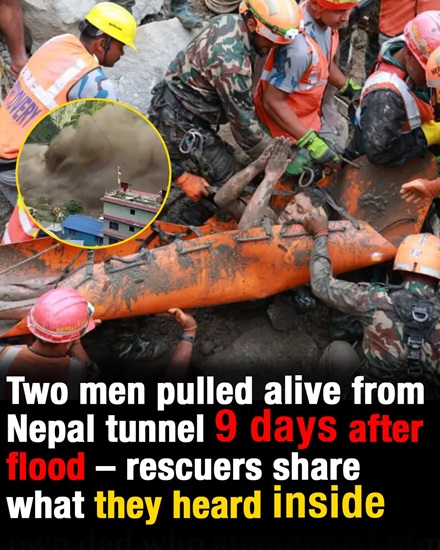
For days, rescue crews in Nepal had been pushing through mud, debris and damaged tunnels with no guarantee that anyone trapped inside was still alive.
The scale of the disaster was enormous.
Entire communities had been devastated.
Roads and bridges had disappeared.
Hydropower facilities had been overwhelmed.
And hundreds of workers were believed to be trapped inside underground structures.
Then, more than a week after the flooding began, rescuers received the kind of news families had desperately been waiting for.
Two workers were found alive.
And another remarkable rescue would soon follow.
The Disaster Began High in the Himalayas
The catastrophe struck on August 26, 2026, near Nepal’s border with China’s Tibet region.
A massive collapse involving ice, rock and mud sent a destructive surge into the river system below.
The resulting flash floods tore through the Trishuli River valley and surrounding areas.
Homes were destroyed.
Roads disappeared beneath mud and debris.
Bridges were swept away.

Several hydropower projects suffered catastrophic damage.
Satellite images and photographs from the affected region later showed entire sections of landscape transformed by the flood.
What had once been villages, roads and construction areas became wide stretches of gray debris.
But the danger above ground was only part of the emergency.
Hundreds of people were working underground.
Hydropower Tunnels Became Rescue Priorities
Nepal relies heavily on hydropower, and numerous projects in the affected Himalayan region include extensive underground tunnel systems.
When the flooding struck, water, mud and debris entered some of those structures.
Workers suddenly found themselves trapped.
By the end of August, Nepalese authorities believed more than 900 hydropower workers were missing across damaged projects, with hundreds potentially trapped underground.
That created a particularly difficult rescue challenge.
The tunnels were dark.
Some were flooded.
Others were blocked by thick mud, rock and collapsed material.
Heavy machinery could only reach certain areas.
And rescuers had to work while remaining alert to the possibility of further landslides or flooding.
International teams began joining Nepalese crews.
Experts from India, China, South Korea and other countries brought equipment and specialized experience.
Still, progress was painfully slow.
Then came a breakthrough.
Two Men Were Found Alive Nine Days Later
On September 4, rescue teams reached two workers trapped inside a tunnel connected to the Upper Trishuli 3A Hydropower Station.
They had survived for nine days.
The men were identified in reports as Sanjay Sah and Kabir Maharjan.
They were discovered approximately 170 meters inside the tunnel.
Both were alive.
The rescue immediately renewed hope that other workers might also have survived inside pockets protected from the floodwaters.
The men were taken for medical treatment after being brought out.
Reports indicated that Sah’s injuries were not considered critical.
For families waiting outside damaged hydropower sites, the rescue offered something that had become increasingly difficult to hold onto.
Proof that survival was still possible.
But the operation was far from finished.
Rescuers Were Still Searching Deeper Inside
Teams continued working through mud and obstructions inside multiple hydropower facilities.
At several locations, progress could be measured in meters.
Indian specialists deployed to the Chilime area encountered tunnels with deep mud and difficult access conditions.
Chinese and Nepalese teams were also searching damaged hydropower sites.
Excavators, controlled blasts and specialized equipment were used to clear blocked passages.
The work was dangerous.
A tunnel that appeared stable could still contain unstable debris.
Water could remain trapped behind blockages.
And rescuers had little certainty about what they would find farther inside.
In some locations, hopes were raised by reports of possible voices.
But every meter had to be approached carefully.
The Human Toll Continued to Rise
While rescuers concentrated on tunnels, the wider disaster continued producing devastating numbers.
By early September, more than 1,300 deaths had been reported in Nepal.
Thousands of people remained missing.
Foreign nationals were among those still unaccounted for.
Across the border in Tibet, Chinese authorities also reported deaths and hundreds of missing people.
Identification became another major challenge.
Some bodies had been carried long distances by floodwaters.
Others were recovered after remaining in mud or water for days.
In cases where visual identification was no longer possible, authorities began relying on DNA samples and other forensic methods.
Families were asked to provide information that could help identify relatives.
For many, waiting for confirmation became another form of anguish.
Yet inside the damaged tunnel network, rescuers kept searching.
And one day after Sah and Maharjan were brought out, another extraordinary discovery was made.
A Third Worker Was Still Alive
On September 5, rescuers reached another survivor.
This time, the man was a Chinese worker named Lu Haitao.
He had been trapped in a tunnel at the Upper Trishuli-1 Hydropower Project.
Lu was found roughly 225 meters inside the tunnel.
He had survived for around ten days.
After being brought out, he was reported to have mild hypothermia but was otherwise in stable condition.
He was taken to hospital for treatment.
His survival was remarkable.
And it reinforced the possibility that underground spaces could have protected some workers from the initial flood.
For rescue teams, that possibility mattered enormously.
Every newly reached section could potentially contain another survivor.
Another Survivor Was Found Away From the Tunnels
The same period produced another unexpected rescue.
A Nepalese woman was found alive after spending days trapped in debris in Nuwakot.
She too was taken for medical treatment.
After more than a week of grim recovery operations, finding survivors offered rare moments of hope.
But those individual successes did not reduce the scale of the catastrophe.
Hundreds of hydropower workers were still unaccounted for.
Thousands of families across Nepal were still searching for relatives.
And entire communities faced years of rebuilding.
The Flood Destroyed More Than Homes
Early government assessments estimated economic losses from the disaster at roughly 387.5 billion Nepalese rupees, equivalent to about $2.56 billion.
Thousands of homes were destroyed.
Many more were damaged badly enough to require rebuilding.
Power infrastructure, roads, bridges and commercial facilities were also affected.
Hydropower was hit particularly hard.
That matters because Nepal’s river systems are central to the country’s electricity production and its growing energy sector.
Some damaged facilities had been under construction.
Others were already operating.
In both cases, underground tunnels became some of the most dangerous places when the flood arrived.
Survivor accounts describe just how quickly conditions changed.
One Worker Described Fighting Through Darkness
Dhan Bahadur Tamang was working at the Upper Trishuli-1 project when the flood struck.
He later described being caught inside an underground tunnel as water surged through the structure.
He survived by holding onto pipes and eventually moving through darkness with other workers as the water level changed.
The group had only limited light.
They stayed close together while trying to find a way out.
Eventually they reached daylight.
Tamang survived with injuries.
Others around him did not.
His account illustrates why rescuers believe some people could have survived in protected sections deeper underground.
But it also demonstrates how little time workers had to react.
The flood arrived with devastating force.
The Exact Trigger Remains Important
Early reports described a glacier collapse or a large collapse involving ice, rock and debris in the Himalayan border region.
Scientists and authorities have continued examining the precise sequence that produced the flood.
Because high-altitude disasters can involve several connected processes, it is important not to simplify the event beyond what investigators have established.
What is clear is that a huge mass of ice, rock and mud entered the river system and produced a destructive downstream surge.
Researchers have also warned for years that Himalayan communities face growing risks associated with unstable glaciers, glacial lakes and rapidly changing mountain conditions.
But assigning the exact cause of an individual disaster requires detailed scientific analysis.
For the rescue teams in Nepal, however, the immediate priority remains much simpler.
Find people.
Every Survivor Changes the Search
After nine days underground, Sanjay Sah and Kabir Maharjan were brought back into daylight.
A day later, Lu Haitao followed.
Three men.
Three families given news that many others are still waiting to hear.
The rescues do not erase the enormous loss surrounding them.
More than 1,300 people have died.
Thousands remain missing.
And hundreds of hydropower workers are still among those rescue crews are trying to locate.
But the tunnel rescues changed one crucial assumption.
More than a week after the flood, being missing did not automatically mean there was no hope.
Some people had found pockets where they could survive.
Some had endured darkness, injuries and isolation.
And rescuers were still reaching places that had been inaccessible for days.
That is why teams continue moving deeper.
Behind each wall of mud or debris could be another empty section.
It could contain only evidence of what happened.
Or it could contain something completely different.
Another person waiting to hear rescuers approaching from the other side.
