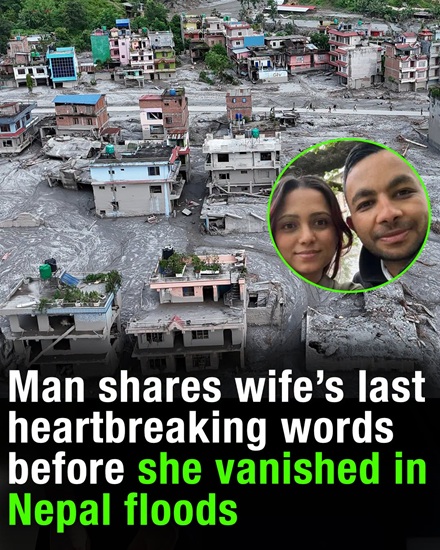
His Last Call With His Newlywed Wife Came Hours Before Nepal’s Catastrophic Flood
Pramod Poudel could not have known that an ordinary phone call with his wife would soon become one of the most painful memories of his life.
They spoke on the morning of August 26.
His wife, Sumitra, was in Nepal.
Pramod was thousands of miles away in Britain.
Their conversation was brief and affectionate.
Nothing suggested what was about to happen.
Then the mountains gave way.
Within hours, a catastrophic flood carrying water, rock, ice and mud tore through the Nepal-China border region and into communities below the Himalayas.
Villages were overwhelmed.
Roads disappeared.
Bridges were destroyed.
And communication with entire communities suddenly stopped.
For Pramod, four people were missing.
His wife.
His mother.
His brother.
And his uncle.

The search that followed would take him from East Sussex back to the country where he was born.
But even reaching his home village became a struggle.
A Disaster That Arrived With Terrifying Speed
The flood struck Nepal’s Rasuwa district on August 26, 2026.
The International Centre for Integrated Mountain Development reported a sudden surge of water, sediment and boulders moving through the Bhote Koshi and Trishuli river systems.
Water levels in the Bhote Koshi basin began rising rapidly that morning.
The disaster caused severe damage to communities and critical infrastructure along the river corridor.
What initially appeared on seismic instruments to resemble an earthquake was later linked to a massive glacial and debris collapse.
The event sent enormous quantities of material downhill.
The force was devastating.
Homes were destroyed.
Roads were blocked.
Bridges vanished.
Hydropower installations were buried or damaged.
And areas that were already difficult to reach became almost inaccessible.
The disaster was not simply a flood.
It was a fast-moving mass of water, mud, rock and ice.
And many people had very little warning.
The Scale Continued Growing
In the first hours, the reported death toll was already severe.
But the numbers continued rising as rescue teams reached more communities.
By September 4, Nepalese authorities were reporting more than 1,250 deaths and over 4,200 people still missing.
Thousands had also been displaced.

Damage to homes, roads, electricity systems and other infrastructure was extensive.
Official estimates placed property and infrastructure losses in Nepal at approximately $2.56 billion.
The country was facing not only a rescue operation but the beginning of a massive recovery effort.
Yet for thousands of families, rebuilding was not the first question.
Finding missing relatives was.
Pramod Poudel was one of them.
Four Members of One Family Disappeared
Pramod Poudel, 34, lives in Uckfield in East Sussex.
He was born in Nepal and later moved to Britain.
There, he runs the MoMo Nepalese Street Food business.
His wife, Sumitra, was 25.
The couple had married only a short time before the disaster.
She remained in Nepal while Pramod returned to Britain for work.
Then came August 26.
After the flood struck, Pramod was unable to contact Sumitra.
His mother, Tulasa, was also missing.
So was his brother, Pradip.
And his uncle, Madhav.
The family’s village of Sole had been badly damaged.
Pramod initially estimated that around 90 percent of it had been swept away.
Videos emerging from the area showed destruction so extensive that he struggled to recognize the place where his family had lived.
But watching videos from Britain was not enough.
He needed to go back.
“My Family Needs Me”
Within a day of the disaster, Pramod made the decision to return to Nepal.
He told British media that he needed to see what had happened and be with his family.
The decision sounded simple.
The journey was not.
Destroyed bridges and blocked roads made many affected areas difficult or impossible to reach by vehicle.
Electricity and phone service had also failed across parts of the disaster zone.
That meant people searching for relatives faced two separate problems.
They could not easily reach the affected communities.
And they could not easily contact anyone inside them.
Pramod flew to Nepal.
Then he began trying to move closer to Sole.
The journey eventually required long stretches on foot through mountainous terrain.
Every kilometer brought him closer.
But not necessarily closer to an answer.
Nothing Looked the Same
When Pramod finally reached areas near the village, the scale of the destruction became more visible.
The landscape he remembered had changed.
Homes were gone.
Bridges that had once connected communities had been washed away.
Mud and debris covered the ground.
River channels had widened or shifted.
The flood had not merely damaged buildings.
In places, it had erased familiar landmarks.
ITV later reported that Pramod was with his father, the surviving member of his immediate family who could be located.
His wife, mother, brother and uncle were still missing and feared dead.
The uncertainty was becoming harder to carry.
But one memory remained exceptionally clear.
The last phone call.
The Last Conversation With Sumitra
Pramod had spoken with his wife shortly before the disaster.
He later recalled that Sumitra asked how he was doing and told him that she loved him.
It was a normal exchange between newlyweds separated by distance.
There was no warning that it might be their final conversation.
Hours later, the flood struck.
Pramod could no longer reach her.
No calls.
No messages.
No confirmed sighting.
At first, he spoke publicly about remaining hopeful.
He wanted to believe that Sumitra and his relatives might have survived somewhere beyond the destroyed communication networks.
That possibility was not entirely irrational.
People were still being found alive days after the disaster.
But as the search continued, hope became harder to maintain.
Survivors Were Still Being Found
The devastation produced remarkable survival stories.
Several people were later rescued from tunnels at damaged hydropower sites.
One Nepali foreman survived for nine days after becoming trapped at the Upper Trishuli 3A Hydropower Station.
He had remained behind to help others escape before becoming trapped himself.
Other survivors were also found after extended periods amid mud and debris.
Those rescues demonstrated how difficult it was to know who might still be alive.
They also gave families a reason not to abandon hope too quickly.
But every passing day changed the calculation.
For Pramod, the uncertainty became increasingly painful.
His relatives had not made contact.
No confirmed rescue had brought their names.
And access to some damaged areas remained extraordinarily difficult.
A Village Almost Erased
Sole was more than a location on a map for Pramod.
It was where he had grown up.
His family lived there.
His memories were tied to it.
After the flood, large parts of that physical history were gone.
Media reports described the village as having suffered overwhelming destruction.
Homes had disappeared.
Residents were missing.
Families were scattered.
The loss extended beyond individual buildings.
When a small community is destroyed, neighbors lose the physical places that connect their lives.
Homes.
Paths.
Shops.
Meeting places.
Family land.
All can disappear within minutes.
For someone returning after years abroad, the contrast can be almost impossible to absorb.
The place is familiar.
And yet nothing looks familiar.
Rescue Work Faced Enormous Obstacles
The flood hit a region where geography already makes emergency response challenging.
Steep mountains surround narrow valleys.
Roads often follow rivers.
Bridges are essential for connecting communities.
When those bridges fail, entire areas can become isolated.
Heavy mud and debris can also make ordinary rescue vehicles useless.
Helicopters become crucial.
So do specialized teams capable of searching collapsed structures, tunnels and riverbanks.
Nepal appealed for international assistance as the scale of the catastrophe became clearer.
Rescue teams searched damaged hydropower projects.
Forensic teams worked to identify bodies.
Authorities collected DNA samples from unidentified victims.
Families gathered at identification centers.
Each hoped not to recognize a loved one.
Yet they also desperately wanted certainty.
That contradiction is one of the cruelest parts of a disaster involving thousands of missing people.
Not knowing can become its own form of suffering.
Hydropower Workers Were Among the Missing
The flood also struck major hydropower facilities along the Trishuli River.
Hundreds of workers were believed to have been trapped or missing at multiple projects.
Some had taken shelter in tunnels.
Others were caught when the flood buried facilities under mud, rock and ice.
Rescuers attempted to reach those underground spaces while considering air supply, clean water and structural stability.
The tunnels offered a strange possibility.
They could become traps.
But they could also provide shelter from the destruction outside.
That possibility later proved real when survivors were found.
For families elsewhere in the disaster zone, each successful rescue offered another reason to keep waiting.
One Warning Saved Hundreds of Students
Not everyone had time to escape.
But in one remarkable case, hundreds of students did.
At Tribhuvan Trishuli Secondary School in Bidur, headmaster Rajendra Dawadi received a warning that floodwater was coming.
There was little time.
He ordered an evacuation.
More than 900 students and staff escaped to higher ground before the school was destroyed.
The warning reportedly gave them only minutes to act.
Their survival shows how important early information can be during a flash flood.
A phone call.
An alarm.
A decision made quickly enough.
Sometimes those minutes separate survival from tragedy.
Pramod’s family appears to have had no such opportunity.
Entire Families Were Left Waiting
Pramod’s experience was repeated in different forms across Nepal.
Families searched hospitals.
They checked survivor lists.
They traveled to identification centers.
They contacted authorities.
Some walked toward inaccessible villages.
Others waited beside phones that remained silent.
The disaster affected Nepalese residents, hydropower workers and foreign visitors.
Tourists and pilgrims were among those initially listed as missing.
Some later contacted authorities after being stranded without communications.
That created brief moments of relief.
But thousands of other names remained unresolved.
Each number in the missing-person total represented a separate family waiting.
The statistics were huge.
The grief was individual.
The Search Gradually Became a Recovery Operation
In the first days after a disaster, rescue dominates.
Teams look for survivors.
Every sound beneath debris matters.
Every possible air pocket matters.
But as time passes, the operation changes.
Authorities must also recover and identify the dead.
Nepal’s morgues became overwhelmed by the number of bodies recovered after the flood.
Some unidentified victims were temporarily buried after DNA samples and identifying information were collected.
The decision was emotionally difficult.
For many families, proper funeral rites carry enormous cultural and religious importance.
But authorities were also dealing with limited storage and rapidly deteriorating remains.
The situation illustrated the enormous logistical burden created by a disaster of this scale.
Even death became difficult to manage.
Pramod’s Hope Began to Fade
In his earliest interviews, Pramod continued saying that he hoped his family would be found.
Days later, after reaching Nepal and trying to search the affected area, his outlook had changed.
Reports described him as increasingly fearful that Sumitra and his relatives had not survived.
He had traveled thousands of miles.
He had crossed difficult terrain.
He had reached the devastated region.
But he still had no confirmation of where they were.
That absence of information was becoming an answer he did not want.
Still, without formal identification, uncertainty remained.
And uncertainty keeps families searching.
Their Marriage Had Barely Begun
One detail makes the story especially painful.
Pramod and Sumitra had married only months earlier.
They had expected to be building a life together.
Instead, work temporarily separated them.
Pramod returned to Britain.
Sumitra stayed in Nepal with his family.
Nothing about that arrangement was supposed to be permanent.
Then came the flood.
The final call between them became something completely different in retrospect.
Words that would normally be forgotten became unforgettable.
A simple expression of love became the last known message from his wife.
That is often how disaster changes memory.
Ordinary moments become permanent.
Why This Flood Became So Destructive
The source of the disaster was linked to a major glacial collapse high in the Himalayan region.
The resulting mass of ice, rock and debris moved downhill and entered river systems.
Once a large volume of material enters a narrow valley, the destructive potential can increase rapidly.
Water carries boulders.
Mud becomes dense and powerful.
Debris strikes buildings and bridges.
River levels rise.
And downstream communities may have only minutes to respond.
ICIMOD warned immediately after the disaster that debris blocking river systems could also create additional hazards downstream.
In mountain environments, the first flood is not always the final danger.
Debris dams can form.
Water can accumulate behind them.
If those barriers fail, another surge can follow.
That made rescue work even more dangerous.
The Himalayas Are Changing
Scientists have repeatedly warned about growing risks associated with glaciers and glacial lakes across the Hindu Kush Himalaya.
Warming temperatures can contribute to glacier retreat and changing glacial systems.
That does not mean every individual disaster can be attributed to climate change through one simple statement.
Specific events require scientific analysis.
But the wider region is experiencing significant cryosphere change.
And communities downstream can face serious hazards when ice, water and unstable rock interact.
The August 26 disaster became another reminder of how destructive those mountain processes can be.
The people living below them often have very little time.
Rebuilding Will Take Years
The immediate search will eventually end.
The longer recovery will not.
Nepalese officials estimated losses from the flood at roughly $2.56 billion by September 4.
At least thousands of homes were destroyed or damaged.
Roads need reconstruction.
Power infrastructure needs repair.
Water systems need restoration.
Schools need rebuilding.
Displaced families need temporary shelter before permanent homes can even be considered.
The physical reconstruction may take years.
The emotional recovery may take longer.
For families like Pramod’s, rebuilding begins with a more basic need.
Knowing what happened to the people they love.
One Family Inside a Much Larger Disaster
It is easy to become numb when disaster statistics reach the thousands.
1,000 dead.
4,000 missing.
Thousands displaced.
Billions of dollars in damage.
The numbers become difficult to imagine.
Pramod’s story gives them a human scale.
Four missing relatives.
One wife.
One mother.
One brother.
One uncle.
One man traveling from Britain back to the mountains where he grew up.
One final phone call that he never expected to remember forever.
That does not make his grief more important than anyone else’s.
It makes the scale of the wider disaster easier to understand.
Every missing name belongs to someone.
And Still, Families Wait
As rescue and recovery operations continue, Nepal remains in the difficult period between catastrophe and rebuilding.
Some survivors have returned.
Others have been found after extraordinary periods underground.
Many families have received devastating confirmation.
Thousands of others are still waiting.
Pramod Poudel’s family remains part of that uncertainty in the latest detailed reports about his search.
His wife Sumitra, mother Tulasa, brother Pradip and uncle Madhav were still missing and feared dead after the flood devastated Sole.
The last known words Pramod remembers from Sumitra were simple.
She asked how he was.
Then she told him she loved him.
Nothing dramatic.
Nothing that sounded like goodbye.
And perhaps that is what makes the memory so difficult.
For them, it was supposed to be just another phone call.
Hours later, almost everything had changed.
