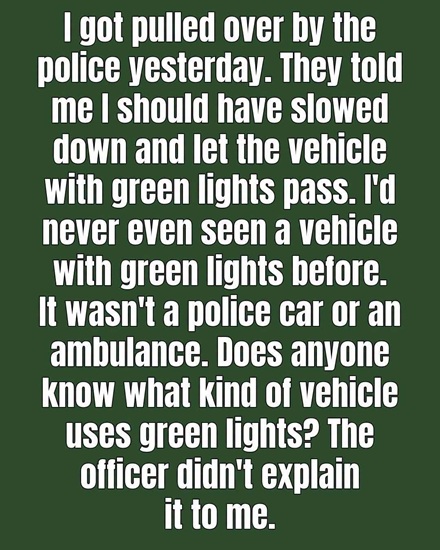
What Does a Flashing Green Light on a Car Really Mean?
A flashing green light on an ordinary-looking vehicle can easily catch a driver’s attention.
It may look unusual, especially if there is no police marking, ambulance design, fire department logo or other obvious sign that the vehicle is connected to emergency response.
That can lead to an immediate question.
What exactly does the green light mean?
The answer is more complicated than a single universal definition.
A flashing green light can identify certain emergency responders in some jurisdictions, but the rules are determined locally. A meaning that applies in one province, state or country should not automatically be assumed to apply somewhere else.
Ontario provides a useful example of why that distinction matters.
In Ontario, the Green Light Has a Specific Purpose
Under Ontario’s Highway Traffic Act, a firefighter may carry and operate a lamp producing intermittent flashes of green light while proceeding to a fire or another emergency.
The law also allows prescribed classes of volunteer medical responders to use flashing green lights under specific circumstances.
That may sound simple.
But there is an important detail.
The vehicle itself may look completely ordinary.
A volunteer firefighter responding in a personal car does not necessarily arrive in the large red fire engine people normally associate with an emergency response.
From the outside, the vehicle may resemble any other car on the road.
The flashing green light helps make its purpose visible.
And that is where understanding the signal becomes useful.
Why Would a Responder Use a Personal Vehicle?
Emergency response does not always begin when a fire truck or ambulance leaves a station.
In some communities, firefighters or authorized volunteer responders may need to travel from their current location toward an emergency, fire station or other required destination.
Their personal vehicle may therefore become part of the early stages of the response.
Without a recognizable signal, surrounding motorists would have little reason to know that the driver is responding to an emergency.
A flashing green light provides that additional information.
It tells other road users that the vehicle may be connected to an authorized emergency response.
But it does not turn the vehicle into something with unlimited privileges.
That distinction is essential.
A Green Light Is Not a License to Ignore Traffic Rules
Seeing a flashing green light should not be interpreted as evidence that the driver can automatically disregard every normal traffic requirement.
Ontario’s rules authorize particular people to operate these lights in specified circumstances.
The light communicates the responder’s role and helps other motorists recognize that cooperation may be useful.
It is not a reason for other drivers to panic.
It is also not a reason to make a dangerous maneuver.
The safest response begins with something much simpler.
Remain predictable.
What Should Another Driver Do?
Ontario’s official driver’s handbook notes that some firefighters and volunteer medical responders may display a flashing green light while using their own vehicles to respond to a fire or medical emergency.
The handbook asks motorists to yield the right-of-way to help them respond quickly and safely.
The final word matters just as much as the first.
Safely.
If there is a safe opportunity to allow the vehicle to proceed, creating space can help the responder continue toward the emergency.
But cooperation should not mean suddenly swerving across lanes, stopping somewhere dangerous or entering an intersection without checking surrounding traffic.
One emergency should not create another.
Stay Calm Before Making Space
Imagine noticing a green flashing light approaching from behind.
The first reaction should not be an abrupt steering movement.
Check the mirrors.
Observe nearby vehicles.
Look for cyclists, pedestrians and traffic approaching from other directions.
Signal appropriately if a lane change is necessary.
Then make room when it can be done safely.
Predictable driving gives everyone around you more time to understand what is happening.
That includes the responder.
A few seconds of calm awareness can be more helpful than a dramatic maneuver.
Not Every Green Light Means the Same Thing Everywhere
This is perhaps the most important part of the subject.
Green warning lights do not have one worldwide meaning.
Vehicle-lighting laws vary between jurisdictions.
A driver who learned what a flashing green light means in Ontario should not assume the identical rule exists in another Canadian province, a U.S. state or another country.
Different authorities can reserve colors for different categories of vehicles or services.
Some uses may require authorization.
Others may be prohibited entirely.
That is why explanations online should include the jurisdiction instead of presenting one local rule as a universal fact.
The color alone does not tell the whole story.
Ontario Also Restricts Who May Use the Light
Ontario law does more than describe who can use a flashing green light.
It also restricts its operation to authorized categories.
The Highway Traffic Act identifies firefighters proceeding to a fire or another emergency.
Ontario regulations additionally identify specific volunteer medical responders who may use flashing green lights under defined circumstances.
Those circumstances are not unlimited.
For example, the regulation covers specified medical responders while responding to certain medical emergency calls, transporting a patient at the request of a government or government agency, or performing duties assigned through a municipal emergency plan.
The regulation currently identifies members of Hatzoloh Toronto and St. John Ambulance within the applicable volunteer medical responder category.
There is another requirement as well.
While using the flashing green light under those provisions, an eligible volunteer medical responder must carry the required membership identification and provide it for inspection when lawfully requested.
So the light is not simply a decorative accessory.
Its legal use is tied to authorization and circumstances.
What the Green Light Does Not Tell You
A flashing green light can provide useful information.
But it provides only limited information.
It does not reveal the medical condition of another person.
It does not tell you whether someone inside the vehicle is seriously injured.
It does not indicate that a passenger receives dialysis or has a particular illness.
It does not even necessarily mean a patient is inside the vehicle.
In Ontario, a firefighter may be traveling toward a fire or another emergency.
An authorized medical responder may be traveling toward an emergency rather than transporting a patient.
Trying to infer personal medical details from the light therefore goes far beyond what the signal actually communicates.
The safer interpretation is much narrower.
An authorized responder may be trying to reach an emergency.
That is enough information for another driver to act responsibly.
It Is Different From Seeing a Traditional Emergency Vehicle
A marked ambulance, police vehicle or fire truck is usually easy to identify.
Its shape, markings, lighting and equipment often make its function immediately obvious.
A private vehicle is different.
It might be a sedan, pickup truck, SUV or another ordinary passenger vehicle.
That visual difference explains why the green signal can matter.
It fills an information gap.
The surrounding traffic sees an otherwise normal vehicle but receives a visible indication that its driver may be responding in an authorized capacity.
The signal does not need to reveal every detail.
It only needs to help other road users recognize the situation.
Buying a Light Does Not Automatically Make Its Use Legal
Emergency-style lights are widely available as physical products.
That does not mean anyone who purchases one is automatically allowed to use it on public roads.
The legal question is not simply whether a person owns the equipment.
It is whether local law authorizes that person, vehicle and use.
In Ontario, flashing green lights are specifically restricted by law.
Anyone considering installing or operating emergency-style lighting should therefore check the applicable legislation and official transportation guidance rather than relying on a product description or a social-media post.
What can be purchased and what can legally be displayed are two different questions.
The Situation Matters Too
Authorization may also depend on what the responder is doing at that moment.
Ontario law, for example, refers to firefighters using the light while proceeding to a fire or another emergency.
The rules for the specified volunteer medical responders similarly describe defined situations in which the green light may be used.
This is another reason broad claims can be misleading.
The existence of the light does not mean the same authorization applies at every moment of a responder’s day.
Legal permission can depend on the response activity itself.
The details matter.
Why Cooperation Can Still Make a Difference
When another driver safely creates space, the benefit may appear small.
Perhaps the responding vehicle gains only a few moments.
But emergency response is built from many small actions.
A clear lane.
A predictable merge.
A motorist who notices the signal.
Another driver who avoids blocking an intersection.
None of these actions requires panic or speculation.
They require awareness.
That is ultimately what the green light is trying to create.
The Best Response Is Awareness, Not Guesswork
If you encounter a flashing green light, first recognize that its legal meaning depends on the location.
If you are in Ontario, official guidance explains that some firefighters and volunteer medical responders may use flashing green lights while responding in their own vehicles.
Motorists are encouraged to yield the right-of-way so they can respond quickly and safely.
That does not mean abandoning normal caution.
Look around.
Stay predictable.
Create space when it is safe.
And avoid inventing details about the emergency that the light cannot possibly reveal.
There may be a fire.
There may be a medical call.
There may be another qualifying emergency.
The driver beside you does not need to know which one.
The important information is already visible.
Someone authorized to use that signal may be trying to get where they are needed.
And sometimes the most useful thing another motorist can do is surprisingly simple: notice the light, understand its purpose, and safely make room.
