The Hidden Face in This Vintage Optical Illusion Is Harder to Spot Than It Looks
Have you ever looked at an image for several seconds and felt completely certain that you understood what you were seeing?
Then, suddenly, someone points out one hidden detail.
And the entire picture changes.
That is part of what makes optical illusions and hidden-image puzzles so entertaining.
They take an ordinary-looking scene and arrange its shapes, shadows, lines, and spaces in a way that allows more than one interpretation.
At first, the obvious scene usually wins.
You notice the people.
You notice the landscape.
You notice the large objects.
Your attention settles into a familiar interpretation.
But there may be another image hiding inside the first one.
And once you finally recognize it, it can become surprisingly difficult to stop seeing it.
That is exactly what makes this vintage-style illustration so intriguing.
At first glance, nothing seems especially mysterious.
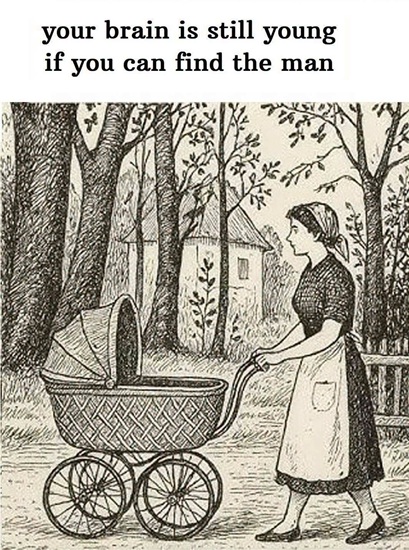
The drawing appears to show a quiet outdoor setting.

A woman is walking through a park-like or countryside landscape.
She appears to be pushing a baby stroller.
Trees surround the path.
Branches stretch across the scene.
Shadows create darker regions in the background.
The composition feels calm and ordinary.
For many viewers, that is where the first interpretation ends.
Woman.
Stroller.
Trees.
Landscape.
Nothing more.
But the picture has another layer.
Somewhere within the arrangement of the background is the suggestion of a man’s face.
And that is where the puzzle really begins.
The First Look Can Be Misleading
When people first examine a picture, they usually do not analyze every line separately.
The brain rapidly organizes visual information into recognizable objects and scenes.
That process helps us make sense of the world efficiently.
In everyday life, this is extremely useful.
You do not need to consciously study every edge of a chair before recognizing that it is a chair.
You do not need to inspect every leaf individually before recognizing a tree.
You see the overall pattern.
Then your brain makes sense of it.
Hidden-image puzzles take advantage of that tendency.
They encourage one interpretation first.
Then they hide another interpretation inside the same collection of shapes.
That second interpretation may remain unnoticed until attention shifts.
This is why a viewer may stare directly at the hidden feature without consciously recognizing it.
The eyes may already be looking at the correct area.
The challenge is interpreting what is there.
And that is an important distinction.
It Is Not a Medical Test
Some versions of visual puzzles are promoted with dramatic titles.
“Young eyes will see it instantly.”
“Only geniuses can find the hidden man.”
“People over 40 cannot spot this.”
Those statements may make a puzzle sound more exciting.
They should not be treated as scientific conclusions.
A recreational hidden-image puzzle cannot determine someone’s intelligence.
It cannot diagnose eyesight problems.
It cannot measure brain health.
And it cannot reliably determine someone’s age from how quickly they find an image.
Many ordinary factors can influence whether someone notices the hidden detail.
The size of the picture matters.
Image quality matters.
Screen brightness can matter.
Contrast matters.
How far someone is sitting from the screen can affect perception.
Previous experience with similar puzzles can help.
So can knowing that a face is present before looking.
Even the first object that catches someone’s attention can influence what happens next.
That makes the challenge fun.
It does not make it clinical.
What Do You See First?
Look at the scene without searching for anything.
What immediately attracts your attention?
For many people, it will probably be the woman.
Human figures naturally stand out in visual scenes.
The stroller may also draw attention because it forms a recognizable object with a clear outline.
The path and trees then provide the environmental context.
Your brain begins building a simple explanation.
A woman is taking a walk.
She is pushing a stroller.
She is outdoors.
Once that interpretation becomes established, everything else tends to be understood as part of the landscape.
A dark patch becomes shade.
A curved line becomes a branch.
A light area becomes open sky.
A cluster of shapes becomes foliage.
But that initial interpretation is not the only possible one.
And here comes the trick.
Search the Background, Not the Main Subject
The hidden man is not presented like a conventional portrait.
There is no neatly drawn face sitting openly beside the woman.
Instead, facial features are suggested through other parts of the illustration.
Lines that appear to belong to trees may also help define facial contours.
Shadows may form part of an eye or cheek.
Open areas between objects can contribute to the shape of the face.
This means the hidden image may not become obvious while you are concentrating on the central subject.
Your attention has to move away from the woman.
Look toward the broader scene.
Pay attention to the spaces between objects.
Notice where light and dark regions meet.
Then look again.
You may begin to see something that was not obvious before.
Do Not Search for a Perfect Portrait
One reason hidden faces can be difficult to notice is that people often search for a fully detailed human face.
Two clear eyes.
A nose.
A mouth.
A complete outline.
That may not be what the illusion contains.
Instead, the face may be suggested by only a few essential features.
The human visual system is remarkably good at detecting face-like patterns.
Sometimes only a rough arrangement of shapes is enough.
This is why people occasionally see faces in clouds, rock formations, tree bark, building facades, or other ordinary objects.
The broader phenomenon is commonly called pareidolia.
In a deliberately designed illusion, however, the face-like structure is intentionally incorporated into the artwork.
That changes the challenge.
The artist expects you to see two things.
The ordinary scene first.
The hidden image later.
The moment between those two interpretations is the entire point.
Look at the Negative Space
A useful way to approach this drawing is to stop looking only at the objects.
Look at the empty spaces too.
Visual artists often call the space surrounding or between objects negative space.
In ordinary viewing, people tend to focus primarily on the objects themselves.
But negative space can also create recognizable forms.
The gap between branches might help define a forehead.
A pale section between darker shapes could contribute to an eye.
The outline formed by two unrelated objects might resemble a nose.
Several small clues can combine into something much larger.
At first, each clue seems meaningless.
Then the pieces connect.
And suddenly the face appears.
Try Looking at the Whole Image
Another common mistake is examining the picture too closely.
When you zoom in too far, you may see individual lines very clearly.
But you can lose the overall arrangement.
Hidden-image puzzles often work best when multiple shapes are viewed together.
That means stepping back can sometimes help.
If you are looking on a phone, hold it slightly farther away.
If you are viewing the picture on a computer screen, lean back a little.
Do not strain.
Simply allow the image to become slightly smaller in your visual field.
Sometimes the hidden pattern becomes easier to recognize when details merge into larger shapes.
But not always.
And that is part of the challenge.
Try a Different Angle
Another harmless strategy is to change your viewing angle slightly.
Tilt your head.
Move the device a little.
Change the distance.
Look briefly away and then return.
These actions do not magically improve eyesight.
They simply interrupt your first interpretation of the picture.
Once your visual attention resets, you may notice a different pattern.
Sometimes the most useful step is not looking harder.
It is looking differently.
Your First Interpretation Can Become “Sticky”
Once the brain settles on an explanation for an image, that interpretation can become difficult to abandon.
You may continue seeing branches as branches.
Shadows remain shadows.
Nothing seems unusual.
Then another person points out a single feature.
Perhaps an eye.
Perhaps the outline of a forehead.
Perhaps the location of the nose.
Suddenly the hidden image begins to organize itself.
The same lines have not changed.
The drawing has not changed.
Your interpretation has.
And after that happens, the illusion can almost feel unfair.
The face may suddenly seem obvious.
You might even wonder how you missed it.
That reaction is one of the most enjoyable parts of hidden-image puzzles.
Do Not Worry About Speed
Some viewers may recognize the face very quickly.
Others may need much longer.
Neither response says anything definitive about intelligence.
People search images differently.
Some begin with the center.
Others scan from left to right.
Some focus on faces immediately.
Others concentrate on recognizable objects.
People who frequently solve optical illusions may also know what kinds of visual tricks to look for.
Experience changes strategy.
Strategy changes speed.
So there is no meaningful reason to compare your result with someone else’s as though it were an exam.
The puzzle is more interesting when it is treated as a small experiment in perception.
Give Yourself Another Look
Return to the illustration.
This time, intentionally ignore the woman and stroller.
Let them become background information.
Now examine the trees.
Look at the darker masses.
Look at the boundaries created by the trunks and branches.
Look at unusual curves.
Look for areas that could resemble the basic structure of a face.
Do not search for every feature at once.
Find one.
Then allow the rest of the pattern to develop around it.
That can be much easier.
Start With the Eyes
Faces are often recognized most quickly from the general arrangement of the eyes.
You do not necessarily need to find two perfectly drawn eyes.
Instead, search for two regions positioned roughly where eyes would normally sit.
Once you think you have found them, look for a nose below.
Then check whether nearby shadows or lines could suggest the rest of the face.
If the arrangement suddenly makes sense, you may have found the hidden figure.
But if it does not, keep exploring.
The first candidate is not always correct.
Or Start With the Nose
Some viewers find the central feature of a hidden face more easily than the eyes.
A long branch or dark line can sometimes act as the nose.
A surrounding shadow can suggest the bridge.
Once that center point is recognized, the other features become easier to place.
This is another reason there is no single “correct” way to solve the image.
Different viewers may discover different clues first.
The final interpretation can still be the same.
The Scene Is Designed to Distract You
The stroller is particularly useful as a distraction.
It is familiar.
It has a recognizable shape.
It suggests a story.
A woman walking with a stroller creates an immediate narrative.
That narrative occupies attention.
You start thinking about what is happening in the foreground.
The hidden face becomes less important.
This is a common principle in visual puzzles.
Give the viewer something obvious to understand.
Then hide the second image among less obvious details.
The first scene acts almost like camouflage.
But the camouflage is made from interpretation rather than paint.
Trees Are Perfect for This Kind of Puzzle
Trees contain irregular shapes.
Branches curve in unpredictable directions.
Leaves create clusters of light and dark.
Trunks form long lines.
Gaps between branches create additional shapes.
That makes wooded scenes ideal for hidden images.
A facial contour can disappear into foliage.
A shadow can resemble an eye without looking unnatural.
A branch can form a nose or eyebrow.
A tree trunk can create part of a jawline.
The artist can hide recognizable features without making the environment look obviously artificial.
Until you see the second image.
Then the construction becomes much easier to understand.
Why Vintage Illustrations Work So Well
Old-fashioned drawings and engravings often rely heavily on line work and contrast.
Photographic realism is not always the goal.
Instead, artists build texture through repeated lines, hatching, and carefully placed shadows.
That creates enormous opportunities for visual ambiguity.
A dark region can belong to one object at close range.
From farther away, it can become part of another.
A curved line can outline a branch.
It can also define a cheek.
This flexibility makes vintage-style artwork particularly effective for hidden-picture puzzles.
It also explains why digital reproductions can sometimes change the difficulty.
Poor compression can remove details.
Low resolution can blur lines together.
Heavy contrast can erase subtle transitions.
The exact version of the image matters.
Screen Size Can Change the Experience
Someone using a large monitor may see different details than someone using a small phone.
On a large screen, tiny lines may become distracting.
On a smaller screen, those lines may merge into broader forms.
Neither format is automatically better.
They simply create different visual conditions.
This is another reason claims like “you should find it in five seconds” should be taken lightly.
Five seconds under what conditions?
Which version of the image?
What screen size?
What resolution?
Did the viewer already know where to look?
Without controlling those factors, timing comparisons are mostly entertainment.
Brightness and Contrast Matter Too
If the image is too dark, subtle features can disappear.
If it is too bright, shaded areas may lose definition.
The same picture can look surprisingly different on different screens.
That does not mean something is wrong with your vision.
Displays vary.
Image files vary.
Compression varies.
If you cannot find the face, adjusting your screen slightly may help.
But extreme adjustments are unnecessary.
The hidden image should ultimately emerge from the drawing itself.
A Small Hint Is Better Than the Full Answer
If another person has already found the face, resist asking them to point directly at it.
Ask for one small hint.
For example:
“Which half of the picture should I examine?”
Or:
“Should I focus above or below the woman’s head?”
A partial clue preserves the puzzle.
Once you know the exact location, the discovery becomes immediate.
That can remove the most satisfying part.
One small hint is often enough to trigger the shift in perception.
Then the rest feels like your own discovery.
Why the Face Can “Appear” Suddenly
The hidden face usually does not emerge gradually.
Many people experience a sudden transition.
Nothing.
Nothing.
Still nothing.
Then—
There it is.
This abrupt recognition can happen because the brain finally organizes several ambiguous shapes into a familiar pattern.
Once enough pieces fit together, the overall interpretation becomes stable.
The experience can feel almost like the image has changed.
It has not.
Only your interpretation has changed.
And once the face becomes dominant, returning to the original landscape-only interpretation may become more difficult.
That reversal is another fascinating feature of ambiguous images.
Hidden Images Have a Long History
Artists have been experimenting with ambiguous and hidden imagery for centuries.
Some paintings conceal secondary figures.
Satirical illustrations sometimes hide portraits inside landscapes.
Decorative designs may contain animals, faces, or symbols.
Puzzle books later popularized similar techniques for entertainment.
Modern social media has given these images a new audience.
A puzzle that once appeared in a printed magazine can now be shared with millions of viewers.
The format has changed.
The basic appeal has not.
People still enjoy discovering something that was visible all along.
Our Brains Constantly Search for Meaning
Human vision is not simply a camera recording pixels.
The brain interprets visual information continuously.
It compares patterns.
It identifies boundaries.
It separates foreground from background.
It recognizes familiar shapes.
Faces are especially important.
Humans are highly sensitive to face-like arrangements.
That ability helps with social interaction.
But it can also make us recognize faces in patterns where no actual person exists.
In a hidden-image puzzle, that tendency is deliberately used by the artist.
The puzzle gives the brain just enough information to build a second interpretation.
Context Influences What You See
Imagine being shown the illustration without any title.
You may simply see a woman and stroller.
Now imagine being told:
“There is a hidden man.”
Suddenly your viewing strategy changes.
You begin searching for facial features.
The image has not changed.
Your expectation has.
That expectation can dramatically influence perception.
This is another reason puzzle titles matter.
They tell the viewer what category of object to search for.
Without that clue, the hidden image may remain unnoticed much longer.
The Title Can Also Mislead
A dramatic headline may claim that only a particular group of people can solve the puzzle.
That is usually unnecessary.
The actual challenge is interesting enough.
Adding unsupported claims about age, intelligence, eyesight, personality, or neurological health does not make the illusion more scientifically valid.
A more accurate challenge is simpler:
Can you find the hidden face?
That is enough.
Everything else should remain entertainment rather than diagnosis.
What If You Still Cannot See It?
Do not force your eyes.
Pause.
Look somewhere else for several seconds.
Then return.
Scan the entire picture from the edges toward the center.
Try to identify large light and dark shapes rather than individual objects.
Then search specifically for a face.
If that still does not work, ask someone for a small positional hint.
Sometimes knowing the approximate region is all the brain needs.
The recognition may happen immediately afterward.
And when it does, the image can suddenly seem completely different.
Finding It Once Changes Everything
The strangest part comes after the discovery.
Return to the picture again.
Now try not to see the face.
For many viewers, that becomes difficult.
The shapes that once looked like unrelated pieces of scenery now belong together.
An eye is no longer merely a shadow.
A nose is no longer simply a branch.
The outline no longer looks accidental.
The brain has learned the pattern.
Once that pattern becomes familiar, it competes strongly with the original interpretation.
That is why hidden images often become easier every time you view them.
Your visual system already knows what to expect.
This Is Why Sharing the Puzzle Is Fun
Show the drawing to another person without revealing the secret.
Ask them what they see.
Then tell them there is a hidden face.
Watch how their search changes.
Some people will find it almost immediately.
Others may examine every corner.
One person may notice an eye first.
Another may identify the shape of the head.
Someone else may need a hint.
Those differences are part of the entertainment.
There does not need to be a winner.
The interesting moment is the transformation.
One second it is a landscape.
The next second it is also a portrait.
Avoid Turning It Into a Competition About Intelligence
Online puzzles are often accompanied by statements such as:
“Only 1% can solve this.”
“Only geniuses see the face.”
“Your IQ is high if you find it.”
Unless such claims come from a real controlled study—and they usually do not—they should not be presented as facts.
A single hidden-picture puzzle is not an IQ test.
Recognizing the image quickly may simply mean that the viewer happened to search the correct area first.
Or they may have solved similar illusions before.
Or they may be viewing a clearer version.
Enjoy the challenge for what it is.
There is no need to attach a medical or psychological label to the result.
Observation Is More Interesting Than Speed
Instead of asking how fast you solved it, ask how your perception changed.
What did you notice first?
Which feature finally revealed the face?
Did the picture suddenly become obvious?
Could you switch back to seeing only the original scene?
Those questions reveal more about the experience itself.
And they make the puzzle more interesting than a stopwatch ever could.
Slow Looking Can Reveal More
Modern online content encourages quick scanning.
Images appear.
People scroll.
A decision is made in seconds.
Hidden pictures reward the opposite behavior.
They ask you to stay.
Look again.
Notice the margins.
Examine the background.
Pay attention to shapes that initially seemed unimportant.
That slower style of observation can reveal details that fast viewing misses.
The same idea applies well beyond optical illusions.
Art often rewards a second look.
So does photography.
So does architecture.
Even ordinary surroundings can contain patterns unnoticed during routine viewing.
There May Be More Than One Interesting Detail
Once you find the hidden man, continue exploring the illustration.
Notice how the artist arranged the lines.
Ask which parts of the landscape contribute to the face.
Does a tree form part of the outline?
Does a shadow create one eye?
Which feature looked most ordinary before the face appeared?
Understanding the construction can be just as entertaining as solving the puzzle.
You are no longer simply finding the answer.
You are examining how the illusion works.
The Artist Depends on Ambiguity
An effective hidden image cannot make the second picture too obvious.
If the face were clearly outlined, there would be no puzzle.
But it also cannot make the face too vague.
If viewers need to invent most of the features themselves, the illusion loses its impact.
The artist therefore needs balance.
Each shape must make sense in the ordinary landscape.
At the same time, enough shapes must align to create the hidden face.
That dual purpose is what gives the image its charm.
Every important line is doing two jobs.
Foreground and Background Can Switch Roles
Normally, the woman and stroller feel like the foreground.
The trees form the background.
But once the face appears, your visual priorities can reverse.
The landscape becomes the main subject.
The woman may suddenly feel like a smaller detail placed inside a larger portrait.
This shift is similar to other ambiguous figures where viewers alternate between two interpretations.
Neither image has physically changed.
Attention decides which structure dominates.
That is why the experience can feel so dramatic.
Our Expectations Are Powerful
If someone tells you to look for a dog, you search for dog-like shapes.
If they tell you to look for a face, you begin organizing shapes around eyes, noses, and mouths.
Expectations guide attention.
That does not mean you are imagining the hidden image.
It means the clue helps you interpret ambiguous visual information.
Puzzle designers depend on this.
The right hint can make a previously invisible pattern suddenly obvious.
The wrong hint can send you searching in completely the wrong direction.
Give the Puzzle Time
There is no prize for solving it instantly.
Take ten seconds.
Take a minute.
Look away.
Return.
Try another distance.
Ignore the obvious subjects.
Examine the spaces.
Then search for facial structure again.
The reward is not speed.
It is the moment of recognition.
And that moment can be surprisingly satisfying.
When the Answer Finally Appears
Eventually, something changes.
A set of unrelated lines begins to connect.
The shape of the head becomes clearer.
One feature leads to another.
The man’s face emerges from what previously looked like ordinary scenery.
And then comes the familiar reaction:
“How did I not see that?”
That question is almost the signature of a successful optical illusion.
The information was present from the beginning.
But perception had organized it differently.
Look One More Time
Before asking for the answer, return to the entire scene.
Do not stare only at the stroller.
Do not focus only on the woman.
Let your eyes move across the full composition.
Search the trees.
Search the shadows.
Pay attention to curved shapes.
Look for symmetry.
Look for two eye-like regions.
Then find the center.
Does a face begin to emerge?
If not, change your viewing distance slightly.
Then try again.
The solution may be much larger than you expected.
Sometimes the hardest hidden images are not hidden because they are tiny.
They are hidden because we initially interpret them as something else.
The Real Trick Is Perception
That is ultimately what gives this image its appeal.
Nothing supernatural is happening.
The picture is not changing.
Your screen is not moving the shapes.
The man’s face is not appearing and disappearing.
The drawing simply allows more than one interpretation.
Your attention determines which one becomes dominant.
At first, the scene tells you to see a woman walking with a stroller.
Then the puzzle asks you to reconsider the same shapes.
The background becomes more important.
The shadows become clues.
The trees become parts of something larger.
And when those pieces finally connect, the entire image takes on a second identity.
One Last Challenge
Try showing the illustration to someone who has never seen it.
Do not tell them exactly where the hidden face is.
Simply ask:
“What do you notice?”
Let them describe the scene.
Then mention that another figure is hidden somewhere inside the drawing.
Watch what happens.
Their eyes may immediately begin moving differently across the picture.
Perhaps they will find the man faster than you did.
Perhaps they will need several minutes.
Either result is perfectly normal for a recreational visual puzzle.
The interesting part is not proving who has better eyes.
It is watching the instant when an ordinary landscape becomes something else.
And once that happens, the final trick begins.
Because after you finally recognize the hidden man, the real challenge may be trying to look at the picture again without seeing him.
That can be much harder than finding him in the first place.
