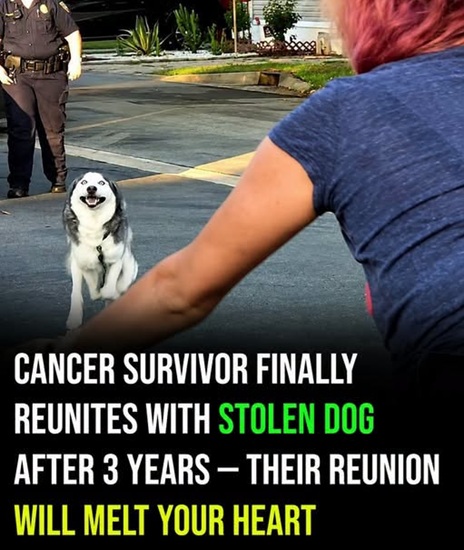
Kameroun Mares’ relationship with her Siberian husky, Semper Fidelis, began during an especially difficult period of her life. Mares had been diagnosed with acute lymphoblastic leukemia years earlier and was continuing to deal with serious health challenges when she brought the puppy home in 2013. She hoped that caring for an energetic dog would help with depression and encourage her to remain physically active. The young husky quickly became an important part of her daily routine.
Mares chose the name Semper Fidelis, a Latin phrase commonly translated as “always faithful.” Years later, that name would carry even greater meaning after an unexpected separation lasting more than two years. Mares took several ordinary precautions intended to make Semper identifiable if he ever became lost. According to ABC News, she brought him to a veterinarian, kept up with vaccinations, registered his microchip with a national service and also registered him with the local humane society in San Diego.
She believed those records would provide a reliable connection between her and her dog. Microchips are designed to provide permanent identification numbers that can be read by scanners used by veterinarians, shelters and animal-control organizations. The identifying number can then be checked against registration databases containing contact information. In Semper’s case, however, the existence of a microchip did not prevent a complicated ownership dispute from developing later.
In 2015, Mares moved from California to Jacksonville, Florida, and Semper went with her. She later discovered that her medical insurance situation required her to return to California for ongoing care. In March 2016, she temporarily left Semper in Florida with people she trusted, including a pet sitter and her roommate. Mares expected the arrangement to be temporary while she handled her medical needs. Instead, she eventually received disturbing news from her roommate. She was told that Semper had escaped through the front door and could no longer be found.
Being thousands of miles away made the situation particularly difficult. Mares began trying to locate Semper while she was still dealing with medical issues of her own. She contacted the microchip company and the humane society and spread information about the missing husky online. She also searched advertisements and communicated with groups dedicated to finding lost dogs. Because Semper had a registered microchip, Mares expected that someone who found him would eventually have the chip scanned and contact her. Days became weeks and then months, yet the phone call she expected never arrived.
Mares continued searching even after returning from treatment. She believed for a long period that Semper might simply be somewhere in Florida without anyone realizing who his owner was. The uncertainty was particularly painful because she had no way of knowing whether he was safe. She searched online, stayed connected with lost-pet communities and continued watching for information that might lead to him. The absence of any notification from the microchip registry remained difficult to understand. If Semper had been scanned, Mares believed her existing registration should have helped connect him with her.
A major clue finally emerged in 2017. A woman in Jacksonville contacted Mares through an online lost-dog group after seeing a husky that appeared similar to Semper. That particular dog ultimately did not turn out to be him, but the conversation encouraged Mares to investigate Semper’s microchip information again. She contacted the humane society associated with his registration. This time, she learned that another registration company had also become associated with the same chip. The discovery immediately raised new questions because Mares’ own registration had never been intentionally surrendered.
The dates connected to the second registration proved especially important. ABC News reported that another registration had been created on April 11, 2016. Mares said this occurred roughly two weeks before she was told that Semper had disappeared. According to Mares’ account, she eventually learned that her roommate had not simply lost the dog. She said Semper had instead been sold without her consent for $200. That information completely changed the nature of her search because she was no longer trying only to locate a dog believed to have wandered away.
The people who acquired Semper were in a very different position. Available accounts indicate that they did not know Mares was searching for him and believed they had purchased the husky legitimately. After taking him home, they registered information through another microchip service. That created competing records connected to the same physical chip. Mares still had her earlier documentation, while another household had possession of the dog and a separate registration associated with him. The situation demonstrates why a microchip number alone does not automatically resolve a legal ownership dispute.
Pet Key, one of the companies involved, later explained to ABC News that a microchip functions as an identifier rather than a legal certificate establishing ownership. Company president Nick Acosta explained that ownership circumstances can change and that determining the rightful owner is not necessarily the responsibility of a microchip registry. A single chip can also appear in more than one registration database. For that reason, scanning an animal is only one step in the process. Registration history, veterinary records and other documentation can become important when conflicting ownership claims arise.
By this stage, Mares needed more than ordinary lost-pet searches. She obtained the help of a private investigator and an attorney as she worked to determine exactly where Semper was and establish her claim to him. Private investigator Ana Campos became involved in tracing the dog and examining the circumstances surrounding his disappearance. The investigation helped uncover how Semper had moved from Mares’ household to another home. Finding his location, however, did not automatically mean he could simply be taken back. A legal ownership issue had developed because another family had been caring for him for an extended period.
Mares therefore relied on documentation that predated Semper’s disappearance. Her veterinary history, registration records and earlier connection to the dog helped establish that she had owned him before the disputed sale occurred. The matter eventually required legal assistance rather than simply an exchange between two households. This distinction is important because the people who had purchased Semper were not presented as the people who originally took him from Mares. They had acquired a dog through what they understood to be a legitimate transaction and had developed their own attachment to him. Resolving the situation consequently required determining who had the stronger documented ownership claim.
After years of uncertainty, the process finally resulted in Semper being returned to Mares. ABC News reported that the reunion took place on October 18, 2018. By then, they had been apart for approximately two and a half years. Mares had spent much of that period believing first that Semper was missing and later trying to recover him after learning that he was living elsewhere. The reunion therefore represented the end of several different struggles: searching for a missing pet, discovering what had happened and establishing her right to bring him home.
The emotional significance of Semper’s return was closely connected to why Mares had brought him into her life in the first place. He had originally been adopted while she was coping with serious health problems and looking for companionship and motivation. Their separation happened while she was again traveling for medical reasons. Recovering him therefore restored a relationship that had begun during one of the more challenging periods she had experienced. Mares described the reunion as allowing a deep emotional wound to begin healing after years of uncertainty.
Semper’s response after returning also attracted attention. Accounts of the reunion described him recognizing Mares and responding to familiar interactions after their long separation. Material documenting the case also reports that he still remembered commands Mares had taught him when he was younger. One of those routines involved being told to go home and moving toward the appropriate door. For Mares, that familiar behavior took on a new meaning after spending years trying to bring him back. The connection between owner and dog had survived a separation neither of them had chosen.
The case also highlighted an important feature of pet microchips that can sometimes be misunderstood. A microchip is not a GPS tracker and does not continuously reveal where an animal is located. Instead, it carries an identification number that must be scanned and then compared with registration information. The effectiveness of that system therefore depends on accurate databases and careful checking by the organizations involved. In Semper’s case, different registrations became associated with the same chip, creating confusion rather than immediately returning him to Mares. ABC News reported that multiple companies can have records connected to one microchip number.
That does not mean microchipping has no value. A correctly registered chip can be extremely useful when a lost animal reaches a shelter, veterinary office or animal-control agency. Semper’s experience instead demonstrates why owners should keep their contact information current and retain additional documentation showing their relationship with an animal. Veterinary records, adoption or purchase paperwork, vaccination history, photographs and local licenses can provide supporting evidence when questions about ownership arise. A microchip can form an important part of that record, but it should not be assumed to function as an automatic legal title.
The story also offers a practical lesson for people obtaining animals through private advertisements. Buyers may have no obvious reason to suspect that a person offering a dog for sale lacks permission to do so. Having the animal scanned for a microchip before completing a transaction can reveal whether registrations already exist. Asking for veterinary documents or other ownership records can provide additional information about the seller’s relationship to the animal. None of those measures guarantees that every problem will be detected, but they can make it harder for someone to transfer an animal without legitimate authority.
Semper’s case became particularly complicated because the circumstances initially appeared to involve a missing dog. Mares spent considerable time searching under the assumption that her husky had escaped. Only later did the second registration and subsequent investigation reveal a different sequence of events. That distinction can matter when documenting a missing pet case. If evidence suggests an animal may have been intentionally taken or transferred without permission, maintaining detailed records and seeking appropriate legal guidance can become important. Laws governing ownership and theft vary by jurisdiction, so individual cases depend on the applicable local rules.
The timeline is also worth describing accurately. Mares adopted Semper in 2013, moved with him to Florida in 2015 and left him temporarily in the care of others while returning to California for medical needs in 2016. She was later told he had escaped, while records subsequently showed another registration associated with his chip shortly before that report. After continued searching, investigation and legal assistance, Semper was returned on October 18, 2018. The commonly used description “nearly three years apart” captures the general scale of the separation, but the more precise reporting places it at approximately two and a half years.
The name Semper Fidelis became an especially appropriate detail after the reunion. Mares had selected it years earlier because of its association with faithfulness and loyalty. She could not have known at the time that she and the young husky would later be separated for years. Despite the distance and the changes that occurred during that period, their relationship resumed when he finally returned to her. The story became widely shared because it combined an unusual ownership dispute with a reunion between a woman and an animal that had already played an important role during a difficult stage of her life.
What the documented reporting supports is ultimately straightforward. Kameroun Mares owned and registered Semper before his disappearance, was told in 2016 that he had escaped, and later discovered circumstances indicating he had been sold without her permission. Another household had acquired and cared for Semper without knowing Mares was still searching for him. Conflicting microchip registrations complicated the situation, and Mares used investigative and legal assistance to recover the dog. After approximately two and a half years apart, Mares and Semper were reunited in October 2018.
This account is based on publicly reported information about Kameroun Mares and Semper Fidelis and is written entirely from an outside, third-person perspective. It does not claim that the publisher personally knows Mares, participated in the search, lives in the communities involved or witnessed the reunion. Statements concerning how Semper was transferred are attributed to Mares’ reported account and the investigation surrounding the case rather than presented as private firsthand knowledge. The purpose is to summarize the documented events accurately while avoiding invented dialogue, exaggerated medical claims or unsupported assumptions about the people involved.
