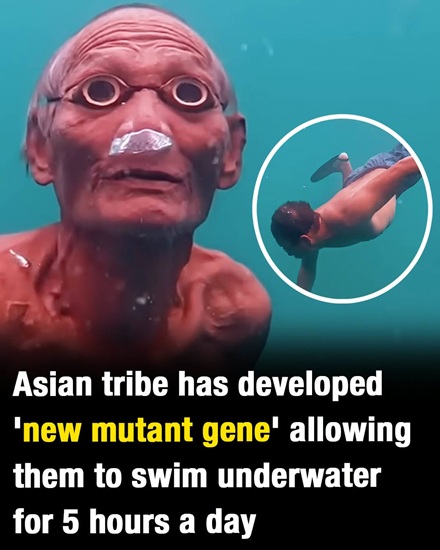
For generations, many Bajau communities in Southeast Asia have depended heavily on the sea for food, travel and work. Often described as “Sea Nomads,” some Bajau traditionally practice repeated breath-hold diving while fishing and gathering marine resources. Their diving ability has attracted the attention of scientists because certain experienced divers can spend long periods working in the water without conventional scuba equipment. Rather than relying on compressed-air tanks, they use breath-hold techniques developed through practice and tradition.
Researchers wanted to know whether this demanding lifestyle might also be associated with biological adaptations. A major study published in 2018 provided evidence that at least part of the answer may involve the spleen and genetic differences shaped by natural selection. The study was led by researcher Melissa Ilardo and examined Bajau individuals in Indonesia alongside members of a nearby population with a different lifestyle. Researchers used ultrasound measurements to compare spleen size and also collected genetic data.
They found that the Bajau participants had significantly larger spleens on average than individuals in the neighboring comparison group. Importantly, the difference was observed not only among active Bajau divers but also among Bajau participants who did not regularly dive. That finding suggested that training alone might not fully explain the difference. The researchers therefore investigated whether inherited genetic factors could be contributing to the larger average spleen size. The spleen is relevant to breath-hold diving because it can act as a reservoir for red blood cells.

During the human diving response, several physiological changes occur when a person holds their breath and is submerged. Heart rate can slow, blood vessels in the limbs can constrict, and the body prioritizes oxygen delivery to critical organs. The spleen can also contract during apnea, releasing additional red blood cells into circulation. Since red blood cells transport oxygen, this response can temporarily increase the amount of oxygen available in the bloodstream. A larger spleen could therefore potentially provide an advantage during repeated breath-hold dives, although it is only one part of a much more complicated physiological response.
Genetic analysis in the 2018 research identified evidence of natural selection in several regions of the Bajau genome. One of the strongest signals was associated with a genetic variant near PDE10A, a gene involved in biological pathways connected with thyroid hormone regulation. Previous animal research had linked thyroid hormones with spleen development, providing a possible mechanism through which genetic variation could influence spleen size. The researchers proposed that natural selection may have favored variants contributing to larger spleens in a population with a long history of breath-hold diving. This is very different from saying that scientists discovered a completely new or unique “mutant gene.” The evidence concerns differences in the frequencies of genetic variants already found within humans.
The research is especially interesting because the Bajau have maintained a strongly maritime lifestyle over many generations. University of Copenhagen research describing the work notes that Bajau and other Southeast Asian Sea Nomad populations have depended on marine resources for a very long period. Traditional diving can involve repeated underwater work throughout the day rather than a single prolonged dive. Experienced divers may descend considerable distances while collecting fish, shellfish and other marine resources. Researchers studying this lifestyle became interested in whether generations of exposure to repeated low-oxygen conditions could leave detectable evolutionary signatures. The 2018 results provided evidence that cultural practices and biological evolution may sometimes interact over long periods.

One widely reported observation from field research is that traditional Bajau divers can spend a substantial proportion of their working day underwater through repeated dives. Individual dives vary considerably in duration and depth, so descriptions should not imply that every Bajau person routinely reaches extreme depths or remains underwater for many minutes. Diving ability also depends on experience, health, age and individual physiology. The extraordinary performances described in reports generally refer to skilled traditional divers rather than every member of the broader Bajau population. This distinction is important because the Bajau are culturally diverse communities, not a single group of genetically identical professional divers.
The human diving response itself is not unique to the Bajau. All humans possess physiological mechanisms that help conserve oxygen during breath-holding and immersion. The heart rate may decrease, peripheral blood vessels constrict, and blood circulation becomes more focused on maintaining oxygen supply to vital organs such as the brain and heart. The spleen can contract as part of this response and release stored red blood cells. Research on other trained breath-hold divers has also documented changes in blood distribution and oxygen-related physiology during apnea. What made the Bajau study notable was evidence that long-term natural selection may have influenced characteristics associated with this universal human response.
The larger average spleen size found among Bajau participants therefore does not mean they possess an entirely different organ or an ability unavailable to other humans. Instead, it represents a measurable difference in a physiological characteristic that could improve oxygen availability during repeated breath-hold diving. Scientists often study adaptations in this way by comparing variations already present within our species. Over generations, environmental conditions and lifestyles can favor certain inherited traits when those traits provide advantages for survival or reproduction. The Bajau research offered an unusually clear example of how such evolutionary processes might operate in a population whose daily activities repeatedly expose individuals to low-oxygen conditions.
Another important point is that the 2018 study did not prove that spleen size alone explains the Bajau’s diving ability. Breath-hold diving depends on many factors, including learned technique, physical conditioning, tolerance of rising carbon dioxide levels, cardiovascular responses and individual anatomy. Generations of cultural knowledge about the ocean are also crucial. Bajau children who grow up around diving communities may acquire practical skills and familiarity with the marine environment that cannot be explained by genetics. Biological adaptation and learned behavior can therefore operate together rather than being competing explanations for exceptional diving performance.
Researchers also identified additional genetic regions that showed signs consistent with natural selection, including genes potentially involved in responses to low oxygen and other physiological processes. Scientists remain cautious when interpreting these associations because identifying a selected genetic region does not automatically establish exactly how every gene affects diving performance. Genetic adaptation is usually complex and often involves multiple interacting traits. The strongest conclusion from the Bajau research is that their population history contains detectable evidence of natural selection associated with a marine, breath-hold-diving lifestyle. Further research can help clarify precisely how individual variants influence the body during repeated apnea.
The study is also valuable because it demonstrates that human evolution did not simply stop in the distant past. Natural selection continues whenever inherited differences influence survival or reproduction under particular environmental conditions. Other well-known human adaptations include biological changes associated with living at high altitude or consuming particular foods. The Bajau research adds a marine example to that broader picture. A culturally specialized way of obtaining food may have created conditions in which certain physiological characteristics became increasingly common over many generations. Scientists studying population genetics use cases like this to better understand how relatively recent human environments have shaped biological diversity.
However, scientific findings about the Bajau should not be exaggerated into claims that they are a separate type of human or possess supernatural abilities. They are ordinary human populations with a distinctive cultural history and measurable biological variation. Statements such as “a new mutant gene allows them to breathe underwater” are inaccurate. Bajau divers still need to hold their breath, and their bodies remain limited by oxygen availability just like those of other humans. Their remarkable diving performance appears to result from a combination of practice, cultural knowledge, normal human diving physiology and evolutionary adaptations that may make prolonged or repeated breath-hold diving more effective.
The term “biological scuba tank” has sometimes been used informally to explain the role of the spleen, but it should be understood as a metaphor rather than a literal description. A scuba tank contains a large supply of breathable compressed gas, while the spleen does something entirely different. During apnea, contraction of the spleen can release additional red blood cells into the circulation, temporarily increasing the blood’s oxygen-carrying capacity. This effect may help extend the time a person can work while holding their breath, but it does not provide unlimited oxygen. The comparison is useful for explaining the general idea, provided it is not mistaken for a precise medical description.
More recent research on trained breath-hold divers continues to show how complicated human adaptation to apnea can be. Studies have investigated changes in hemoglobin concentration, blood distribution, lung function and cardiovascular responses during prolonged breath-holding. These findings reinforce the idea that no single organ or gene completely explains exceptional diving performance. The human body uses multiple coordinated mechanisms to conserve oxygen, while repeated training can produce additional physiological changes. The Bajau study contributes an evolutionary dimension by showing that inherited population-level differences may operate alongside these universal and trainable responses.
The broader scientific significance extends beyond understanding traditional diving. Researchers are interested in how humans tolerate temporary reductions in oxygen because low-oxygen conditions are relevant to several areas of physiology and medicine. Studying naturally adapted populations can provide clues about biological pathways that influence oxygen use and circulation. Researchers such as Rasmus Nielsen have emphasized that population studies can help identify genetic differences associated with responses to acute low oxygen. Such findings do not automatically translate into medical treatments, but they can help scientists identify mechanisms worth investigating more closely.
The Bajau research is therefore best understood as evidence of human adaptation rather than the discovery of a mysterious new mutation. Scientists found larger average spleens and genetic signatures consistent with natural selection in a population with a long-standing tradition of breath-hold diving. Those findings offer a plausible biological contribution to the impressive underwater abilities observed among some Bajau divers. At the same time, researchers recognize that cultural experience, individual training and several physiological systems also contribute to diving performance. The complete explanation involves far more than one gene or one organ.
This account is based on published scientific research and institutional information about the Bajau and their physiological adaptations. It is written from an outside, third-person perspective and does not claim that the publisher belongs to a Bajau community, has personally observed traditional diving, or speaks on behalf of people living in Indonesia or elsewhere in Southeast Asia. The discussion concerns scientific findings rather than a local political or domestic issue. Terms that could create misleading impressions, including claims about a completely “new mutant gene,” have been avoided in favor of what the research actually supports: evidence of natural selection, larger average spleen size and genetic variation associated with a long-standing marine lifestyle.
