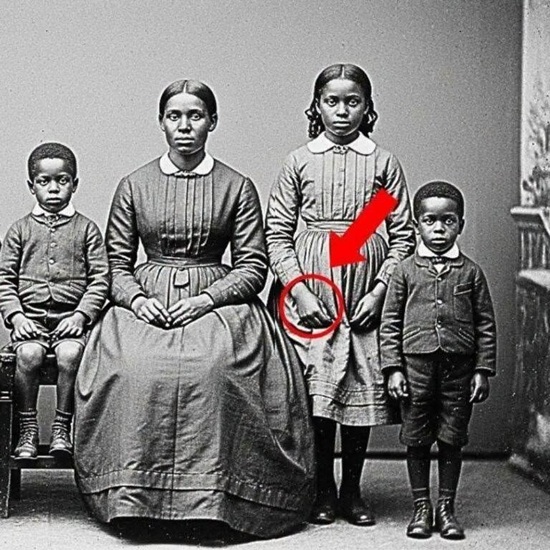
At first glance, the old family portrait appears to contain nothing particularly unusual. A mother sits with her children in a carefully arranged pose, their clothing and expressions reflecting the formal style commonly associated with nineteenth-century studio photography. Everyone seems positioned deliberately for the camera, and the image has the solemn quality familiar from many surviving portraits of the period. Then attention shifts toward one of the children, where an unusual shape appears to resemble an additional hand.
That small detail has transformed an otherwise ordinary historical-looking portrait into an online mystery. Versions of the photograph circulating online have reportedly been described as dating to 1872. However, that specific date and the identities of the people pictured should be treated cautiously unless they can be traced to an original print, photographer’s archive, museum collection or another reliable historical record. Old photographs are frequently reposted without complete provenance, and dates attached to them can become repeated across websites even when the original source is unclear.
The mystery therefore begins not only with the apparent hand but also with what can actually be established about the photograph itself. The unusual shape is nevertheless easy to understand as a source of curiosity. Once someone points it out, it becomes difficult to look anywhere else. What initially appears to be a conventional arrangement of people suddenly seems anatomically confusing. Viewers begin tracing shoulders, elbows, wrists and fingers, attempting to determine whether every visible hand can be connected logically with a person in the photograph.
Some observers interpret such details dramatically. Historical photographs have long been associated with ghost stories, unexplained figures and supposedly supernatural appearances. The visual imperfections of nineteenth- and early-twentieth-century photography provide especially fertile material for those interpretations because old images frequently contain fading, scratches, unusual shadows, blur and damage.
None of those characteristics, however, constitutes evidence of anything supernatural.
Historical photography involved physical and chemical processes very different from modern digital photography. A photographer could not simply take dozens of instantaneous photographs and immediately inspect the results on a screen. Preparing, exposing and processing an image required considerably more effort, and the photographic materials themselves introduced limitations that modern viewers may not immediately recognize.
Exposure time was one important factor. Early photographic processes could require subjects to remain still for periods much longer than people expect from a modern camera. The required exposure depended on the photographic process, equipment, available light and period involved, so it would be inaccurate to assign one universal exposure time to every Victorian photograph.
What matters for understanding strange photographic details is that movement during an exposure could affect the final image.
A person who moved a hand, shifted position or changed posture could produce blur or an unusual-looking form.
The effect would not necessarily resemble the familiar motion blur produced by a modern smartphone photograph.
Depending on the process and circumstances, movement could create partial shapes, reduced detail or areas that appear less solid than the surrounding subject.
Hands are particularly interesting because people recognize them extremely quickly.
The human visual system is highly sensitive to familiar biological forms.
A few shapes resembling fingers and a palm may therefore be interpreted as a complete hand even when the visual information is incomplete.
That process can make an ambiguous area of an old photograph appear far more anatomically convincing than it really is.
Another historical factor involves posing.
Portrait photography was often treated as a serious event.
People were expected to maintain their positions while the photographer prepared and exposed the image.
Various posing devices were developed to help subjects remain steady.
Head rests, stands and other supports could be positioned behind people or concealed by clothing and furniture.
These devices were not normally intended to become prominent features of the finished portrait.
Their purpose was practical.
A photographer wanted to reduce unwanted movement and produce a sharper image.
If part of a support became visible because of the camera angle, clothing position or later cropping, a modern viewer unfamiliar with the equipment might interpret the shape incorrectly.
That does not mean every strange object in an old portrait is a posing stand.
It simply represents one historically plausible category of explanation.
Clothing creates another possibility.
Nineteenth-century garments often contained considerably more fabric than modern everyday clothing.
Large sleeves, layered dresses, folds and dark materials could overlap in visually confusing ways.
When several family members sat close together, their clothing could merge into a complicated pattern of light and shadow.
A hand resting partly beneath fabric might appear disconnected from the arm that actually belongs to it.
One person’s fingers could overlap another person’s clothing.
A sleeve could hide a wrist.
A fold could resemble part of a palm.
Once the original tonal information has faded, those relationships become even more difficult to reconstruct.
This problem becomes more pronounced when viewers are not examining an original photographic print.
Most people encountering mysterious historical photographs online are looking at digital reproductions.
That reproduction may already be several generations removed from the original.
An old print may have been photographed.
That photograph may have been scanned.
The scan may have been compressed for a website.
Someone else may have copied it to another platform.
Each stage can change the visual information.
Compression can remove subtle tonal differences.
Sharpening can exaggerate edges.
Contrast adjustments can turn gradual shadows into hard boundaries.
Cropping can remove contextual information that might have helped explain a confusing shape.
Even resizing an image can change how individual fingers or fabric folds appear.
This is why analyzing a viral copy cannot necessarily establish what was visible on the original photographic plate or print.
There is another possibility that deserves consideration when examining historical photographs: retouching.
Photo manipulation did not begin with computers.
Photographers and artists were altering photographs more than a century before Adobe Photoshop existed.
Historical techniques included painting, retouching, combining negatives and modifying photographic surfaces.
This fact has particular relevance because another famous “extra hand” photograph circulating online has been associated with historical retouching.
That image shows a group of female linen-mill workers in Belfast and is generally dated to around 1900.
A hand appears to rest on one woman’s shoulder despite seeming to have no visible owner.
The image generated substantial online discussion, with some viewers treating the hand as a paranormal mystery.
Reports about the photograph have also noted that photographic manipulation was already possible during that period.
The Belfast image is important because it demonstrates how easily different “mysterious hand” photographs can become confused online.
A picture can be reposted with a new caption.
Another date can become attached.
Context can disappear.
Eventually, people may discuss a photograph without knowing where the image originally came from.
That is why provenance matters.
A reliable historical photograph ideally has information connecting it to an archive, photographer, studio, family collection, dated album or institutional record.
Without that documentation, confidently announcing an exact year can create an appearance of certainty unsupported by evidence.
The same caution should apply to identifying the people pictured.
Calling the subjects a particular family requires evidence.
Clothing and photographic style can suggest an approximate historical period, but appearance alone normally cannot establish names, relationships or an exact year.
A mother sitting beside children may certainly look like a family portrait.
But responsible historical description distinguishes what is visible from what has actually been documented.
This does not make the photograph less interesting.
In fact, uncertainty is part of what makes old images so compelling.
The viewer sees real people who lived in another period but possesses only a tiny fragment of information about them.
Their clothing survives visually.
Their expressions survive.
Their physical arrangement survives.
But their voices, thoughts and reasons for taking the photograph may be completely lost.
A strange visual detail then becomes a point around which modern viewers build theories.
That is where perception becomes especially important.
Humans naturally search for recognizable patterns in ambiguous information.
One term often associated with this process is pareidolia.
It describes the tendency to perceive familiar forms in visual material that may not clearly contain them.
Seeing a face in a cloud is a familiar example.
People may also see faces in electrical outlets, animals in rock formations or figures in random shadows.
Old photographs provide ideal conditions for this effect.
Fading removes information.
Damage adds information that was never part of the original scene.
Scratches create lines.
Dust produces spots.
Contrast changes shapes.
The brain then attempts to organize those imperfect signals into recognizable objects.
A possible hand is particularly powerful because the human brain is accustomed to identifying fingers and limbs.
Once someone labels an ambiguous shape as an “extra hand,” later viewers approach the image with that expectation already established.
They are no longer simply looking at a collection of light and dark areas.
They are actively searching for fingers.
When they find shapes consistent with that expectation, the interpretation becomes stronger.
This does not mean viewers are foolish or imagining everything.
Pattern recognition is a normal and extremely useful part of human perception.
It allows people to recognize objects rapidly even when part of an object is hidden.
The same ability that makes everyday vision efficient can also create convincing interpretations when the available information is incomplete.
That is why independent examination matters.
A useful first step is to ignore the mysterious interpretation and trace every visible arm.
Where does each shoulder begin?
Which direction is each elbow pointing?
Can the visible wrist be followed into a sleeve?
Could one person’s hand be resting behind another person’s arm?
Does a fabric fold interrupt the connection?
These questions may reveal a straightforward explanation.
Lighting should also be examined.
A real hand positioned in the scene should generally interact with the same illumination affecting nearby objects.
Its highlights and shadows should make sense relative to the surrounding clothing and faces.
However, analyzing lighting from a compressed reproduction has limits because digital processing can substantially change contrast.
Sharpness is another clue.
If the suspected hand is noticeably softer or sharper than objects at approximately the same distance from the camera, that difference may suggest movement, retouching, damage or later alteration.
Again, this remains suggestive rather than definitive without the original photograph.
Edges can be particularly deceptive.
Digital sharpening often creates bright or dark outlines around high-contrast objects.
Those artificial boundaries can make an ambiguous shape look more separate from the surrounding fabric.
A viewer may then perceive a distinct hand where the original print contained a much softer transition.
Scratches and restoration can introduce similar problems.
Many historical photographs available online have been digitally cleaned.
Restoration can be extremely useful because it removes distracting damage and makes faces easier to see.
But aggressive restoration can also introduce information.
Modern software may reconstruct missing edges.
Artificial-intelligence enhancement can create details that were not clearly present in the source.
That creates an additional problem for historical mysteries.
If an AI-enhanced copy is analyzed instead of the original scan, viewers may be studying details partly generated by software.
For that reason, the earliest available reproduction is usually more valuable for serious analysis than the sharpest-looking version circulating online.
A highly polished image may be visually attractive but historically less reliable.
The original physical print would be better still.
Researchers could examine the photographic paper, surface, damage and retouching directly.
If a negative or glass plate survived, it could provide even stronger evidence.
Unfortunately, viral images rarely arrive with that level of documentation.
The mystery is usually detached from the archive.
That makes definitive conclusions difficult.
It also makes supernatural conclusions particularly weak.
An unexplained visual feature is not automatically evidence of a paranormal event.
It is simply unexplained within the information currently available.
There is a substantial difference between saying “the photograph contains a shape whose origin is unclear” and saying “the photograph captured a ghostly hand.”
The first statement describes evidence.
The second assigns a cause without sufficient evidence.
Historical photography offers numerous ordinary mechanisms capable of producing strange visual results.
Movement is one.
Retouching is another.
Overlapping people are another.
Clothing and shadow can contribute.
Damage to the print can alter shapes.
Scanning can introduce artifacts.
Compression can remove information.
Modern editing can create or exaggerate details.
Any responsible analysis must consider those possibilities before moving to an extraordinary explanation.
Double exposure is another phenomenon frequently mentioned in discussions of unusual historical photographs.
In photographic processes capable of recording more than one exposure on the same material, overlapping imagery could produce ghostlike figures or partially transparent forms.
Double exposures later became closely associated with so-called spirit photography.
During the nineteenth century, photographers claiming to photograph spirits produced images in which translucent people appeared alongside living subjects.
Some audiences found those photographs convincing.
Others recognized or exposed techniques involving multiple exposures and manipulation.
The history demonstrates that apparently supernatural photographic effects could be produced without anything supernatural occurring.
However, simply knowing double exposure existed does not prove that it explains a particular mysterious family portrait.
That would require evidence from the image or original material.
The same rule applies to posing stands.
Their historical use makes them plausible in general.
It does not prove that one particular shape is a support.
A careful article should therefore present possible explanations as possibilities.
It should not replace one unsupported certainty with another.
Saying “this definitely shows a ghost” is unjustified.
Saying “this definitely resulted from a posing stand” may also be unjustified without evidence.
The most accurate answer may simply be that the available reproduction does not allow a definitive conclusion.
That uncertainty is not a weakness.
It is an honest description of the evidence.
Historical research frequently works this way.
Sometimes enough documentation survives to reconstruct an event in extraordinary detail.
Other times, only a photograph remains.
When records are missing, responsible interpretation has limits.
The portrait can still tell viewers something about photography.
It shows the formal visual language associated with old studio portraits.
Subjects were arranged deliberately.
Clothing was chosen carefully.
The occasion of being photographed often carried more significance than the casual photographs people take today.
In the nineteenth century, photography was becoming increasingly accessible, but a formal portrait could still represent an important family record.
People were creating an object intended to preserve their appearance.
They could not have anticipated that more than a century later, strangers might enlarge a tiny portion of the image and debate one apparently misplaced hand.
That contrast is part of the photograph’s appeal.
The original subjects presumably wanted future viewers to look at their faces.
Modern viewers often look at the anomaly instead.
The mystery changes the way the entire image is experienced.
Without the strange detail, the photograph might receive only a few seconds of attention.
With it, people study every person carefully.
They inspect clothing.
They count hands.
They trace arms.
They compare shadows.
In an unexpected way, the visual puzzle encourages people to examine historical photography more closely.
That can be valuable if curiosity leads to accurate research.
It becomes less useful when speculation is presented as historical fact.
For example, attaching an exact date such as 1872 should ideally be supported by provenance.
If the original source cannot be identified, the safer wording is that the photograph has been circulated or described online as dating from that period.
That distinction is small but important.
It tells readers what is known and what is merely attributed.
The same applies to the mysterious hand.
It can accurately be described as a shape that appears to resemble an additional hand.
Calling it an actual detached hand assumes the interpretation before the evidence has been established.
Language matters when discussing visual mysteries.
“Appears to show” is different from “shows.”
“Reportedly dated” is different from “was taken.”
“Possible photographic artifact” is different from “confirmed double exposure.”
Those qualifications are not attempts to make a story less interesting.
They prevent uncertainty from becoming misinformation.
The photograph does not need a paranormal conclusion to be fascinating.
The history of photography already provides a rich context.
Nineteenth-century photographers were solving difficult technical problems with chemistry, glass, metal, paper, lenses and light.
They were creating portraits without autofocus, digital sensors or instant previews.
Subjects had to cooperate with the limitations of the equipment.
Photographers developed methods for controlling pose, exposure and lighting.
Retouchers developed ways to alter images long before computers existed.
All of those factors created opportunities for unusual visual details.
A hand-shaped anomaly can therefore become a doorway into understanding photographic history.
It encourages questions about exposure.
It raises questions about posing.
It demonstrates the importance of provenance.
It illustrates how images change when copied repeatedly.
It reveals how perception responds to ambiguous information.
Those lessons are more durable than a ghost story.
The photograph can still be enjoyed as a mystery.
There is nothing wrong with looking at it and wondering what happened.
The mistake occurs only when wondering becomes certainty without evidence.
Perhaps a person moved.
Perhaps fabric overlapped in an unusual way.
Perhaps the image was retouched.
Perhaps a support or another person was partly hidden.
Perhaps damage or later reproduction altered the appearance.
Without stronger evidence, those possibilities remain open.
One of them may eventually prove correct if an original source is located.
An archive could contain another print.
A family album might identify the subjects.
A photographer’s collection could reveal similar portraits.
Another photograph from the same sitting might show the arrangement more clearly.
Those discoveries would dramatically improve the analysis.
Until then, the reproduction itself has to carry more evidentiary weight than it can reasonably support.
That is why caution is appropriate.
The photograph’s age, attribution and technical history should not be invented to fill gaps.
Neither should the identities or emotions of the people pictured.
It may be tempting to create a dramatic story about what happened immediately before or after the photograph.
There is no evidence for such a story unless documentation accompanies the image.
The strongest version of the article therefore remains grounded in what can actually be observed.
There is an old-looking formal portrait.
A section of the image appears visually confusing.
Some viewers interpret that section as an extra hand.
Historical photographic processes provide several non-supernatural ways unusual shapes can appear.
The exact explanation remains uncertain without stronger provenance or access to the original material.
That is enough for a compelling story.
It also avoids turning visual ambiguity into false history.
There is another useful lesson in the way people react to such photographs.
Modern viewers are accustomed to assuming that a photograph records one precise instant.
Digital cameras encourage that expectation because exposure times can be extremely short.
Historical photography did not always work that way.
An old photograph could record a longer interval.
Movement occurring during that interval might become part of the image.
Thinking of a photograph as accumulated light rather than a frozen instant helps explain why strange forms can appear.
This does not solve the mystery by itself.
It simply changes the range of plausible explanations.
A moving hand may leave a different record from a stationary face.
A shifting person may appear less distinct.
An overlapping exposure can combine separate moments.
The resulting photograph may therefore contain visual relationships that never existed in exactly the same form at one instant.
That concept is easy to forget when viewing historical images through a modern screen.
The physical history of the print matters too.
A photograph more than a century old can experience scratches
