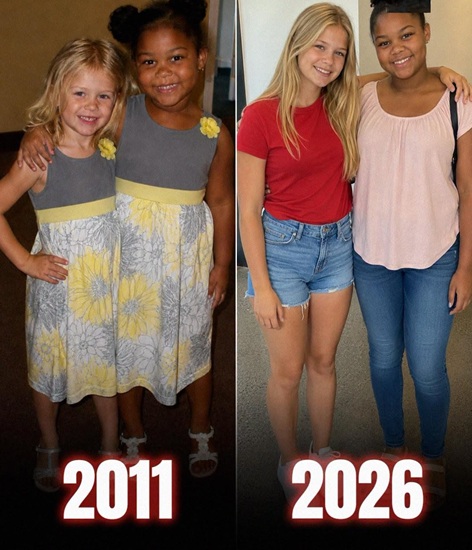
At first, I believed my daughter was going through the kind of heartbreak that sometimes comes with being sixteen. Emma had been inseparable from Sophie since kindergarten, and the two of them had grown up almost like sisters. They had shared birthday parties, sleepovers, school projects, Halloween costumes, summer trips, and countless afternoons at each other’s homes. So when Sophie began planning her Sweet 16 celebration, Emma naturally assumed she would be there.
In fact, Sophie had involved her in almost every detail, from music and decorations to the dress Emma planned to wear. Three weeks before the party, the girls had gone shopping together and chosen a pale-pink dress for Emma. Sophie had held it up against her in the fitting room and told her she would be standing beside her in every photograph. Emma came home glowing that afternoon. She spent the next several weeks finishing a scrapbook she had been making for Sophie, with one picture from every year of their friendship.
She had carefully written notes beneath many of the photographs, remembering inside jokes, childhood vacations, school dances, and all the ordinary moments that had made their friendship feel permanent. Then the invitations went out, and Emma did not receive one. At first, she genuinely believed it was a mistake. She laughed when she told me about it and said Sophie must have forgotten to give her the envelope at school. But as the days passed, more students began talking about the party. Girls Sophie barely knew had been invited.
Classmates she hardly spent time with had invitations. Emma still had nothing, and Sophie’s behavior toward her had suddenly changed. Emma sent several messages asking whether something was wrong. Sophie did not answer. She called once, then twice, and both calls went to voicemail. At school, Sophie began avoiding her. Once, Emma saw her walking toward the cafeteria and called her name, only to watch Sophie turn in the opposite direction. By the end of the week, Emma was no longer pretending that the missing invitation had been an accident. She was devastated.
I found her one evening sitting on the floor of her bedroom with the pale-pink dress hanging from the closet door. Her eyes were red, and the scrapbook lay unopened beside her. She looked at the dress for several seconds before asking whether we could return it. The question sounded simple, but I understood what she was really asking. She wanted to erase everything connected to a celebration she had spent months expecting to share with her closest friend.
I sat beside her and asked what had happened between them. Emma shook her head and said she did not know. That was what hurt her most. If they had argued, she could have apologized. If she had made a mistake, she could have tried to fix it. But Sophie had given her nothing. There was no explanation, no confrontation and no goodbye. There was only silence.
My husband, Mark, appeared in the doorway while Emma was talking. He had always been gentle with her when she was upset, and he immediately sat down beside her. Emma leaned against him and asked why Sophie was doing this. Mark answered surprisingly quickly. He said that sometimes people let you down and that Emma should not blame herself for somebody else’s behavior. He told her that anyone willing to throw away eleven years of friendship without an explanation was making the wrong choice.
His words sounded comforting, but something about them bothered me. Mark seemed too certain that nothing could be repaired. He did not sound curious about what had happened or surprised by Sophie’s sudden behavior. He sounded as though he already knew the situation was complicated and wanted Emma to stop asking questions. When I told him I was going to call Sophie, he immediately told me not to.
That was the first moment I became genuinely suspicious. Mark said the girls were sixteen and needed time to handle things themselves. Emma also asked me not to pressure Sophie into inviting her, and I promised I would not. But I could not watch my daughter spend another night wondering whether she had unknowingly done something terrible. I told her I only wanted to find out whether she was responsible for what had happened.
I stepped into the hallway and called Sophie. Mark followed me as far as the bedroom door and quietly said my name, but I held up my hand and told him we could talk later. Sophie answered after several rings. Her voice sounded hesitant when she realized it was me. I told her I was not calling to demand an invitation. I only wanted to know whether Emma had hurt her.
Sophie’s response came instantly. She said Emma had done nothing wrong. The speed of the answer surprised me. I asked why she was avoiding her if Emma was not responsible. Sophie went silent for several seconds. Then, in a much quieter voice, she told me that I needed to ask my husband.
I felt my stomach tighten. Mark was still standing nearby when Sophie repeated his name. I asked what he had done. Sophie hesitated and warned me that he might not tell me the full truth. Then she said the situation involved something Mark had done with her mother, Helena.
For one terrible moment, my imagination went somewhere much darker than the truth. Sophie seemed to recognize what I was thinking because she quickly told me it was nothing like that. There had been no romantic relationship, she said. Mark had been giving Helena money. He had helped her during a difficult period, but according to Sophie, the help had eventually become something that made both of them uncomfortable.
Before I could ask for a complete explanation, Sophie apologized for what had happened to Emma and ended the call. I stood in the hallway trying to understand what I had just heard. When I looked back toward Emma’s room, Mark was gone.
I found him downstairs sitting beside Emma and handing her a mug of hot chocolate. He was telling her that anyone who treated her badly did not deserve her friendship. I stopped on the stairs and watched him for a moment. He knew something. Maybe he did not know every detail of Sophie’s decision, but he clearly knew enough to understand why the friendship had suddenly collapsed.
I did not confront him in front of Emma. She was already confused and hurt, and I did not want to turn her heartbreak into an argument between her parents. I waited until she had gone to bed. Then I found Mark in the kitchen and asked him directly how much money he had given Helena.
His face changed immediately. Before answering my question, he told me it was not an affair. That bothered me almost as much as anything else because I had not accused him of one. I repeated the question. Eventually, he admitted that Helena had experienced financial problems after separating from Sophie’s father.
According to Mark, he had helped with a security deposit when Helena needed housing. Later, her car required repairs. There had also been another expense that he described vaguely as helping her through a difficult month. He insisted that he had only been trying to support a family friend who was struggling.
The money itself was not the only thing that concerned me. Mark and I had always given each other considerable independence with our finances. I grew up in a home where my parents argued constantly about money, so when I married, I wanted trust rather than daily questioning over every purchase. Mark and I had shared accounts, but we rarely demanded explanations for ordinary spending. I had always considered that arrangement a sign of a healthy marriage.
Now I began wondering whether that trust had made it easier for Mark to hide something he knew I would have wanted to understand. I asked why he had never told me the person receiving the money was Helena. He said she had been embarrassed and that he was protecting her dignity. I told him that might explain why Helena had remained silent, but it did not explain why my husband had kept the arrangement from me.
Mark became defensive. He said Helena had begun treating him as though he had done something wrong after accepting his help several times. When I asked what had changed, he said she had stopped wanting his advice. He mentioned money, Sophie’s school plans, classes and future college decisions. The more he spoke, the more I understood that the problem had grown far beyond several private loans.
I asked what happened when Helena stopped accepting his advice. Mark’s expression tightened. Instead of answering directly, he told me to speak with her. Before walking upstairs, he added that I should remember Helena had asked him for financial help more than once. That detail mattered. It did not automatically prove that Mark had behaved properly, but it made the situation more complicated than the version Sophie had been able to explain in a short phone call.
The following morning, I drove to Helena’s house. I did not want rumors, assumptions or half-truths. I wanted to hear directly from the other adult involved. Helena opened the door looking as though she had been expecting me. I asked how many times she had asked Mark for money.
She admitted there had been four significant payments. The first helped with the security deposit on her new place. Another covered car repairs. A third helped with a utility bill during a difficult month. The fourth was connected to a summer program Sophie wanted to attend. Helena said she had asked for help with the first three expenses, while Mark had offered the last one himself.
I asked why she had never spoken to me. Helena looked ashamed. She said the first time had been humiliating because she was newly separated and afraid she could not keep everything together. Once she accepted help without telling me, admitting it later became increasingly difficult. Every new payment made the secret larger.
I understood the embarrassment, but understanding it did not mean I approved. I reminded her that Emma had cried herself to sleep because Sophie had suddenly cut her off. I wanted to know why an arrangement between adults had destroyed an eleven-year friendship between two girls who had nothing to do with the money.
Helena told me the problem had not begun with the loans. For a while, Mark’s involvement had actually seemed helpful. Sophie was already anxious about school and her future. Mark had started talking with her about classes, college applications and possible career paths. He helped her make lists of schools and encouraged her to think about what she wanted after graduation.
According to Helena, Mark eventually told Sophie that if she was accepted to a college she truly wanted to attend, he would help make sure an enrollment deposit did not prevent her from going. Sophie had been deeply moved by that promise. Her own father had become less reliable after the separation, and knowing another adult believed in her gave her a sense of security.
The difficulty began when Mark started expecting his opinions to carry more weight. Helena said he wanted influence over which classes Sophie chose, which universities she considered and even what she might eventually study. At first, Helena accepted the advice because she believed it came from concern. Eventually, however, she told Mark that helping financially did not make him Sophie’s parent.
After that conversation, Mark’s behavior changed. He canceled a college-planning afternoon he had arranged with Sophie. Then he canceled another. Helena showed me messages in which Mark said it might be better if she handled the college planning herself. Another message said that after everything he had done, he had expected more trust.
Those messages did not prove every interpretation Helena had made, but I could understand why she felt uncomfortable. The kindness had begun to feel connected to obedience. The moment she stopped giving Mark influence, some of his involvement disappeared.
Then I asked the question that mattered most to Emma. Why had she been excluded from Sophie’s birthday?
Helena looked at the floor before admitting that she had told Sophie not to invite her. I was stunned. Helena explained that she had become afraid Mark would attend if Emma were invited. She did not want to confront him at the party, and rather than discussing the problem openly, she decided the easiest solution was to keep Emma away.
I could barely believe what I was hearing. I told Helena that she had used my daughter as a shield against an adult problem. She closed her eyes and admitted that was exactly what she had done. Sophie had begged her not to exclude Emma, but Helena had refused because she was afraid the entire conflict would follow them into the celebration.
For the first time, the situation became clear enough for me to see that nobody involved had behaved perfectly. Mark may have started by offering genuine help, but his generosity appeared to have developed expectations. Helena had accepted secret financial assistance from my husband without telling me, then responded to her fear by punishing Emma. Sophie had gone along with the silence rather than telling her best friend that she was innocent.
I told Helena that being hurt did not excuse hurting my daughter. She agreed. She said she had panicked and allowed an adult conflict to damage both girls. I was not ready to forgive her, but I believed that she understood she had made a serious mistake.
Before leaving, I asked her to send me copies of the messages between her and Mark. She asked why I wanted them. I told her I was tired of hearing everyone else’s interpretation of my marriage. I needed to see what had actually been said and decide for myself what it meant.
When I returned home, I opened our shared financial accounts. The payments were there. They had been made months apart and described with vague labels such as helping a friend or temporary loan. Nothing about them had seemed alarming when I first saw them. I even remembered one occasion when Mark had told me he was helping someone through a difficult situation, and I had kissed him on the cheek and told him he was a good man.
That memory hurt more than I expected. The problem was not that helping somebody automatically made him dishonest. It was that I had praised him without knowing enough to understand what I was supporting.
Emma walked into the kitchen while I was looking through the accounts. She had overheard part of our conversation the night before and asked whether Mark had really been giving Helena money. I closed the laptop, but it was too late to protect her from the truth completely.
Mark entered the room a moment later and said he had planned to explain everything. Emma looked between us and asked whether Sophie had rejected her because Helena had taken money from her father. Mark tried to simplify the situation by saying Helena needed help and that was all Emma needed to know.
I stopped him. Emma had already suffered because adults kept deciding what she was allowed to understand. I explained that needing financial help was not the real problem. Helena should have told me about the money, but Mark had also started behaving as though his assistance gave him a greater right to influence Sophie’s future.
Emma turned toward her father and asked what kind of decisions he had tried to make. I mentioned the discussions about college, classes and what Sophie might eventually study. Mark insisted he had only offered advice. I reminded him that when Helena stopped accepting that advice, his involvement with Sophie’s college planning suddenly ended.
Then Emma asked a question that silenced all of us. She wanted to know whether Mark had truly promised Sophie financial help with college. Mark hesitated before saying he had simply told her he would do what he could.
Emma’s face changed. She reminded him that they had never had that same conversation about her own future. The comparison was painful. Whether Mark had intended it or not, Emma now had to process the fact that her father had apparently made reassuring promises to another teenage girl while his own daughter had never heard the same words from him.
She looked at me and finally understood that Sophie did not hate her. The exclusion had never been about something Emma had done. That knowledge brought relief, but it also made her angry. Sophie had allowed her to believe she was responsible because the truth involved secrets belonging to their parents.
After Emma went upstairs, I confronted Mark privately. I told him that for several minutes after Sophie’s phone call, I had feared he might have been romantically involved with Helena. Mark immediately said he had never touched her and seemed offended that the possibility had even crossed my mind.
I told him the truth was troubling in a different way. I could understand a person deciding to help a struggling friend. What I could not accept was the possibility that his generosity had gradually become a source of leverage. Helena had accepted help, and Mark had apparently begun behaving as though that meant his opinions deserved special authority.
Mark rejected that interpretation. He said he had only been trying to protect Sophie from making mistakes. I asked why his willingness to help seemed to decrease the moment Helena stopped following his advice. He had no immediate answer.
That silence led me to a question I had never expected to ask about my own marriage. If Mark sometimes confused care with control when dealing with Helena, had he ever done the same thing with me? Had there been moments when I believed we were making decisions together even though he had already decided what the right answer should be?
Mark insisted he had never controlled me. I told him I was not accusing him of treating me exactly the way Helena believed he had treated her. I was saying that for the first time in seventeen years, I needed to examine our relationship without assuming every act of guidance was automatically an act of love.
I told him that the following day we were going through our accounts together. There would be no more private loans, financial promises or major favors involving shared money without both of us knowing exactly what was happening. Mark accused me of punishing him.
I told him I was not trying to punish anyone. I was removing the part of our marriage where one person could make decisions affecting both of us while the other remained unaware.
Later that day, Helena called. Sophie had apparently told one friend why Emma had been excluded from the party, and word was beginning to spread among the teenagers. Helena said she was considering canceling the entire celebration because everything had become too complicated.
In the background, I heard Sophie protest. She told her mother that she had already lost Emma over an adult problem and begged her not to lose the party as well. Helena went quiet before admitting that every decision she had made out of fear seemed to make the situation worse.
I told her she could stop that pattern. If Sophie wanted Emma at her birthday, the decision should finally belong to the girls. Helena asked what would happen if Emma refused to come. I told her that Sophie needed to hear that answer directly from Emma rather than having another adult decide it for her.
That evening, Emma came downstairs wearing the pale-pink dress. The scrapbook was pressed against her chest. She told me she was still angry. I said she had every right to be. Going to the party did not require pretending that nothing had happened.
Emma nodded and said that was exactly why she had decided to go. She was not going because everything was forgiven. She was going because she wanted to hear Sophie explain the truth herself.
When we arrived, Sophie came outside before we reached the entrance. The moment she saw Emma, she began crying. Emma stayed several feet away and waited. Sophie apologized immediately.
Emma told her that what hurt most was being allowed to believe her best friend hated her. Sophie admitted that she should have told Emma from the beginning that she had done nothing wrong. She explained that everything between the adults had become so complicated that she did not know how to tell the story without revealing details she believed were not hers to share.
Sophie described the months following her parents’ separation. Helena had been frightened about bills, housing and keeping their lives stable. When Mark helped, Sophie had felt safer. For a while, she believed another adult was standing firmly in her corner when so much around her felt uncertain.
Then her mother and Mark began disagreeing. Sophie said she hated the way Mark’s help seemed to change after Helena stopped accepting his advice. At the same time, she still felt grateful for everything he had done earlier. Those conflicting emotions made her feel guilty and confused.
Emma listened carefully. Then she told Sophie that if she had simply explained she was dealing with a family problem, Emma would have been upset but she would not have judged her for needing help. Sophie said she knew that now.
Emma also admitted something of her own. For a short period, she had wondered whether Helena had simply taken advantage of Mark. Once she learned more, she realized the situation was more complicated than choosing one person as entirely good and another as entirely bad.
Sophie opened the scrapbook. The first photograph showed the two girls at five years old, smiling with missing front teeth. She began crying again and said she had missed Emma. Emma admitted she had missed her too.
Sophie asked whether they could repair their friendship. Emma thought for a moment before saying she could not promise everything would be fixed that night. Too much had happened. But she reached for Sophie’s hand and told her they could start.
They walked into the party together.
Watching them disappear through the doors did not solve everything for me. My daughter’s friendship might recover, but my marriage still had questions that could not be answered by one apology or one conversation.
Helena came outside a few minutes later and apologized to me again. I told her I knew she was sorry. Forgiveness, however, would take longer. She had made a decision that caused real pain to Emma because she was afraid of confronting Mark directly.
For years, I had believed protecting my family meant keeping conflict from entering the house. I thought calm meant stability and that avoiding difficult conversations was often the mature thing to do. That week forced me to reconsider all of it.
Sometimes peace is genuine. Other times, it exists because the person asking uncomfortable questions has been persuaded to stop asking them.
I did not know exactly what would happen between Mark and me after that night. I did not know whether the financial secrecy represented one terrible mistake or exposed a deeper pattern in our marriage. I did know that I would no longer accept incomplete explanations simply because demanding clarity might create tension.
Emma had spent days believing she had destroyed the most important friendship of her childhood because several adults had chosen silence over honesty. Sophie had been forced into a conflict she never created. Helena had tried to avoid confrontation and ended up hurting both girls. Mark’s decision to keep his financial involvement private had allowed suspicion to grow until nobody knew whom to trust.
None of that could be repaired by pretending it had been a simple misunderstanding.
The lesson I carried away from the experience was not that generosity is dangerous or that helping someone automatically creates unhealthy expectations. It was that kindness without transparency can become complicated very quickly, especially when money, family and vulnerable teenagers are involved.
Helping another person should not create an invisible debt that gives the helper authority over decisions that do not belong to them. Accepting help should not mean surrendering independence. And protecting someone’s privacy should not require deceiving the people whose lives are also affected.
Most importantly, children should not be made responsible for conflicts between adults.
Emma and Sophie had eleven years of friendship behind them. Whether they could rebuild what had been damaged would be their decision. This time, the adults needed to step back and allow them to make it honestly.
As for me, I drove away that evening with more questions than answers. But something had changed. I was no longer afraid of those questions.
For the first time in a long time, I understood that asking for the truth was not the same thing as creating conflict.
Sometimes it was the only way to discover whether the peace you had been protecting was real in the first place.
