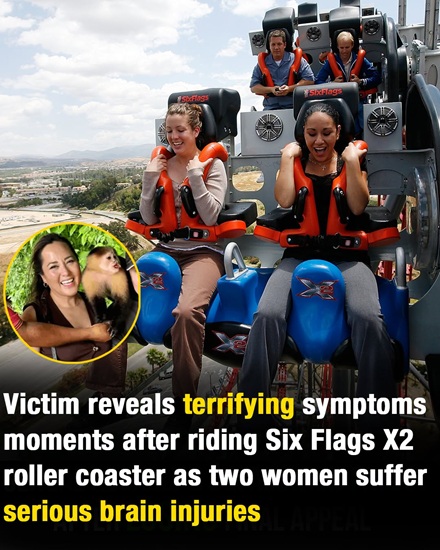
Two women suffered severe brain injuries within days of each other after riding the X2 roller coaster at Six Flags Magic Mountain in Southern California in July 2026. Both women required emergency brain surgery after becoming seriously ill following their rides on the attraction. One of them, 25-year-old Naomi Greer-Wilkinson, remained hospitalized with an uncertain medical outlook when CNN reported on the cases in late August. The other rider, Pamela Guillen, 40, survived emergency surgery and has since spoken publicly about the continuing effects of her injury.
The incidents have brought renewed scrutiny to X2 and to previous injury allegations involving the coaster. X2 is one of the best-known attractions at Six Flags Magic Mountain and is designed to provide a particularly intense ride experience. According to descriptions cited by CNN, its seats rotate independently 360 degrees forward and backward while the train moves along the track. Riders experience a drop of approximately 200 feet, while the coaster reaches speeds of up to 76 miles per hour.
The ride also includes unusual elements sometimes described as “raven turns,” in which the track and rotating seats combine to create rapid directional changes. Six Flags currently lists X2 among the attractions that are closed or undergoing work at the park. Pamela Guillen was visiting Magic Mountain on July 5 with her daughter Camille as part of a celebration for Camille’s 16th birthday. According to CNN’s reporting, Guillen became seriously unwell after riding X2 and was transported by ambulance to a hospital.
Doctors found that she had suffered an acute subdural hematoma accompanied by brain compression. Emergency surgery was performed to relieve the dangerous pressure on her brain. Her daughter described seeing her mother in an alarming condition immediately after the ride, while Guillen later said the experience turned an ordinary visit to an amusement park into a medical emergency within a very short period of time. Guillen survived the emergency and later regained consciousness, but her recovery has been difficult.

In interviews included in CNN’s reporting, she described continuing headaches, fatigue, and other effects of brain damage. She also discussed the emotional impact of struggling with ordinary activities that had previously been easy for her. The reporting did not suggest that every rider on X2 experiences similar problems, nor would these individual cases alone establish that the attraction necessarily injures riders. They do, however, represent serious medical incidents that investigators, doctors, attorneys and the families involved have sought to understand.
Six days after Guillen’s July 5 incident, Naomi Greer-Wilkinson, then 25, also rode X2. She was visiting the park with family members and collapsed after getting off the attraction, according to CNN. She was taken to the same hospital where Guillen had been treated and underwent emergency brain surgery. Her father, Joshua Wilkinson, told CNN that part of her brain had been damaged and had begun bleeding. Her parents described being warned by doctors that her condition was extremely serious, and CNN reported in late August that she remained hospitalized with an uncertain future.
The similarities between the two cases attracted particular attention from the medical professionals involved. Doctors who treated Guillen and Greer-Wilkinson told CNN that, in their professional opinion, the severe injuries were associated with a traumatic rapid acceleration-and-deceleration event experienced on X2. Their assessment represents a medical opinion based on the cases they treated rather than a final legal ruling about responsibility. Reports also said the injuries were of a kind that can occur when the brain is subjected to significant traumatic forces. Those medical findings have become an important part of the broader discussion surrounding the two incidents.

X2 continued operating for several days following Guillen’s injury. CNN reported that the coaster stopped operating shortly after Greer-Wilkinson was injured, and other reporting places the closure on July 12. As of late August and the beginning of September 2026, Six Flags’ own ride-closure page continued to list X2 as unavailable. Six Flags did not give CNN detailed answers to its questions about the recent incidents, though CNN said the company had stated in previous court filings that X2 underwent daily inspections and that a rider using the attraction normally and according to instructions should not suffer a traumatic brain injury.
The two July cases were not the first serious injuries to be alleged in connection with X2. CNN reviewed medical records, lawsuits and other documentation and reported finding more than a dozen riders who had suffered serious injuries and hospitalizations after riding the coaster over a period approaching two decades. Previous cases have included allegations of traumatic brain injuries and significant head or neck symptoms. These earlier cases should be described carefully as reported incidents, medical findings or allegations in litigation rather than as proof that the ride caused every injury attributed to it.
One earlier case involved Lucy Alvarez, who was 46 when she visited the park in 2021. CNN reported that Alvarez said she struck the back of her head against the ride’s headrest and later experienced dizziness and continuing head pain. After returning to San Diego, her symptoms persisted and she eventually went to an emergency department. Medical records reviewed by CNN reportedly showed that she was diagnosed with a traumatic subdural hematoma associated with the roller-coaster ride. Her attorney has said that she continues to experience memory problems, balance difficulties and chronic migraines.
Alvarez has pursued litigation over the incident. According to CNN, Six Flags argued in a legal filing that any injuries she suffered resulted from her own negligence and also relied on arguments concerning the risks assumed by passengers. Her attorney told the network that her case was scheduled for trial in October 2027. Because that litigation remains unresolved, allegations made by either side should not be treated as established findings of fault. A separate X2-related injury lawsuit was also reported by FOX 11 in late August 2026 as having received an August 2027 trial date.
Another highly serious case involved Christopher Hawley, a 22-year-old San Diego State University graduate who visited Six Flags Magic Mountain with his younger brother and cousin in June 2022. According to reporting based on the family’s lawsuit, Hawley complained of severe head pain and became unwell after riding X2. He later lost consciousness and was taken to a hospital, where imaging revealed catastrophic brain trauma. He died the following day, June 24, 2022. A coroner’s report cited in subsequent reporting attributed his death to blunt head trauma sustained in a park ride accident.
Hawley’s parents later filed a wrongful-death lawsuit against Magic Mountain LLC and S&S Worldwide, the company associated with replacement coaster trains used on X2. The family alleged that the attraction subjected Hawley to violent movement and that his fatal injury occurred while riding it. The defendants disputed liability. This distinction is important because allegations contained in lawsuits are claims made by the parties and should not automatically be presented as proven conclusions before a court has ruled on them.
The Hawley litigation has also changed since some earlier reports about X2 were published. On August 27, 2026, court filings showed that settlements had been reached involving Magic Mountain and S&S Worldwide, resolving the wrongful-death case before the planned trial. The terms of the agreements were not publicly disclosed. A settlement ends a legal dispute but does not, by itself, constitute a judicial finding that a company was negligent or legally responsible for the allegations made in the lawsuit.
The July 2026 injuries have now intensified questions surrounding X2’s operating history and the way serious amusement-ride incidents are investigated. Families of injured riders and their attorneys have publicly criticized the continued operation of the coaster after earlier incidents. Six Flags, meanwhile, has previously relied on inspection records, rider warnings and legal defenses when responding to injury claims. These are competing positions, and neither should be presented as an independently established conclusion without supporting evidence or a final regulatory or judicial finding.
California authorities oversee the operation of permanent amusement rides and can investigate serious ride-related incidents. Reporting in August indicated that the state’s occupational safety authorities had been examining circumstances involving X2. The coaster remained closed while questions surrounding the recent cases continued. The existence of an investigation does not itself mean that regulators have determined that the ride was defective or that Six Flags violated safety requirements. Any final conclusion would depend on findings released by the relevant authorities.
For Guillen, the consequences of the July incident have continued long after she left the amusement park. CNN reported that she still experiences frequent headaches, fatigue and difficulty with activities that were once routine. Her description of recovery illustrates how a traumatic brain injury can continue affecting someone well after emergency treatment has ended. Her experience is individual, however, and should not be used to predict the medical outcome of another patient or to make broad claims about the safety of roller coasters generally.
Greer-Wilkinson’s family has faced a different and deeply uncertain situation. When CNN reported on her condition at the end of August, she remained hospitalized after emergency brain surgery. Her parents spoke publicly about the seriousness of her condition and their concern that she had been able to ride X2 at all. Those comments reflect the family’s perspective during an extremely difficult medical crisis and should be attributed to them rather than presented as independent findings about the park’s responsibility.
The case has also demonstrated why distinctions between confirmed facts, medical opinions, allegations and legal conclusions matter when covering serious accidents. It is confirmed that both Guillen and Greer-Wilkinson became critically ill after riding X2 and required emergency brain surgery. Their doctors have expressed the professional opinion that rapid acceleration and deceleration during the ride caused their severe injuries. At the same time, there had not been a publicly reported final regulatory determination establishing all of the causes or assigning legal responsibility for the July incidents when the latest reports were published.
As of September 1, 2026, X2 remains listed as closed on Six Flags Magic Mountain’s official scheduled-closure page. Public reporting has not established when the attraction might return to operation, and speculation about a reopening date should therefore be avoided. The most accurate description at present is that the ride is unavailable while scrutiny surrounding the recent injuries continues. Anyone following the story should rely on official park announcements, state safety findings and subsequent reporting for confirmed developments rather than unverified social-media claims.
The injuries suffered by Pamela Guillen and Naomi Greer-Wilkinson have transformed what began as two separate family visits to an amusement park into a wider examination of one of Magic Mountain’s most recognizable attractions. Their cases have renewed attention on earlier X2-related injury claims, the 2022 death of Christopher Hawley and the way amusement-ride safety concerns are evaluated. For now, the central facts are serious enough without exaggeration: two women required emergency neurological surgery after riding the same coaster six days apart, one continued to face significant health problems, and the other remained hospitalized when CNN published its investigation. X2 remains closed as questions about the attraction continue.
