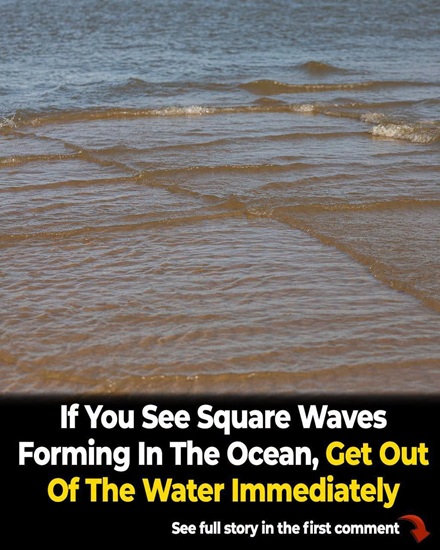
Spending time near the ocean is one of the pleasures many people associate with warm weather, holidays, and summer travel. Beaches can offer opportunities for swimming, boating, surfing, walking, and simply enjoying the view, but the ocean is also a constantly changing natural environment. Wind, tides, currents, waves, underwater terrain, and weather conditions can all influence what happens near the coast. Among the more unusual sights sometimes visible at sea is a pattern commonly described online as “square waves.”
The scientific and maritime term generally used for this phenomenon is a cross sea, and despite its nickname, the water is not actually forming perfectly geometric squares. Instead, two different wave systems intersect and can produce a grid-like appearance when viewed from above. A cross sea develops when waves traveling in different directions occupy the same area of water at the same time. Ocean waves can continue traveling for considerable distances after being generated by wind, meaning a swell produced by one weather system may eventually encounter waves produced somewhere else.
A change in wind direction can also create a newer wave system while an older swell continues moving through the area. When these systems cross at noticeably different angles, their crests can intersect and create a pattern that resembles squares or diamonds on the water’s surface. The pattern is particularly striking when the two systems approach something close to a right angle. Seen from an elevated viewpoint, the ocean can briefly resemble a giant moving checkerboard.
The appearance is unusual enough that photographs and videos of cross seas regularly circulate online. Some posts describe them as mysterious “square waves,” which can make the phenomenon sound almost artificial. In reality, the explanation lies in wave mechanics and changing weather conditions rather than the water somehow organizing itself into fixed geometric shapes. Individual waves continue moving while interacting with other waves, so the pattern is dynamic rather than permanent.
Eventually, one of the wave systems may weaken, change direction, or move away, causing the grid-like appearance to disappear. This changing nature is one reason photographs captured at the right moment can appear particularly dramatic. Crossing wave systems are important to maritime researchers because they can create complicated conditions for vessels. A ship normally responds to wave motion through pitching, rolling, heaving, and other movements, and waves approaching from multiple directions can make those motions more difficult to predict or manage.
Research examining accidents associated with bad weather has identified combinations of wind sea and swell as factors deserving attention when assessing dangerous marine conditions. A 2004 study of dangerous sea states examined shipping accidents and found indications that rapidly developing conditions and particular combinations of wind-generated waves and swell may play an important role. This does not mean that every cross sea causes an accident, but it demonstrates why multidirectional waves matter to maritime safety.
For larger vessels operating in open water, crossing waves can be especially uncomfortable or potentially hazardous when the sea state is already severe. Waves arriving from different directions can contribute to pronounced rolling and other complex ship movements. Researchers have therefore studied multidirectional waves as part of efforts to understand marine operations and improve forecasting of potentially dangerous conditions. The severity depends on many variables, including wave height, wave period, direction, vessel design, wind, and the broader sea state. It would consequently be misleading to judge the danger of an ocean merely because a photograph shows a grid-like surface pattern. Professional mariners rely on detailed forecasts and operational information rather than visual appearance alone.
Online descriptions sometimes go further and claim that seeing square waves means swimmers must immediately expect a deadly current beneath them. That statement is too broad. Cross seas involving large waves offshore can unquestionably create difficult conditions, but the presence of a small cross-wave pattern near the coast does not automatically mean that a swimmer is facing the same danger as a ship navigating a severe open-ocean sea state. Reporting on the phenomenon has specifically noted that warnings presenting every cross sea as immediately life-threatening to swimmers can be misleading. Local wave height, currents, wind, seabed conditions, weather warnings, and instructions from lifeguards or authorities remain much more relevant to an individual swimmer’s safety.
This distinction is particularly important because another ocean hazard, the rip current, is different from a cross sea. Rip currents are concentrated flows of water moving away from the shoreline and can pose a serious danger to swimmers by carrying them farther offshore. They may not produce the dramatic checkerboard appearance associated with crossing waves and can sometimes be difficult to recognize from the beach. Therefore, people should not assume that unusually shaped waves are the only indication of potentially hazardous swimming conditions. Checking local beach warnings, weather information, flags, and lifeguard advice remains one of the most practical approaches before entering unfamiliar water.
One location that has become particularly famous for photographs of cross seas is Île de Ré, an island off the Atlantic coast of France near La Rochelle. Elevated viewpoints around the island can make intersecting wave systems easier to recognize because the pattern is much more obvious when seen from above than from water level. Photographs taken in the area have helped popularize the expression “square waves” on the internet. Île de Ré is therefore frequently mentioned whenever the phenomenon is explained in educational articles about ocean waves. The island is not the only location where cross seas can develop, however, because intersecting wave systems can occur in many parts of the world’s oceans when suitable conditions exist.
Visitors to Île de Ré should also avoid assuming that every day produces the spectacular geometric pattern shown in viral photographs. Ocean conditions constantly change, so the visibility and intensity of crossed waves depend on the wave systems affecting the area at a particular moment. The island has ordinary beaches and surfing locations as well as the conditions that sometimes create the famous photographs. Official tourism information for Île de Ré advises people participating in water activities to check weather and tides and to follow appropriate safety precautions. Some local surf spots can produce powerful waves and are specifically recommended only for experienced surfers.
Another dramatic meeting of marine waters can be observed around Cape Reinga/Te Rerenga Wairua in northern New Zealand. New Zealand’s Department of Conservation explains that currents associated with the Tasman Sea and Pacific Ocean meet offshore over the Columbia Bank, sometimes creating broken water, large areas of foam, spray, and turbulent-looking waves. The location is famous for the visual power of these interacting waters, although it should not simply be treated as an identical example of every photograph labeled “square waves.” Ocean-current interactions and cross-sea wave patterns are related to complex marine conditions but should be described accurately rather than grouped together solely because the surface looks unusual.
Cape Reinga is also significant for reasons extending well beyond oceanography. Te Rerenga Wairua is a place of profound cultural importance to Māori, and New Zealand’s Department of Conservation asks visitors to respect the cultural protocols associated with the location. The lighthouse and surrounding landscape attract visitors who can observe the ocean from land without needing to approach the turbulent waters offshore. Official information describes the region as exposed to powerful winds, surf, and rapidly changing conditions. This provides another reminder that spectacular coastal scenery is best appreciated while respecting both environmental conditions and local guidance.
Scientists study crossed waves through mathematical models that attempt to describe how different wave systems interact. Research into nonlinear wave behavior is considerably more complicated than the simplified explanation usually attached to social-media photographs. Equations used in fluid dynamics can help researchers understand how wave energy, direction, wind, and other variables influence the evolution of crossing seas. The Kadomtsev–Petviashvili equation, often abbreviated as the KP equation, belongs to a family of mathematical approaches used in the study of nonlinear wave behavior. However, describing every photograph of square-looking waves simply as “the KP equation in action” would oversimplify the science. Real ocean conditions involve multiple interacting physical processes and often require more sophisticated models and measurements.
One reason cross seas remain visually fascinating is that most people expect incoming waves to appear roughly parallel when they approach a shoreline. Watching another set of crests move across those waves from a different direction challenges that familiar image of how the ocean is supposed to look. From a high viewpoint, the intersections can become remarkably regular, creating rows of moving diamonds or squares. From beach level, however, the geometric effect may be much harder to recognize because perspective compresses the surface of the ocean. The famous aerial or lighthouse photographs therefore provide a view that swimmers standing at water level may never experience in quite the same way.
Weather systems located far away can also influence what someone sees at a beach. Swells can travel beyond the region where the wind originally generated them, carrying wave energy across substantial distances. If another wind or swell system enters the same region from a different direction, the two can coexist. This is why the weather directly above a beach is not always enough to explain every wave arriving at the shoreline. Ocean conditions can contain the history of weather occurring elsewhere, sometimes far beyond what a person standing on the beach can see.
For recreational swimmers, surfers, and boaters, the most sensible lesson is not to panic whenever waves intersect but to respect unfamiliar conditions. Large, confused, or multidirectional seas can be difficult to navigate, and someone without appropriate experience should not assume that visually impressive water is safe simply because the sky appears calm. At supervised beaches, warnings and lifeguard instructions provide more useful safety information than viral social-media rules. Boaters should similarly consider official marine forecasts and vessel-specific limitations before heading into difficult conditions. Cross seas are one component of marine safety rather than a universal signal that disaster is about to occur.
It is also worth remembering that wave height matters enormously. Two small wave systems crossing close to shore are very different from powerful multidirectional swells affecting a vessel in the open ocean. Research into shipping accidents concerns marine conditions with numerous interacting factors, not simply the presence of a checkerboard pattern. Turning that research into claims that any visible square wave will instantly pull a swimmer underwater removes important context from the science. Accurate safety information should acknowledge genuine risks without exaggerating them.
The phenomenon provides an excellent example of how beautiful natural events can also lead to misunderstandings once photographs spread online. A striking image attracts attention, a dramatic warning is added, and eventually the warning can be repeated without its original scientific context. Cross seas deserve respect, particularly when wave conditions are strong, but they do not need frightening exaggerations to be interesting. The actual physics behind them is already remarkable: separate systems of waves generated by winds and weather can travel across the ocean and intersect to create an unexpectedly organized-looking surface.
For people observing such conditions from a safe coastal viewpoint, a cross sea can be an extraordinary sight. The pattern demonstrates that the ocean is not a single set of waves traveling neatly toward land but a complicated environment carrying energy from different directions. Each swell has its own origin, speed, wavelength, period, and direction, and the surface we see is the combined result of those influences. A geometric-looking sea therefore offers a visible reminder of processes occurring over much larger distances than the photograph itself suggests.
Safety around any coastline ultimately depends on paying attention to the actual conditions rather than relying on one visual rule. Swimmers should consider local warnings, currents, wave conditions, weather changes, and their own abilities. Surfers should understand the characteristics of the break they intend to enter, while boat operators need appropriate marine forecasts and experience for the expected sea state. If conditions appear unusually rough, confused, or unpredictable, remaining ashore until they improve can be the safest decision.
Square waves, or more accurately cross seas, are therefore both scientifically interesting and worthy of sensible caution. They form when different wave systems intersect, sometimes creating the extraordinary checkerboard patterns seen in photographs from places such as Île de Ré. Strong crossing seas can contribute to challenging and potentially hazardous conditions for ships, particularly when other aspects of the sea state are severe. At the same time, it is inaccurate to claim that every small cross-sea pattern near a beach is automatically a deadly threat to swimmers. Understanding that difference allows people to appreciate one of the ocean’s most unusual sights without replacing useful safety information with unnecessary fear.
The ocean can be spectacular precisely because it is dynamic, complicated, and never completely identical from one moment to the next. Cross seas are one example of that complexity, transforming ordinary-looking swells into a pattern that can seem almost deliberately designed. The science behind the phenomenon is more interesting than the alarming myths that sometimes accompany it online. By respecting local conditions, using reliable safety information, and viewing unusual seas from an appropriate location when conditions are uncertain, people can appreciate this remarkable natural phenomenon while keeping the risks in proper perspective.
