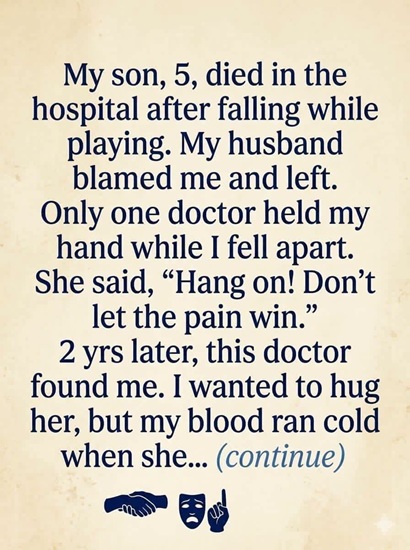
The account begins with a moment that no parent would ever want to experience. According to the story, a mother lost her young son after a serious playground accident in which he slipped, suffered a devastating injury, and never regained consciousness. What had begun as an ordinary day was transformed within hours into a period of shock, uncertainty, and profound grief. The hospital environment became part of the memory, with medical equipment, quiet conversations, and people waiting for news that would never bring the recovery everyone hoped for.
Nothing about the experience could make the death seem reasonable or fair. From that point forward, the mother described her life as being divided into everything that existed before the accident and everything that came afterward. The loss affected more than one person, and the story emphasizes that grief can take very different forms even inside the same family. Her husband was also overwhelmed by what had happened, but the two parents did not respond to the tragedy in the same way.
Feelings of guilt, helplessness, and anger began to influence their relationship, and communication became increasingly difficult. Instead of becoming a source of stability for one another, they gradually became more distant. Eventually, according to the account, the marriage ended and her husband left. The mother was therefore dealing not only with the death of her son but also with the collapse of a relationship that had once been part of her expected future.
Returning home after the hospital created another kind of pain. Ordinary rooms contained reminders of a child who was no longer there, and familiar objects suddenly carried a completely different emotional weight. A bedroom, a toy, a piece of clothing, or a routine household sound could bring memories back without warning. Grief did not appear only during formal moments of remembrance. It entered ordinary activities such as waking up, preparing food, walking through the house, or reaching automatically for something connected with her son. The world around her continued moving, but emotionally she often felt unable to move with it.
The story also describes a doctor who remained near the mother during one of the hardest moments at the hospital. The doctor could not offer an explanation capable of removing the tragedy, nor could she promise an outcome that medicine could no longer provide. What she offered instead was presence. She stayed nearby, held the grieving mother’s hand, and encouraged her not to allow the loss to destroy every remaining part of her life. Those words did not eliminate grief, and the account does not suggest that a brief conversation could repair such a devastating experience. Their importance came from the fact that the mother was not entirely alone during the first overwhelming hours.
In the weeks and months that followed, healing was anything but predictable. Some mornings, getting out of bed felt almost impossible, while on other days she managed to complete basic tasks and spend a short period outside. Progress was measured in small actions rather than dramatic transformations. Taking a shower, eating a meal, answering a message, or sitting in sunlight could represent meaningful effort during an especially difficult day. She gradually learned that grief did not move according to a calendar. A relatively peaceful morning could be followed by an unexpectedly painful afternoon, and an anniversary or familiar sound could revive emotions she thought had become easier to manage.
Eventually, the mother joined a grief-support group. The significance of those meetings was not that everyone had experienced exactly the same tragedy. Instead, participants understood what it meant to live with major loss and to encounter emotions that other people sometimes found difficult to discuss. In that setting, she could speak about her son without feeling that she needed to shorten the conversation or protect others from discomfort. She could say his name and remember particular moments from his life. The support group did not provide a cure for grief, but it gave her a place where grief did not have to be hidden.
Writing became another important part of the process described in the account. The mother began keeping a private journal and sometimes wrote entries as letters to her son. She recorded memories she feared might fade, along with anger, sadness, guilt, questions, and ordinary details she wanted to preserve. Writing allowed complicated emotions to exist on the page without requiring immediate answers. Some entries were painful, while others focused on happy memories. The journal gradually became a record not only of what she had lost but also of the changing ways she was learning to live with that loss.
She also planted a garden in memory of her son. The garden did not symbolize forgetting, nor was it presented as something capable of replacing him. It simply provided a physical place where care could continue. Watering plants, removing weeds, watching flowers appear, and noticing the changing seasons introduced gentle routines into days that had once felt almost completely without structure. Growth in the garden could not undo the past, but the repetitive work gave her something tangible to care for. Over time, the space became associated with remembrance rather than only with tragedy.
None of these practices made grief disappear. The story is careful about that distinction. Support groups, journals, gardens, relationships, or personal routines cannot guarantee that someone will stop feeling the pain of bereavement. Instead, the mother gradually discovered that pain could become one part of her life rather than controlling every part of it. There were still difficult mornings, unexpected memories, and periods when sadness returned intensely. The difference was that those moments no longer seemed to erase everything else. She slowly developed room for grief and ordinary life to exist at the same time.
Approximately two years after the original hospital encounter, the account says the mother attended a community event connected with child safety and support for families. While there, she heard a familiar voice and realized that the doctor from the hospital was participating in the event. The two women recognized one another and began talking. Their first meeting had occurred under devastating circumstances, so seeing each other again in a completely different environment brought back powerful memories. This time, however, they were able to speak for longer and learn more about what had happened in each other’s lives after that hospital night.
During their conversation, the doctor reportedly shared that her own child had later experienced a serious accident. The circumstances and outcome were not described as identical to the mother’s loss, and the account does not treat the two experiences as interchangeable. What changed for the doctor was her understanding of how suddenly fear can take over a family’s life when a child’s safety is threatened. The experience reportedly influenced the way she communicated with frightened parents and contributed to her growing interest in accident prevention and emotional support. Shared vulnerability created a different kind of connection between the two women.
Their relationship was important partly because neither woman attempted to claim complete understanding of the other’s experience. Grief is deeply individual, even when two people have faced situations that appear similar from the outside. They could acknowledge fear, helplessness, guilt, and uncertainty without turning suffering into a competition. Listening became more valuable than searching for perfect words. The account emphasizes this point because people dealing with loss are sometimes surrounded by friends who desperately want to help but do not know what to say. Practical support and patient presence can often matter more than an elaborate explanation.
As their conversations continued, the mother and doctor began discussing ways they might support other families. According to the story, those discussions eventually developed into an initiative focused on grief resources, family support, and child-safety awareness. The project was intended to connect parents with useful information while creating opportunities for honest conversations about bereavement and accident prevention. Its purpose was not to suggest that every accident can be prevented or that grieving families should turn their experiences into public causes. Instead, it represented one particular way these two women chose to respond to what they had experienced.
An important part of the story is the distinction between finding purpose after tragedy and claiming that tragedy happened for a purpose. The son’s death was not presented as necessary, beneficial, or justified by anything that came later. No organization, project, or act of service could make the loss worthwhile. The mother did not need to believe that her child had died so that she could eventually help other people. Her later work simply represented a choice about how to use the love, energy, and experience that remained after something irreversible had happened.
That distinction matters because inspirational stories can sometimes make grief appear too simple. A person experiences tragedy, discovers a mission, and suddenly everything seems resolved. Real bereavement rarely follows such a clean sequence. In the account, the mother continued to experience sadness even after becoming involved in helping other families. Working on child-safety issues sometimes brought difficult memories back to the surface. Listening to other parents could be emotionally exhausting. Meaningful work and painful memories could exist side by side rather than one replacing the other.
She therefore had to learn boundaries as well. Helping another grieving parent did not require carrying that person’s entire emotional burden. Resting did not mean abandoning the initiative, and taking a day away from discussions of loss did not mean she loved her son any less. She could continue attending her support group, writing privately, spending time in the garden, and participating in ordinary activities unrelated to grief. These different parts of life supported one another. No single practice was treated as the solution to everything she had experienced.
As more time passed, moments of genuine peace began to appear more often. At first, those moments sometimes created guilt. Laughing could feel strange when she remembered how much had been lost, and enjoying an afternoon could produce the uncomfortable feeling that she was somehow moving too far away from her son. Gradually, however, she began to understand that remembering someone does not require remaining in uninterrupted pain. Love can continue even when laughter returns. A good day does not erase a difficult history, and building new relationships does not cancel the importance of relationships that existed before.
Her son’s memory remained part of her identity, but it no longer had to be represented exclusively through the circumstances of his death. She could remember his personality, favorite activities, small habits, jokes, and moments of affection. This allowed his life to occupy a larger space in memory than the accident that ended it. The garden, journal, and conversations with others became ways of preserving those memories without turning every remembrance into a retelling of the hospital experience. Over time, remembering became capable of containing warmth as well as sorrow.
The project with the doctor also changed the way the mother understood service. At first, helping other families seemed closely tied to the need to make something meaningful emerge from terrible circumstances. Later, she realized that meaningful action did not need to justify the past. It could simply improve the present for another person. Sharing information about child safety, directing someone toward grief resources, or listening to a struggling parent could have value on its own. The usefulness of those actions did not depend on pretending that tragedy had been necessary.
The doctor reportedly experienced a similar shift in perspective. Medical professionals routinely work with frightened families, but personal experience can alter how someone understands emotional vulnerability. Her own family’s accident did not make her automatically understand every parent’s circumstances. It did, however, reinforce the importance of listening carefully and recognizing the human experience surrounding medical treatment. Technical knowledge and compassion were not opposing qualities. In difficult situations, families could need accurate medical information while also needing to feel that their fear and grief were being acknowledged.
The mother’s relationship with her former husband remained another unresolved part of the story. Their marriage did not recover simply because she began healing in other areas of life. The separation remained one of the consequences surrounding an already devastating period. The account does not reduce either person to a villain or suggest that grief always damages marriages in the same way. Couples respond to bereavement differently, and no single story can represent every family. In this case, however, loss and guilt contributed to a distance that ultimately became permanent.
Accepting that reality required another form of grieving. The mother was not only mourning her son but also the future she once imagined for her family. Birthdays, holidays, family traditions, and plans for later years had all been imagined differently before the accident. Healing therefore involved acknowledging several losses at once. Some were obvious, while others became clear only months later. The future itself had to be imagined again, not because she wanted to replace what had existed, but because life continued despite the fact that its original direction had been interrupted.
Over time, the idea of moving forward became easier to understand than the phrase “moving on.” Moving on could sound as though a person was expected to leave someone behind. Moving forward allowed memory to remain part of the journey. The mother could continue loving her son while building a different life. She could experience sadness and still make plans. She could participate in the initiative and also enjoy activities that had nothing to do with grief. Emotional recovery did not require choosing between remembrance and living.
The larger message of the story is therefore not that suffering automatically produces strength. Some experiences remain painful and unfair regardless of what follows them. The more careful lesson is that people sometimes develop new relationships, routines, and forms of meaning while carrying experiences they never would have chosen. Growth does not prove that the original tragedy was good. It shows that a human life can contain more than one emotional truth at the same time. Deep sadness can exist beside compassion, and remembrance can exist beside hope.
The account also highlights the importance of avoiding simplistic expectations about bereavement. There is no universal schedule that determines when someone should feel better, stop talking about a loved one, remove belongings, return to work, or begin enjoying life again. Individual circumstances vary enormously. Some people find comfort in groups, while others prefer private reflection. Some create memorial projects, while others do not. The mother’s choices in this story represent her own path rather than instructions that every grieving person should follow.
Similarly, turning personal loss into advocacy or service is not an obligation. A grieving parent does not owe the public an organization, campaign, speech, or inspirational lesson. In this account, community work became meaningful because the mother voluntarily chose it and because it fit the way she wanted to remember her child. Another person might find meaning through family life, private remembrance, creative work, faith, professional support, or completely different activities. There is no single correct way to carry the memory of someone who has died.
Child-safety awareness also benefits from careful language. Serious accidents can happen even when adults make thoughtful efforts to protect children. Prevention efforts can reduce certain risks, but they cannot eliminate every possible danger. Families affected by accidents should therefore not automatically be blamed for what happened. Effective safety education focuses on practical information, safer environments, appropriate supervision, and evidence-based measures rather than using fear or shame. This distinction allows prevention efforts to remain constructive while respecting families who have already experienced devastating events.
The partnership described in the story reflects this approach. Rather than presenting themselves as people with every answer, the mother and doctor focused on connecting families with support and encouraging conversations about safety. Their experiences gave them motivation, but personal experience alone was not treated as a substitute for professional guidance or verified safety information. The most responsible form of advocacy recognizes those limits. Emotional stories can encourage people to pay attention, while reliable information should guide actual safety decisions.
Years after a profound loss, memory can continue to change without disappearing. A mother may remember an anniversary differently from one year to the next. A song can unexpectedly bring back a particular afternoon. A photograph can create sadness on one occasion and gratitude on another. These changing reactions do not mean the importance of the person has diminished. They reflect the way memory becomes integrated into a life that continues to accumulate new experiences.
In the account, the mother’s greatest transformation was not that grief vanished. It was that grief gradually lost the ability to define every hour of every day. Her son’s absence remained real. Her marriage remained over. The hospital experience remained part of her history. Yet those facts no longer represented the complete story of her life. There was also a garden, a journal, supportive people, meaningful work, new conversations, quiet mornings, and eventually moments of happiness that no longer felt like betrayal.
That is what gives the story its emotional significance. Something meaningful grew after devastation, but nothing meaningful replaced the child who was lost. Compassion stood beside grief rather than erasing it. Service stood beside memory rather than justifying tragedy. New relationships stood beside old love rather than competing with it. The mother’s life did not return to the version that existed before the accident, because some events change a person permanently. Instead, she gradually learned that permanent change does not have to mean permanent hopelessness.
Ultimately, this account presents healing as an ongoing process rather than a dramatic conclusion. There is no moment when the past is undone and no project capable of returning what was lost. What changes is the amount of space life gradually develops around the pain. Memories remain, but so do opportunities for connection, purpose, rest, and even joy. The mother does not defeat grief by forgetting her son. She learns to carry his memory into a life that continues to grow, demonstrating that meaning can exist after loss without ever pretending that the loss itself was necessary.
