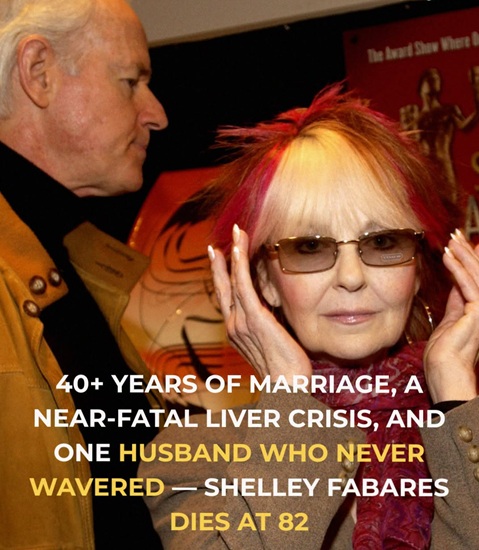
Shelley Fabares, the actress and singer whose career stretched from the golden age of television into the 1990s, died on Saturday, August 22, 2026, in Los Angeles at the age of 82. Her death brought renewed attention not only to the television roles and music that made her famous, but also to the difficult health crisis she survived decades earlier. Fabares was surrounded by loved ones at the time of her death, according to a statement released by her family. No cause of death was disclosed in the initial announcement.
She is survived by her husband, actor Mike Farrell, and her stepchildren. For generations of television viewers, Fabares was a familiar and comforting presence. Her family remembered her as much more than a performer, describing the kindness, humor and generosity she brought to the people around her. Those qualities were also remembered publicly by friends and colleagues following her death. Craig T. Nelson, who worked alongside Fabares for years on Coach, paid tribute to his longtime costar and recalled the importance of their relationship.
Her death therefore marked the loss not only of an accomplished entertainer but also of a woman whose friendships and family relationships remained an important part of her life. Born Michele Marie Fabares in Santa Monica, California, on January 19, 1944, she entered entertainment at an unusually young age. Acting and performance were already present in her extended family through her aunt, celebrated actress and singer Nanette Fabray.

Fabares modeled as a young child before moving into television, making her television debut when she was around 10 years old. What began as childhood work soon developed into a professional career that would continue, with different phases and reinventions, for decades. By her teenage years, Fabares had become known to millions of American television viewers.
Her breakthrough came through The Donna Reed Show, where she portrayed Mary Stone, the daughter of Donna Reed’s character. Fabares joined the family sitcom during its early years and became one of the program’s defining young performers. The role arrived during an era when television was rapidly becoming a central part of American popular culture, and her regular appearances made her a recognizable face nationwide. Donna Reed also became an important professional influence on the young actress. The success of the series gave Fabares a foundation that allowed her to move into music and movies while she was still very young.

Music unexpectedly became another major chapter of her early career. In 1962, Fabares recorded “Johnny Angel,” a song that became an enormous commercial success and reached No. 1 on the Billboard Hot 100. The achievement transformed her from a successful television actress into a recording star as well. Although acting ultimately remained the main focus of her career, “Johnny Angel” became permanently associated with her name. Decades later, the recording continued to introduce Fabares to listeners who may not have been old enough to remember her original television success.
Hollywood soon offered additional opportunities. During the 1960s, Fabares appeared in three movies with Elvis Presley: Girl Happy, Spinout and Clambake. Working with one of the world’s most famous entertainers expanded her visibility beyond television and music. She also appeared in other films during the decade, including Ride the Wild Surf. Following her death, actress Barbara Eden, who had worked with Fabares on that film, remembered her as a kind and talented friend. The tribute demonstrated how relationships Fabares formed during her early career continued to be remembered more than six decades later.
Fabares successfully navigated the difficult transition from child and teenage performer to adult actress. Her credits eventually included appearances on numerous popular television programs, and she continued finding new audiences long after The Donna Reed Show. Her work included One Day at a Time, along with guest appearances on familiar television series. She also appeared in the acclaimed television movie Brian’s Song. Rather than being remembered exclusively for the role that made her famous as a teenager, Fabares repeatedly found ways to remain active as the television industry changed around her.

One of the biggest opportunities of her adult career arrived in 1989 with the ABC sitcom Coach. Fabares portrayed Christine Armstrong opposite Craig T. Nelson’s Hayden Fox. The series ultimately ran for nine seasons and 200 episodes, while Fabares remained an important part of its success. Her performance earned her two Emmy nominations and introduced her to a generation of viewers who may have had little familiarity with her earlier career. Years later, Fabares remembered her experience making Coach with considerable affection, describing the opportunity as an especially positive period of her professional life.
While television audiences knew Fabares through her characters, her private life eventually became centered on another television star. She and Mike Farrell, best known for playing B.J. Hunnicutt on MASH*, first crossed paths years before they became a couple. Their lives took separate directions before they eventually reconnected. Fabares had previously been married to music producer Lou Adler, while Farrell had been married to actress Judy Farrell and had two children from that marriage. By the early 1980s, circumstances had changed, allowing Fabares and Farrell to develop the relationship that would define much of their adult lives together.
Fabares and Farrell married on December 31, 1984, in the backyard of Nanette Fabray’s home. Their marriage also created a blended family, with Fabares becoming stepmother to Farrell’s children. Like many blended families, adjusting to the new relationships required patience and time. Fabares later spoke about the emotional work involved in building those bonds rather than presenting the transition as effortless. Over the decades, however, the marriage between Fabares and Farrell became an enduring partnership. They remained married for more than four decades, until her death in 2026.
A major challenge arrived in 1994, beginning with what initially appeared to be a serious but straightforward accident. Fabares fell through floor joists while her home was under construction. The fall left her with every rib on the left side of her body broken. Doctors treated the immediate injuries and recommended that she follow up with her physician afterward. Those routine medical checks unexpectedly revealed something much more concerning: tests showed severely abnormal liver counts. The accident that injured her ribs had inadvertently led doctors toward the discovery of a potentially life-threatening medical problem.
At first, physicians could not identify precisely what was causing the liver abnormalities described in the 2003 Cedars-Sinai account. Fabares began taking medication, and for several years her condition appeared relatively stable even though her liver test results remained abnormal. For a time, there was reason to hope the situation could continue to be controlled. That changed dramatically in early 1999. Without warning, Fabares experienced a severe esophageal bleed and was rushed to the emergency department at Cedars-Sinai Medical Center in Los Angeles. The frightening episode revealed how serious her liver disease had become.
After doctors stabilized her, they explained that the bleeding was connected to progressive liver failure. Her liver had deteriorated to a point where medication could no longer reverse the damage, according to Cedars-Sinai’s later account of her experience. Another bleeding episode could potentially be fatal. A liver transplant was no longer simply a distant possibility; it had become necessary for her survival. Fabares later recalled that she initially struggled to understand how urgently she needed the procedure. Eventually, the reality became unavoidable: without a donor liver, she faced a potentially fatal outcome.
In April 1999, Fabares was placed on the liver transplant waiting list. Waiting for an organ brought an entirely different form of uncertainty. A transplant could not simply be scheduled like an ordinary operation because an appropriate donor organ first had to become available. Fabares understood that many people waiting for organs became too ill or died before a suitable transplant could take place. The situation created enormous physical and emotional strain. Her health was deteriorating while she and Farrell waited for a telephone call or pager alert that could determine whether she would receive another chance at life.
The pager Fabares carried became a constant reminder of that uncertainty. She later recalled that it sometimes went off because someone had dialed the wrong number, producing moments of immediate panic before she and Farrell realized there was no transplant available. Eventually they learned to control their reactions, but the emotional pressure remained. Behind the scenes, Farrell stayed deeply involved in her care. What viewers saw on television gave little indication of the exhausting medical uncertainty the couple was facing privately.
As the months passed, Fabares became progressively weaker. She later described overwhelming exhaustion as one of the most difficult aspects of the illness. Even something as ordinary as getting out of bed for a glass of water could feel like too much effort. She was not describing a dramatic Hollywood storyline but the everyday reality of serious illness: sleeping for long periods, losing energy and waiting without knowing when or whether a donor organ would become available. Farrell remained beside her throughout the process, accompanying her to medical appointments and helping her deal with responsibilities that became increasingly difficult to manage.
Fabares received guidance from the medical specialists overseeing her case at Cedars-Sinai, including hepatologist John Vierling and transplant surgeon Steve Colquhoun. She later credited the medical team with helping both her and Farrell understand what was happening while dealing with the fear surrounding the transplant process. Their willingness to explain the situation repeatedly became important to the couple as they navigated months of uncertainty. Fabares would later speak with deep gratitude about the physicians and other medical professionals whose work helped keep her alive.
Finally, on October 23, 2000, the message they had spent so long waiting for arrived: a donor liver was available. Fabares had spent roughly 22 months waiting for a transplant. The procedure at Cedars-Sinai was successful, giving the actress an opportunity to rebuild her life after years of worsening health. The transplant did more than address a medical crisis. Fabares later explained that the experience fundamentally changed the way she thought about life, relationships and what mattered to her.
Her gratitude extended to the donor whose organ made her survival possible. Organ transplantation involves a complicated mixture of hope and grief because the opportunity for one patient to survive can arise from another family’s devastating loss. Fabares became acutely aware of that reality during the long months she spent waiting. Her experience also highlighted the persistent shortage of donor organs. In 2000, the United Network for Organ Sharing reported thousands more people awaiting liver transplants than the number of liver transplant procedures performed that year.
Farrell’s role during his wife’s illness became one of the defining elements of their relationship. Fabares later said he had accompanied her to every doctor’s appointment during the period when she was seriously ill. She credited him with helping her through an experience that affected her physically, psychologically and emotionally. Rather than describing the illness as something that pushed them apart, Fabares said the crisis made their family stronger and closer. The experience offered a private example of the commitment behind a marriage that ultimately lasted more than four decades.
The transplant also changed Fabares’ perspective on everyday life. By 2003, when Cedars-Sinai published a detailed account of her medical journey, she said she viewed herself differently than she had before becoming critically ill. Life had returned to a degree of normality, but she believed the experience had permanently altered her priorities. She expressed gratitude for being alive, for her medical team, for what she had learned and particularly for Farrell’s support. Surviving a crisis that could easily have ended differently gave ordinary days a new significance.
Health advocacy also became part of Fabares’ public life for another deeply personal reason. Her mother developed Alzheimer’s disease, and Fabares became involved in raising awareness about the illness. Her advocacy reflected experiences within her own family rather than simply being another celebrity endorsement. That work became another dimension of a public life already spanning acting, music and her own serious medical history. Farrell likewise became known for supporting humanitarian and human-rights causes during his career.
Fabares’ professional accomplishments remained substantial even as her personal experiences gave her life story additional dimensions. She had achieved something unusual in Hollywood: success across multiple generations of television. Viewers of the late 1950s and early 1960s knew her as Mary Stone. Music listeners remembered the voice behind “Johnny Angel.” Elvis Presley fans recognized her from his movies, while later television audiences knew her as Christine Armstrong on Coach. Few performers successfully maintained such a recognizable presence across so many different periods of American entertainment.
Her work on Coach was particularly important in demonstrating the longevity of her talent. When the series began in 1989, decades had passed since Fabares first became famous as a teenager. Yet Christine Armstrong became one of her most memorable roles. The chemistry between Fabares and Craig T. Nelson helped anchor the personal side of a sitcom largely centered on football coach Hayden Fox. Fabares earned two Emmy nominations for the performance, providing formal recognition for a role that connected her with another large television audience.
Nelson’s reaction after her death demonstrated how meaningful that professional partnership had become. He remembered Fabares not simply as a costar but as an important figure in his own life. Other colleagues similarly recalled her warmth following the announcement of her death. Barbara Eden looked back on their experience making Ride the Wild Surf in Hawaii during the 1960s, showing the extraordinary length of Fabares’ connections within Hollywood. These tributes came from people associated with very different chapters of a career that stretched across much of television history.
Her relationship with Farrell, meanwhile, lasted even longer than many of the television programs that had made both actors famous. They were married for approximately 42 years and supported one another through career changes, family responsibilities and serious health challenges. Farrell spoke publicly about their relationship over the years, including shortly before her death. Their story was not presented as a perfect Hollywood romance without complications. Instead, both acknowledged the work required to build a blended family and maintain a partnership over decades.
The liver transplant remains an especially consequential chapter because it allowed Fabares to experience more than two additional decades of life. The sequence began almost accidentally with the 1994 fall at her unfinished home, continued through years of abnormal test results and reached a crisis with the 1999 esophageal bleed. Then came the transplant waiting list, months of exhaustion and uncertainty, and finally the successful operation in October 2000. The Cedars-Sinai account published several years afterward preserves Fabares’ own reflections on how profoundly those events changed her.
Her experience is also a reminder that serious health problems are not always visible to the outside world. Fabares had spent much of her life working in an industry built around public appearances, yet one of her greatest struggles happened largely away from cameras. During that period, the central figures were not directors, producers or audiences but her husband, family and medical team. Her later willingness to discuss the experience offered the public a glimpse into the uncertainty faced by transplant patients and their families.
When Fabares died on August 22, 2026, she left behind a body of work stretching back more than 70 years. Her family emphasized the personal qualities they valued in her, while colleagues and audiences remembered the performances that had made her famous. She had lived several distinct public lives within one career: child performer, teenage television star, chart-topping singer, movie actress, sitcom veteran and advocate. Her successful transplant and the decades she lived afterward added another chapter, one centered not on celebrity but on survival, gratitude and family.
For Mike Farrell, the loss ended a marriage that had endured for more than four decades. Their partnership had survived circumstances neither could have anticipated when they first crossed paths as young actors. During Fabares’ most dangerous medical period, Farrell’s presence became a source of stability as they moved from one appointment to another and waited for the transplant that might save her life. Fabares herself later made clear how much that support meant to her, describing her gratitude for the man who remained beside her throughout the ordeal.
Shelley Fabares will inevitably be remembered through familiar images from The Donna Reed Show, Coach, her movies with Elvis Presley and the enduring success of “Johnny Angel.” Yet her story also extended far beyond entertainment. She survived severe liver failure and a long transplant wait, spoke openly about the gratitude she felt afterward, supported Alzheimer’s awareness and maintained a decades-long marriage through periods of profound uncertainty. Her death at 82 closes an unusually long chapter in American television history, while the performances, music and personal relationships she left behind continue to tell the story of a life that was far larger than any single role.
