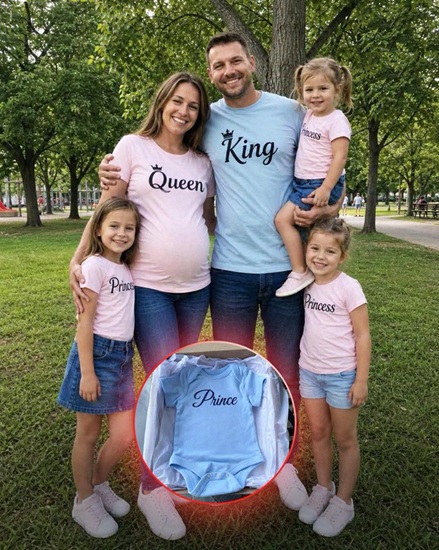
or nearly a decade, Claire believed she understood her husband better than anyone else in the world. She knew how Wesley took his coffee, which television shows could make him fall asleep within ten minutes, and exactly how he sounded when he was worried but pretending everything was fine. Together they had built a busy home filled with three daughters, countless toys, unfinished laundry, school drawings, and the ordinary chaos that came with raising children. Claire loved that life more than she had ever expected.
When she discovered that their fourth baby would be a boy, she imagined she was about to give Wesley one of the happiest surprises of his life. The secret sat inside a small silver gift box on top of her dresser. Inside was a tiny blue baby outfit, folded carefully beneath white tissue paper. Claire had opened the box so many times that she could practically picture every stitch without looking. Each time she saw it, she imagined Wesley’s reaction. She pictured his surprise, then the enormous smile she believed would follow.
She had heard him talk about someday teaching a son to fish, taking him to the lake, and passing along an old family watch. To Claire, the little outfit represented a dream coming true. One evening Wesley appeared in the bedroom doorway while she was looking at the box again. Claire quickly closed it and tucked it behind her, laughing when he asked what she was hiding. She told him she was simply organizing clothes for the upcoming family photoshoot.
Wesley shook his head with an amused smile and reminded her that he had never cared about elaborate family pictures. As far as he was concerned, a photograph of their daughters climbing all over him would have been perfect. Claire insisted that after years without a formal family portrait, she wanted something special. Down the hallway, their daughters were arguing over dresses and ribbons.
Their eldest, Kayla, was trying to convince her younger sisters that her bow was clearly the largest. The twins disagreed loudly. Wesley listened to their voices and laughed. Claire watched him quietly because scenes like this were exactly why she considered him such a good father. He attended school events, learned to braid hair badly but enthusiastically, and willingly played whatever character his daughters assigned him during imaginary tea parties.
Wesley had never treated the girls as though they were less important to him. That was why Claire had never thought much about the occasional comments he made about having a son. He spoke about fishing trips, teaching a boy how to repair things, and passing along his grandfather’s watch. Claire interpreted those comments as excitement about experiencing something different, not dissatisfaction with the children they already had. She believed there was enough love in their family for both ideas to coexist.
There had always been one detail she never completely understood. Whenever Wesley discussed his childhood, particularly his relationship with his father Mike, his mood could change unexpectedly. A conversation that began happily could end with Wesley becoming unusually quiet. Claire occasionally noticed tension when Mike talked about family traditions or what he believed men were supposed to do. Wesley rarely challenged him directly. Instead, he would change the subject, walk into another room, or focus on the children.
Claire mistook that silence for patience. She assumed Wesley simply preferred avoiding arguments with an opinionated parent. Mike had strong views about almost everything, from work schedules to holidays to how children should behave. Claire found him frustrating occasionally, but she had never considered his comments genuinely harmful. Wesley had spent a lifetime navigating his father’s personality and seemed capable of handling it. At least that was what she believed.
When Claire became pregnant with their fourth child, she and Wesley initially decided not to make the baby’s sex the focus of the pregnancy. Their biggest concern was that the baby was developing normally. Wesley attended appointments whenever work allowed and asked endless questions about Claire’s health. He joked about being permanently outnumbered in the house. Claire teased him that another daughter would finally destroy any remaining illusion that he controlled the television remote.
At one appointment, however, Wesley was unexpectedly called into work. The doctor asked Claire whether she wanted to learn the baby’s sex. She hesitated while looking at the empty chair beside her. They had originally discussed waiting, but curiosity won. Claire asked the doctor to tell her privately. When she heard the words “It’s a boy,” she covered her mouth and began crying.
Her reaction was not because she valued a son more than her daughters. She was thinking about Wesley. She remembered every casual conversation about fishing, the family watch, and the things he imagined doing with a boy someday. She decided that simply telling him at home would not feel special enough. She wanted to capture his reaction so their children could look back on it years later.
That evening, Claire called her sister and began planning the surprise. She envisioned a family photoshoot in a park, with herself and the girls wearing soft pink while Wesley wore pale blue. At the end, she would hand him the box containing the tiny blue outfit. The photographer would capture the exact second he understood what it meant. Claire believed the resulting photograph would become one of the happiest images in their home.
She also invited Mike. At the time, the decision seemed generous rather than dangerous. Claire knew father and son were not always close, and she thought sharing news about another grandchild might create a warm memory between them. She did not understand that Mike’s presence would instead expose a disagreement that Wesley had spent years avoiding. Had she known what was happening beneath the surface, she would have planned everything differently.
The day of the photoshoot arrived with warm afternoon light filtering through the trees. The girls wore matching pink dresses and spent more time spinning in circles than listening to instructions. Wesley arrived in the blue shirt Claire had chosen. Around his wrist was the old family watch his father had given him years earlier. Mike sat near the photographer’s equipment, quietly observing.
At first, nothing seemed unusual. The photographer arranged the family in different combinations and encouraged the girls to laugh naturally instead of forcing smiles. Wesley lifted one daughter onto his shoulders and pretended to lose his balance, making all three children shriek with laughter. Claire felt relieved because everything looked exactly as she had imagined. She believed the difficult part had been keeping the secret.
But something had happened earlier that morning without her knowledge. Before leaving for the photoshoot, Mike had spoken privately with Kayla. He told his granddaughter that perhaps this baby would finally be the son her father had been waiting for. To Mike, the comment reflected a traditional belief about sons carrying family names and traditions. To a young girl, it sounded very different.
Kayla later approached Wesley and quietly asked whether he had always wanted a boy instead of her. She wanted to know whether he had been disappointed when she was born. She also asked whether her younger sisters had disappointed him too. Wesley was stunned. He immediately tried to reassure her, but the family was already preparing to leave and Claire was calling everyone toward the car. He decided he would speak with his wife after the pictures.
That conversation was still weighing on him when Claire prepared the surprise. She did not know why he had suddenly become quieter. She believed he was simply tired from managing three excited children. The photographer finished another series of pictures and then announced that Claire had requested one final special shot.
Claire reached into her bag and removed the silver box. Her hands trembled with excitement as she handed it to Wesley. He smiled, clearly expecting a sentimental gift or perhaps something related to the photographs. The girls moved closer to watch. Mike stood behind them with an expression Claire could not read.
Wesley slowly lifted the lid. He moved aside the tissue paper and saw the tiny blue outfit. For a moment he simply stared at it. Claire waited for the reaction she had imagined countless times. She expected laughter, tears, or an enormous hug. Instead, the smile disappeared from her husband’s face.
His eyes moved from the outfit to Claire’s stomach. Then he looked toward Kayla. Finally, he looked at his father. Claire’s excitement turned immediately into confusion. She told him softly that they were having a boy. Wesley repeated the word “boy,” but his voice contained none of the joy she expected.
Claire asked whether something was wrong. Wesley’s first question surprised her even more. He wanted to know whether she had told the girls that he had always wanted a son. Claire felt hurt. She reminded him that he had talked about having a boy for years. She mentioned the fishing trips, the lake, and the family watch.
Wesley closed his eyes as though every example made the situation worse. He explained that Claire had misunderstood something he himself had only recently begun understanding. Those dreams were real, but they had been influenced by ideas he had heard throughout childhood. His father had constantly emphasized sons, family names, and male traditions. Wesley had repeated some of that language without thinking about what his daughters might hear.
Mike interrupted from behind them. He said there was nothing wrong with a man wanting a son. In his view, a boy was the person who would carry the family name and continue traditions. He spoke casually, as though the subject were obvious and harmless. Wesley immediately became tense.
The girls stopped playing. Kayla looked at the ground. Claire noticed the change and suddenly realized something had happened before the photoshoot. She asked Wesley to explain. He hesitated because he did not want to discuss the issue in front of the children, but Mike continued talking.
Mike said Wesley had waited a long time for a son and that everyone should simply celebrate. Wesley finally told him to stop. His voice was quiet but firm enough that the photographer lowered her camera. Claire had rarely heard her husband speak to his father that way.
Wesley then explained what Kayla had asked him that morning. Mike had told her that perhaps Wesley would finally get the boy he had been waiting for. Kayla interpreted the statement to mean that she and her sisters had never been enough. She had asked her father whether he wished they had been boys.
Claire looked at her daughter and immediately understood why Kayla had been unusually quiet throughout the afternoon. Suddenly the carefully coordinated clothes looked different. Three little girls stood in pink beside their father in blue, while Claire prepared to announce the arrival of the boy everyone supposedly wanted. What she had designed as a harmless surprise could easily look to a child like a celebration of finally receiving something better.
Claire felt overwhelmed by guilt even though she had never intended that message. She knelt beside Kayla and told her she had misunderstood nothing about her mother’s love. The baby’s sex was simply information about the newest member of their family. It did not change the importance of any child already standing there.
Wesley joined them. He told all three daughters that he needed them to hear something clearly. He had never wished that any of them were boys. He had never considered them temporary versions of the child he truly wanted. They were his daughters, and being their father had given him more happiness than he had known how to describe.
He also admitted that words could hurt even when someone did not intend them that way. He had talked too casually about someday having a son. He had repeated expressions about passing down names and traditions without thinking about what those ideas might communicate to the girls. Wesley told them he was sorry.
Claire initially tried to reassure him by saying he had never meant anything harmful. Wesley gently disagreed. Intent mattered, he said, but consequences mattered too. Kayla had heard those conversations and had begun wondering whether she was somehow less important. He did not want to dismiss that feeling simply because it was never his intention.
Mike reacted defensively. He insisted that everyone was exaggerating an ordinary family tradition. In his generation, he said, sons carried names and inherited certain responsibilities. He saw no cruelty in acknowledging that. Claire realized that arguing about history would not solve the immediate problem.
Wesley answered simply that whatever rules Mike had grown up with did not have to become rules in his own household. Their daughters were not less important because another child happened to be male. Their son would not arrive carrying a higher rank within the family. The children would have different personalities and interests, but their value would be equal.
Mike then pointed toward the watch on Wesley’s wrist. The heirloom had passed from father to son through several generations. He said at least there would now be someone appropriate to inherit it one day. The word he chose—“appropriate”—made Wesley look down at the watch differently.
Claire watched her husband slowly unfasten it. Mike immediately realized what he was doing and objected. The watch, he argued, belonged in the male line. Wesley did not respond at first. He walked toward Kayla.
He knelt in front of his daughter and asked her to look at him. He told her again that she had always been exactly the child he wanted. The arrival of a brother could add something new to their family without taking anything away from her or her sisters. Then he placed the old watch around Kayla’s small wrist.
The band hung loosely because the watch had been made for an adult. Kayla stared at it in surprise. Her younger sisters immediately crowded around, fascinated by the object they had seen their father wear for years. For the first time since the reveal, Kayla smiled.
Mike was furious. He reminded Wesley that the watch traditionally moved from father to son. Wesley replied that his daughters were part of the family too. If an heirloom was truly meant to represent family continuity, there was no logical reason a daughter could not receive it.
Claire stood beside her husband. She had spent years assuming that family traditions were harmless simply because they were old. Now she understood that traditions could be kept, modified, or abandoned depending on what they communicated to the next generation. Respecting the past did not require repeating every expectation attached to it.
Mike eventually walked toward the parking lot. Nobody tried to stop him. Wesley looked disappointed rather than triumphant. He had not wanted a confrontation with his father. He had simply reached a point where avoiding conflict would mean allowing his daughters to absorb a message he no longer accepted.
The photographer remained silent for a moment. Then she asked whether the family wanted to continue. Claire looked at the girls. Their carefully planned reveal had collapsed completely, but the afternoon no longer felt ruined. Something much more important had happened.
They decided to take one final photograph. Wesley sat in the grass with all three daughters gathered around him. Kayla wore the oversized watch. Claire stood beside them with one hand resting on her pregnant stomach. There were no signs saying “It’s a boy,” no dramatic blue announcement, and no carefully staged reaction.
The photograph captured something Claire had not planned. It showed a family after an uncomfortable but necessary conversation. Wesley was smiling at his daughters instead of looking toward the camera. Kayla’s sisters were touching the old watch and laughing. Claire later realized that it was the most honest picture taken that day.
That evening, the little blue outfit remained inside the gift box. Wesley eventually picked it up and smiled. Now that the earlier tension had settled, he allowed himself to feel excited about meeting his son. Claire sat beside him and asked whether he was afraid to celebrate.
Wesley admitted that he was. After hearing Kayla’s question, he worried that any excitement about having a boy would confirm her fear. Claire reminded him that loving their daughters did not require pretending the new baby’s arrival was unimportant. The problem had never been happiness about a son. The problem was the suggestion that a son mattered more.
They decided to talk with the girls together. Wesley explained that families could celebrate differences without ranking them. He was excited about their brother because every new baby was exciting. He had been equally excited before each daughter was born, even if the memories and circumstances had been different.
Kayla asked whether he would still take her fishing. Wesley laughed and admitted that she had already been old enough for years. The truth was that he had attached fishing to an imaginary son without questioning why. Nothing prevented him from taking his daughters.
The following weekend, Wesley took Kayla to the lake. The twins joined them after insisting they were not going to be excluded. The outing was chaotic. One child complained about worms, another dropped a snack into the water, and Kayla became impatient after twenty minutes without catching anything.
Wesley later told Claire it was one of the best mornings he had spent with them. He realized that many of the traditions he had labeled “father-and-son” experiences were simply activities he wanted to share with his children. The gender requirement had existed largely because that was how the activities had been described to him growing up.
The watch became another conversation. Claire worried that giving such a valuable family object to a child impulsively might create future problems. Wesley agreed that Kayla did not need to wear it every day. They decided to keep it safely stored until she was older while making clear that it was hers.
They also agreed that their future son would receive meaningful family objects and traditions of his own. Equality did not mean making every child identical. It meant ensuring that opportunities, affection, and family significance were not automatically assigned according to gender.
The discussion with Mike took longer. Several weeks passed before Wesley felt ready to speak with his father privately. Their conversation was difficult because Mike initially believed Wesley was rejecting everything about the way he had been raised.
Wesley explained that he was not trying to erase his childhood. He appreciated many things his father had taught him. He simply disagreed with the assumption that preserving a family name or tradition made sons inherently more important. Their daughters had heard enough language to believe they were disappointing their father, and Wesley could not ignore that.
Mike did not immediately agree. Beliefs carried for decades rarely disappear after a single conversation. Wesley therefore stopped trying to force immediate understanding. Instead, he established a boundary: nobody would tell his daughters that their brother was more important, more legitimate, or more capable of carrying the family forward.
Claire supported that boundary. She also acknowledged her own role. She had heard some of the same comments before and dismissed them because she believed they were harmless. She had even designed the photoshoot around pink and blue in a way that unintentionally reinforced the story Kayla feared.
This did not mean the colors themselves were wrong. The issue was context. A pink dress or blue baby outfit had no moral meaning. The problem arose when adults connected those symbols with ideas about one child finally completing the family.
Claire kept the photographs from that afternoon. She did not hide the story from the children as they grew older. Instead, the family gradually treated it as the day they learned something important about communication.
Wesley also became more careful with the language he used around the children. He stopped saying that he needed a son to carry on his name. Their daughters carried the family name too, regardless of whether they kept or changed it as adults. More importantly, he realized that family continuity was about relationships rather than surnames.
The baby boy was born months later, healthy and loudly opinionated from his first days. His sisters were fascinated with him. Kayla became especially protective, often correcting anyone who joked that Wesley had finally gotten what he wanted.
Once, a relative made a casual remark about Wesley finally having “his little man.” Kayla responded that her father already had everything he wanted before her brother arrived. Wesley overheard and quietly smiled.
He still dreamed about taking his son fishing one day. But now the dream included four children arguing over fishing poles rather than one boy standing beside him alone.
The old family watch remained with Kayla. Years later, it became less important as a symbol of conflict and more important as a reminder of a conversation that changed how her father understood family traditions.
Mike gradually softened as well. He never became a completely different person, and some of his beliefs remained traditional. But he learned that comments about boys being more important would not be tolerated around the children.
The relationship between father and son improved only after Wesley stopped using silence as his main method of avoiding conflict. For years he had believed peace meant saying nothing. Eventually, he understood that silence could allow harmful assumptions to continue unchallenged.
Claire learned something similar. Good intentions did not automatically guarantee that an action would feel good to everyone involved. Her photoshoot had been created entirely from love, yet it collided with an insecurity she did not know existed.
That did not make her a bad mother or wife. It made communication necessary.
The family never stopped celebrating their son. They simply refused to celebrate him as a replacement for something supposedly missing.
Each child became important for reasons that had nothing to do with completing a category.
The girls were not placeholders.
Their brother was not an heir whose arrival suddenly gave the family legitimacy.
They were four children belonging to the same imperfect household.
The photograph from that afternoon eventually hung in the hallway. Visitors often assumed it was simply a sweet family portrait. They saw a father sitting with his daughters, a pregnant mother beside them, and a large watch wrapped around a little girl’s wrist.
Only the family knew everything that had happened before the shutter clicked.
Claire sometimes looked at the picture and remembered the photograph she originally wanted. She had imagined Wesley holding a blue outfit and celebrating the news that he was finally having a son.
She was grateful that was not the photograph they ended up framing.
The actual picture represented something larger.
It captured the afternoon when a father recognized how deeply children can absorb the things adults say casually.
It captured a mother realizing that traditions should be examined rather than repeated automatically.
It captured three daughters being reassured that another child entering the family would never reduce their place within it.
And it captured a family choosing to change an inherited expectation before passing it into another generation.
Years later, when their son became old enough to understand the story, Wesley explained the watch to him.
The boy asked why Kayla had received it if Grandpa once believed it belonged to a son.
Wesley answered that traditions were created by people.
That meant people were also allowed to change them.
The boy considered this seriously before asking whether he could still go fishing.
Wesley laughed.
“Of course.”
Then his sisters reminded him that fishing belonged to all of them now.
And that, more than any watch or surname, became the tradition the family ultimately chose to keep.
