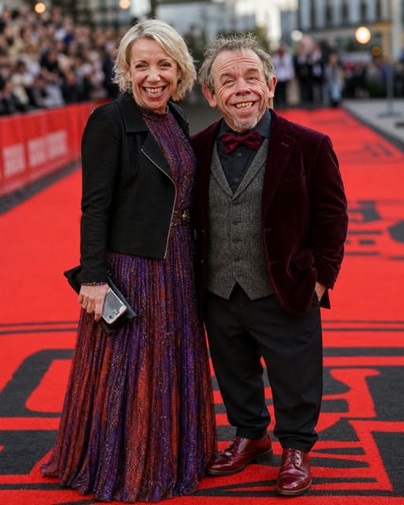
For millions of moviegoers, R2-D2 is one of the most instantly recognizable characters ever created for the screen. The compact blue-and-white astromech droid could not speak in conventional human sentences, yet audiences quickly understood his excitement, impatience, courage and stubborn personality. Behind many of those movements in the original Star Wars films was British performer Kenny Baker, whose face remained hidden while his physical performance reached audiences around the world.
Baker stood approximately 3 feet 8 inches, or about 112 centimeters, tall, making him physically suited to work inside the original R2-D2 costume. But his contribution went far beyond simply fitting inside the mechanical shell. Through carefully controlled movement and comic timing, he helped give a machine-like character enough personality to become an enduring part of cinema history. Kenneth George Baker was born on August 24, 1934, in Birmingham, England, and his path toward entertainment began long before anyone had imagined the world of Star Wars.
After leaving school as a teenager, Baker was introduced to professional entertainment through a touring troupe and began learning how to perform before live audiences. His early work included pantomime, ice shows and circus entertainment, environments where performers needed to communicate quickly and clearly with crowds. He also worked as a clown with Billy Smart’s Circus, developing skills in movement, visual humor and timing. Later, he partnered with fellow performer Jack Purvis to create a comedy act known as the Mini-Tones. Those years gave Baker an unusually strong background in physical performance, which would eventually become essential when his most famous role allowed him almost no opportunity to use his own facial expressions.
Baker’s height inevitably influenced the kinds of professional opportunities that came his way, particularly during an era when performers with dwarfism were often offered a limited range of roles. Yet his career cannot accurately be described simply as a consequence of his stature. He had spent years developing professional experience before Star Wars, learning how to entertain audiences through movement and humor. Performing in circuses, stage productions and comedy acts required discipline, repetition and an ability to read an audience.
Those skills mattered when Baker later entered film, because operating a costume such as R2-D2 demanded far more than standing inside a prop. The performer needed to understand how tiny physical actions would appear on camera. What might have seemed like a small gesture from inside the costume could become an essential part of the character once projected onto a cinema screen. His life changed dramatically when George Lucas was preparing the film that would eventually be released in 1977 as Star Wars.
Baker and his comedy partner Jack Purvis became involved in the casting process, and Baker was selected to work inside R2-D2. At the time, nobody could have known how enormous the film would become or how strongly audiences would connect with its fictional galaxy. R2-D2 was designed as an astromech droid that interacted with characters including C-3PO, Luke Skywalker, Princess Leia and others throughout the story. Unlike the human characters, however, R2-D2 communicated primarily through electronic sounds and physical movement. Baker therefore had to help express a recognizable personality without relying on ordinary dialogue, visible eyes or a human face.
Working inside the original R2-D2 costume was physically demanding and considerably less glamorous than the finished movies suggested. The interior was tight, movement was restricted, and Baker had limited awareness of what was happening around him while the costume was closed. Accounts from his career describe the heat and discomfort inside the unit, along with the practical challenges of receiving directions from the crew.
Baker later explained that he could move the body forward and backward, wobble it from side to side and create motions that suggested simple responses such as agreement or disagreement. Those movements might sound limited when described individually, but together they helped create an expressive screen presence. The challenge was not simply making R2-D2 move; it was making each movement appear intentional and emotionally readable to an audience.
The result became one of the unusual triumphs of physical acting in popular cinema. R2-D2 had no conventional human face, yet audiences could often recognize exactly how the character seemed to feel. A nervous wobble might suggest anxiety, while a slow turn could communicate suspicion or curiosity. A sudden movement could make the droid appear impatient, startled or determined.
Lucasfilm later specifically credited Baker with helping create R2-D2’s adventurous and appealing personality through those physical details. George Lucas remembered Baker as a talented performer who worked under difficult circumstances and described him as central to the character audiences came to love. That recognition is important because the technological appearance of R2-D2 can easily obscure the human performance involved in establishing the character’s original screen identity.
R2-D2 first appeared in Star Wars, later retitled Star Wars: Episode IV – A New Hope, in 1977. The movie became a worldwide phenomenon and transformed science-fiction filmmaking, popular culture and the careers of many people involved in its production. Baker returned as R2-D2 for The Empire Strikes Back in 1980 and Return of the Jedi in 1983, completing the original trilogy. Across those movies, R2-D2 became increasingly established as something more than a piece of futuristic machinery.
The droid repeatedly helped the heroes escape danger, repaired equipment, carried important information and demonstrated a remarkable willingness to move directly into dangerous situations. His enduring friendship with the more anxious protocol droid C-3PO also became one of the franchise’s most familiar relationships.
The pairing of R2-D2 and C-3PO worked partly because the characters approached the world in such different ways. C-3PO, played by Anthony Daniels, expressed his thoughts through elaborate spoken dialogue and often worried about whatever danger was approaching. R2-D2 could not respond in ordinary language, leaving audiences to interpret his electronic sounds and physical reactions. This contrast created humor without requiring R2-D2 to deliver a traditional joke. Baker’s movements could make the droid appear dismissive of C-3PO’s concerns, impatient with instructions or eager to continue toward the next problem. The relationship helped establish R2-D2 as a character rather than merely a device used to move the plot forward. By the end of the original trilogy, audiences did not simply recognize the droid; they had developed an emotional attachment to him.
Baker’s involvement with Return of the Jedi extended beyond R2-D2. He also appeared as Paploo, one of the Ewoks living on the forest moon of Endor. Paploo is remembered for taking an Imperial speeder bike during the film, creating a distraction during the heroes’ effort against Imperial forces. Baker therefore contributed to the movie both inside R2-D2 and as another costumed character. Working inside the Ewok costumes presented its own difficulties, including limited visibility and uncomfortable conditions. Baker later recalled how challenging those costumes could be when performers attempted to move through the forest setting. His wife Eileen also performed as an Ewok, giving the couple a rare shared connection to the production.
Although Star Wars became the work most closely associated with his name, Baker appeared in several other notable productions. His film credits included The Elephant Man, released in 1980, as well as Time Bandits in 1981. He was also associated with Flash Gordon and later appeared in Lucasfilm’s fantasy adventure Willow in 1988. These roles demonstrated that his professional life was not confined to a single mechanical costume or franchise. Baker had spent years working as an entertainer before becoming R2-D2, and he continued accepting different performance opportunities afterward. His career therefore belongs to a broader tradition of British variety performers who moved between stage entertainment, comedy, circus work, television and cinema.
One of Baker’s particularly memorable connections to Hollywood history occurred in 1978. R2-D2, along with other Star Wars characters, was honored at what was then known as Grauman’s Chinese Theatre in Hollywood. Baker helped create R2-D2’s cement impressions outside the famous theater, placing the character alongside decades of movie history. The ceremony illustrated the extraordinary speed with which Star Wars had moved from a new science-fiction release to a major cultural phenomenon. Baker had spent most of his time hidden inside the character, yet the droid itself had become recognizable enough to receive one of Hollywood’s most famous symbolic honors. Those R2-D2 impressions became another permanent reminder of the unusual connection between Baker’s invisible performance and the public image of the character.
When George Lucas returned to the Star Wars universe with the prequel trilogy, Baker once again became associated with R2-D2. He received credit connected with the character in The Phantom Menace in 1999, Attack of the Clones in 2002 and Revenge of the Sith in 2005. By then, filmmaking technology had changed significantly from the techniques available during production of the original movies. Remote-controlled units and other technical approaches could handle an increasing amount of R2-D2’s movement. Nevertheless, Baker’s name remained closely connected with the character because he had helped establish its screen personality decades earlier. When The Force Awakens arrived in 2015, Baker was credited as an R2-D2 consultant rather than performing inside the droid in the way he had during earlier productions.
This distinction matters when describing his contribution accurately. Baker was an important performer behind R2-D2, but the character’s complete creation was the result of collaboration among designers, builders, sound specialists, filmmakers and performers. R2-D2’s famous electronic voice was created separately from Baker’s physical performance, and various mechanical or remote-controlled versions of the droid were also used during filming. Baker’s specific contribution centered on the physical character he could create while operating from inside certain versions of the unit. Giving proper credit to that collaboration does not diminish his importance. Instead, it shows why movie characters can be the result of many different artistic and technical disciplines working together.
Away from movie sets, Baker’s personal life was substantially quieter than the fictional adventures associated with R2-D2. He married Eileen Baker in 1970, several years before the first Star Wars movie transformed his public profile. Eileen was also a performer and, like Kenny, was a person of short stature. Their marriage became an important and lasting part of his life, and they had two sons, Christopher and Kevin. Both children were reported to be of average height. The couple’s life together existed largely outside the intense public mythology surrounding Star Wars, giving Baker a family identity that was separate from the character recognized by fans around the world.
Baker and Eileen’s relationship also brought together two people familiar with navigating environments that were usually designed around people of average height. Their shared experience was naturally part of their lives, but it should not be treated as the sole feature defining their marriage. They were a couple who worked, raised children and built a family while Baker’s career gradually became connected with one of the largest film franchises in history. The enormous scale of Star Wars existed alongside ordinary family responsibilities at home. Baker might spend part of his professional life meeting actors, filmmakers and fans, but away from those circumstances he was also a husband and father. That distinction helps provide a more complete picture of him than stories focused exclusively on his height or costume work.
Family life eventually included significant loss. Eileen died in 1993, years before Baker’s own death. Her death left Baker without the partner with whom he had shared more than two decades of marriage and the raising of their sons. Public accounts of his later life continued to identify his family as an important part of his story. Baker remained active professionally and increasingly participated in events where fans could meet the people behind the Star Wars films. Yet the personal history behind those appearances included both the extraordinary success of his career and the ordinary realities of grief and family responsibility. At the time of Baker’s death, his sons Christopher and Kevin survived him.
The growth of the Star Wars convention community gave Baker another unexpected stage for his career. As interest in the original films continued long after their theatrical releases, fans became increasingly curious about performers whose faces had rarely or never appeared clearly on screen. Baker discovered that audiences wanted to meet the man associated with R2-D2 just as they wanted to meet the stars whose faces had been visible throughout the films. Convention appearances allowed him to sign autographs, tell stories and interact directly with generations of viewers. For performers who had spent much of their screen time concealed by costumes or makeup, such events provided public recognition that had sometimes been absent during the films’ original releases. Baker eventually became a familiar figure on the convention circuit.
That recognition highlighted one of the most interesting contradictions of his career. Baker became internationally famous because of a character that prevented audiences from seeing him. Most actors depend heavily on their face, voice and expressions to establish a relationship with viewers. Baker’s most famous performance removed nearly all of those tools. The audience saw painted metal panels, flashing lights and a rotating dome instead of the performer himself. Yet Baker still managed to contribute movement that viewers interpreted as emotion. His story therefore provides a useful example of how physical performance can influence an audience even when the performer’s own appearance remains completely concealed.
R2-D2 eventually became recognizable to people who had never seen every Star Wars movie. Toys, posters, television programs, games and countless other forms of popular culture kept the droid visible across generations. The character’s visual design was obviously central to that popularity, but personality helped prevent R2-D2 from becoming simply another piece of fictional technology. He could appear confident, impatient, frightened or mischievous depending on the scene. The films repeatedly portrayed him as dependable when the human characters encountered trouble. Official Star Wars material describes R2-D2 as a brave and versatile astromech who repeatedly helped his companions escape dangerous situations. Baker’s early physical performance was one part of establishing the emotional foundation on which that long-running character was built.
The contribution is easiest to appreciate by imagining R2-D2 without recognizable movement. A perfectly stationary machine might still look impressive, but audiences would have far less information about what it was supposedly thinking. By changing the angle of the body or shifting its direction, Baker could suggest attention and intention. Moving quickly could communicate urgency, while a slower response could create comic hesitation. These actions were simple compared with the enormous special-effects sequences surrounding the character, yet their simplicity made them readable. The performance worked because audiences supplied the emotional interpretation themselves. They saw a movement, heard the accompanying electronic sound and understood the droid as though it had spoken.
Baker also became an example of how specialized performers contributed to fantasy filmmaking during an era before digital characters became common. Many creatures, robots and unusual figures in late-20th-century cinema depended on performers physically occupying costumes. Those jobs could be difficult, hot and restrictive, and the people doing them were sometimes less recognizable than conventional actors. Nevertheless, their movements determined whether the finished character seemed believable. Baker’s work belongs within that tradition of practical performance. Modern effects can produce movements that would have been impossible during the original Star Wars production, but the early films relied heavily on physical objects and performers actually present on the set.
His connection with Jack Purvis also followed him into cinema. The two men had worked together as the Mini-Tones before either became associated with Star Wars. Purvis later appeared in multiple films from the original trilogy in various roles. Their movement from live entertainment into one of cinema’s biggest franchises shows how diverse the backgrounds of the original Star Wars performers could be. Baker had not followed a conventional route through prestigious dramatic schools before becoming part of the film. Instead, his education came partly from years of entertaining people directly in clubs, circuses and stage shows. Those experiences developed practical performance instincts that translated unexpectedly well into the unusual requirements of playing R2-D2.
As Baker grew older, health difficulties increasingly affected his ability to travel and perform. During his final years, he experienced significant health problems and at times used a wheelchair. His condition prevented him from traveling to Los Angeles for some major Star Wars events late in his life. Nevertheless, he remained connected to the franchise and its fans. His continuing recognition demonstrated how permanently R2-D2 had attached his name to cinema history. Even as new generations of performers and filmmakers entered the franchise, audiences continued remembering the man who had operated inside the droid during the films that began everything.
Kenny Baker died on August 13, 2016, at the age of 81, just eleven days before what would have been his 82nd birthday. His death prompted tributes from the Star Wars community and from people who had worked with him during his long career. Lucasfilm remembered him as the actor who helped bring R2-D2 to life, while George Lucas praised both his professionalism and his humor. Lucasfilm president Kathleen Kennedy also emphasized how closely Baker’s work had become connected with the personality audiences associated with R2-D2. His death therefore drew attention not only to a beloved character but also to the human performer whose contribution had often taken place out of sight.
The timing of his death offered a striking reminder of the longevity of the franchise he had joined nearly four decades earlier. When the original Star Wars opened in 1977, nobody involved could reasonably have predicted the enormous cultural institution that would follow. By 2016, R2-D2 had appeared across multiple generations of films, and the character was known internationally. Baker had watched a job inside a strange science-fiction costume evolve into the defining association of his career. At fan conventions, people who had first encountered R2-D2 as children could later introduce the same movies to their own children. Few performers receive such a direct connection with several generations of the same audience.
His legacy should nevertheless be described without reducing his entire identity to physical stature. Baker’s height was relevant because it influenced his career and made it possible for him to work inside the original R2-D2 unit. But simply stating that he was 3 feet 8 inches tall does not explain why his performance worked. Another person of the same height would not automatically have brought the same background in physical comedy, stage performance and movement. Baker had spent years learning how to entertain before George Lucas selected him. His stature opened a particular professional opportunity, while his experience helped him make something memorable from that opportunity.
The same principle applies to his family story. Baker and Eileen were both people of short stature, but their marriage should not be framed as a curiosity or spectacle. They married, raised two sons and shared more than two decades together before Eileen’s death. Those facts are meaningful because they show the personal life behind a performer who was otherwise known through a fictional machine. The public could measure R2-D2, count movie appearances or collect memorabilia, but family life operated according to completely different values. Baker’s identity as a father and husband existed whether or not cameras were present.
His two sons also represented a part of Baker’s life entirely separate from celebrity. To audiences, he was the man connected with one of the most famous droids in film history. Within his family, however, he occupied the ordinary role of a parent. That difference between public identity and private identity is common among performers but particularly striking in Baker’s case. He became famous through a character that concealed his appearance, and fans gradually became interested in discovering the person behind the costume. His family had known that person all along.
As appreciation for behind-the-scenes filmmaking increased, Baker’s name became more widely recognized among general audiences. Documentaries, interviews, conventions and retrospectives gave viewers opportunities to learn how practical characters were created before modern digital effects dominated major films. Fans discovered that R2-D2 was not simply a remote-controlled prop moving independently through every scene. Different versions and techniques were used, and Baker physically operated the character in many situations. Understanding that process added another dimension to scenes audiences had already watched for decades. It also encouraged greater appreciation for performers whose work took place behind masks, prosthetics and mechanical shells.
Baker’s story therefore belongs not only to Star Wars history but also to the history of physical screen performance. Cinema contains many examples of memorable characters whose success depended on actors working under restrictive conditions. Costumes can limit sight, movement, hearing and comfort while simultaneously requiring the performer to appear natural. Baker faced exactly those challenges inside R2-D2. His performance had to look spontaneous even when operating the costume required careful physical effort. The apparent simplicity audiences saw on screen was the result of work taking place inside a structure viewers were never meant to notice.
There is also an important lesson in the way Baker’s career developed without needing to turn his life into an exaggerated inspirational story. He faced circumstances that influenced the roles available to him, but he was already a professional entertainer before Hollywood discovered him. He worked, developed specialized skills and accepted an unusual opportunity when it arrived. That opportunity became much larger than anyone expected, but his career was not created by chance alone. Years of experience in live entertainment had prepared him to understand physical comedy and audience response. His achievements are significant without adding claims about overcoming barriers that cannot be documented.
R2-D2’s continued presence in Star Wars after Baker’s active performance years further demonstrates the durability of the character he helped establish. Technology evolved, new production methods appeared and other performers and technicians became involved in bringing the droid to the screen. Yet the fundamental personality remained familiar. R2-D2 continued to be courageous, independent, occasionally mischievous and remarkably dependable. Those characteristics were reinforced across decades of storytelling. Baker was not solely responsible for every aspect of the character, but his original physical contribution formed part of the foundation later filmmakers inherited.
One of the strongest tributes to Baker came directly from George Lucas after the actor’s death. Lucas remembered him as a hardworking performer who handled difficult circumstances and brought humor to the people around him. Lucasfilm similarly emphasized that Baker had helped define R2-D2 for audiences. Such comments are especially meaningful because they came from the filmmakers responsible for the character’s creation and development. They acknowledge that the personality viewers perceived inside R2-D2 was not simply produced by electronics. Human performance mattered.
Today, viewers can return to the original Star Wars films and watch Baker’s work without necessarily noticing the performer inside. That invisibility is part of what makes his contribution unusual. A slight wobble or quick turn may last only seconds, yet it can alter the emotional tone of a scene. Children watching R2-D2 may respond immediately without knowing anything about costume operation or filmmaking history. Adults who understand how the character was created can appreciate a second layer of craftsmanship. Both reactions point toward the same achievement: the mechanical exterior appears to contain a personality.
That personality helped make R2-D2 one of cinema’s enduring companions. The droid is courageous without becoming invulnerable, humorous without speaking conventional jokes and loyal without needing long explanations of friendship. Those qualities emerged through writing, sound design, visual design and movement working together. Baker’s job occupied one specific part of that collaboration, but it was a crucially human part. His movements told audiences when R2-D2 was paying attention, objecting, reacting or preparing to act. The audience completed the process by turning those visual signals into recognizable emotions.
Kenny Baker’s life ultimately contained far more than one costume. He was a circus and variety performer, comedian, actor, husband and father before becoming an enduring figure within fan culture. He worked on films outside Star Wars, traveled to conventions and continued meeting audiences who appreciated his contribution. He experienced extraordinary professional success as well as personal loss when Eileen died. He lived long enough to see the relatively experimental science-fiction movie he joined in the 1970s become one of the world’s largest entertainment franchises. Through all of those changes, R2-D2 remained the character most closely connected with his name.
There is something fitting about that legacy. Baker spent the most famous moments of his career hidden from the audience, yet his work became impossible to separate from a character recognized around the world. He demonstrated that acting does not always depend on a visible face, spoken dialogue or a conventional leading role. Sometimes a small movement can communicate more effectively than a long speech. Sometimes the performer inside the costume contributes something audiences feel even when they never consciously identify who produced it. Baker’s career is a reminder that cinema is built not only by the people standing visibly in front of the camera but also by talented individuals whose contributions may be physically concealed.
More than four decades after R2-D2 first rolled onto movie screens, the character remains immediately identifiable. New generations continue encountering the little astromech through movies, television, toys and other forms of Star Wars storytelling. The technology surrounding the character has evolved considerably since Baker first climbed inside the original unit, but the emotional vocabulary established in those early films remains recognizable. A nervous wobble still feels like nervousness. A determined turn still feels purposeful. A stubborn movement still makes audiences imagine that the droid has a mind of his own.
That is why Kenny Baker’s contribution remains worth remembering. His physical frame made it possible for him to occupy R2-D2, but his professional experience helped turn the opportunity into a performance. His career showed the value of specialized skill and demonstrated how a performer could create personality with extremely limited movement. His family life revealed another side of the person hidden behind the famous screen character. And his decades-long connection with fans proved that an actor does not have to show his face in order to leave a lasting mark on popular culture.
Kenny Baker died in 2016, but the character with which he will always be associated continues to travel through the fictional galaxy. Every time viewers return to the original trilogy, they can see traces of the physical choices he made inside that restrictive metal shell. Those movements became part of R2-D2’s language long before most audiences knew Baker’s name. Eventually, fans learned more about the performer and began recognizing the person behind the machine. In that sense, Baker accomplished something rare in cinema: he became both almost completely invisible and permanently unforgettable.
His legacy is therefore not really a story about being small. It is a story about performance, opportunity, craftsmanship and the unexpected ways a career can develop. Baker entered entertainment long before Star Wars, brought decades of practical experience into an unusual film role and became connected with a character that outlived every expectation surrounding the original production. Away from cinema, he built a marriage and raised two sons, creating a family history separate from the franchise that made him famous. On screen, he helped make audiences believe that a metal droid possessed courage, humor and loyalty. That combination is why Kenny Baker remains an important part of the human story behind one of cinema’s most beloved fictional universes.
