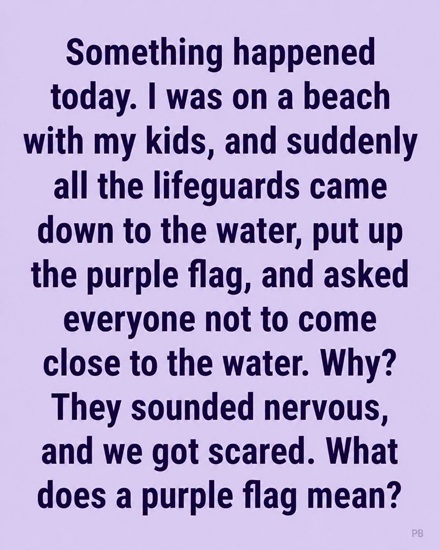
A purple flag flying over a beach can be easy to overlook, especially on a warm day when the water appears calm and inviting. Yet in beach-warning systems used in places such as Florida, a purple flag is an important signal that potentially dangerous marine life has been observed or is considered a concern in the water. Depending on the location and conditions, that may include jellyfish, Portuguese man o’ war, stingrays, sea urchins, or other marine organisms capable of causing painful injuries.
The National Weather Service also describes purple in the Florida beach-warning system as a warning for stinging marine life, including jellyfish and stingrays. That does not automatically mean everyone entering the water will be injured, and it does not necessarily mean swimming is prohibited. It means beachgoers should recognize that conditions have changed and obtain local information before deciding whether and where to enter the water. The distinction is important because beach flags are not all communicating the same type of hazard.
In the commonly used Florida system, green represents relatively calm conditions while still advising caution, yellow indicates a moderate surf or current hazard, red signals a high hazard involving strong currents or surf, and double red means the water is closed to the public. Purple is different because it focuses on marine life rather than primarily describing waves and currents. A purple flag may also appear at the same time as another colored flag because more than one type of hazard can exist at once.
Someone could therefore encounter a purple flag while surf conditions appear relatively calm, or see it together with another warning related to currents. Understanding those differences prevents swimmers from assuming that calm-looking water automatically means there is nothing to worry about. The safest interpretation is not that the ocean has suddenly become hostile, but that people need to pay greater attention to what is sharing the water with them. Marine animals naturally move through coastal areas according to food availability, currents, water temperature, tides, weather patterns, and other environmental conditions.
Humans visiting the beach may never see the organisms that caused a warning to be posted. A jellyfish can be difficult to notice beneath reflective water, while a stingray may rest partially buried in sand. That means visual inspection alone cannot tell a swimmer everything about current conditions. A flag exists precisely because trained personnel or local authorities may have information that an individual beach visitor does not. Jellyfish are one of the better-known reasons people pay attention to marine-life warnings.
NOAA advises beachgoers to watch for jellyfish warnings and to be careful even around jellyfish that have washed onto the sand. Some stranded jellyfish can still sting when their tentacles remain wet, and separated tentacles may also retain the ability to sting. Not every jellyfish species poses the same level of danger to humans, and many encounters cause limited effects rather than serious medical emergencies. Nevertheless, contact can be extremely painful, and some people can experience significant reactions. That is why avoiding unnecessary contact is far more sensible than assuming a motionless or washed-up jellyfish is harmless.
Portuguese man o’ war can present another concern in areas where they occur. Although they are commonly discussed alongside jellyfish, they are actually colonial organisms rather than true jellyfish. Their tentacles can deliver painful stings, and portions of those tentacles may be difficult to see in the water. A person does not need to deliberately touch the visible floating portion to have an unpleasant encounter. Marine organisms can also wash onto shore, which means caution should continue even after someone leaves the water. Children in particular may be tempted to touch unusual objects or creatures they find along the beach. Adults should discourage handling unfamiliar marine life, regardless of whether it appears alive.
Stingrays are another example of an animal that may be present without being immediately visible. Many species spend time close to sandy bottoms and may partially bury themselves. Stingrays do not generally seek out people to attack, but injuries can occur when someone accidentally steps on or very close to one and the animal reacts defensively. This is one reason local beach staff sometimes advise people to move carefully through shallow water when rays are present. However, safety recommendations can vary according to species and local conditions. Rather than assuming one technique works everywhere, beachgoers should ask lifeguards or local authorities what behavior they recommend that day.
Sea urchins can also cause injuries if swimmers or waders step on their spines or make contact while climbing around rocks or reefs. The presence and type of marine life differs considerably from one coastline to another, which is another reason a purple flag should not be interpreted as identifying one specific animal. In some places, officials may have observed large numbers of jellyfish. Elsewhere, the concern could involve another organism entirely. The flag communicates the category of hazard, while lifeguards, posted notices, or local agencies can provide more precise information. Asking what triggered the warning is usually more useful than guessing.
A beach can look perfectly peaceful while a purple flag is flying. There may be no dramatic waves, no visible animals, and no obvious reason to stay alert. That is exactly why understanding warning systems matters. Humans naturally judge risk through what they can immediately see, but many coastal hazards are not visually obvious from shore. Clear water does not guarantee an absence of stinging marine life, just as calm waves do not guarantee an absence of currents. Warning signs add information that cannot always be obtained simply by looking at the ocean.
The first practical response to a purple flag should therefore be straightforward: find out exactly what it means at that beach. Ask a lifeguard if one is present. Read any posted information near the beach entrance or flagpole. Check the appropriate local beach-safety authority when such information is available. Different jurisdictions can operate different warning systems, so travelers should never assume that a color has an identical meaning everywhere in the world. Even within the United States, beach-management practices can vary by location. Local guidance should always take priority over a generic description found online.
This location-specific approach is particularly important for visitors. Someone accustomed to one coastline may arrive at another beach and assume the warning system works exactly the same way. That assumption can be incorrect. The Florida Department of Health, for example, describes a single purple flag in its system as indicating dangerous marine life, while National Weather Service materials associated with Florida identify stinging marine life such as man o’ war, jellyfish, and stingrays. Those descriptions are useful for understanding the system, but they should not be converted into a universal rule covering every beach in every country. Whenever a flag is unfamiliar, asking before entering the water is the simplest solution.
Parents and caregivers should take warnings especially seriously when children are involved. Children often concentrate on playing rather than scanning the water, and they may not recognize marine animals or understand why they should avoid them. The Florida Department of Health emphasizes active supervision around water and advises adults never to leave children unattended around open bodies of water. That recommendation applies regardless of flag color because drowning and other water-related risks do not disappear simply because marine life is the hazard currently being highlighted. Keeping children within close supervision also allows an adult to respond more quickly if something unexpected happens.
It is also important not to interpret a purple flag as the only safety information that matters. The ocean can present several hazards simultaneously. A beach may have marine-life concerns while also experiencing strong surf, rip currents, thunderstorms, excessive heat, or other conditions requiring caution. The National Weather Service specifically warns that the absence of warning flags does not guarantee safe water. Beach visitors should therefore consider the full set of conditions rather than treating one flag as a complete safety assessment.
Swimming at a guarded beach is another useful precaution when that option is available. Lifeguards can provide current information about conditions and are trained to respond to many common beach emergencies. They may know whether jellyfish have been concentrated in one particular section, whether marine-life activity has changed during the day, or whether swimmers are being advised to remain out of certain areas. Their knowledge is more relevant to the immediate situation than a general article written for readers in many different locations. If staff recommend avoiding the water, moving to another section, or following another precaution, those instructions should be taken seriously.
Footwear and protective clothing may reduce certain types of exposure in some situations, but they should not be treated as guarantees. Water shoes can protect the soles of the feet from some sharp surfaces, shells, or objects, while rash guards cover more skin than ordinary swimwear. Neither makes a person immune to marine-life injuries. Tentacles can contact uncovered areas, and many forms of protection are designed primarily for abrasion, sun exposure, or comfort rather than defense against every marine organism. Protective equipment is best regarded as one layer of precaution rather than permission to ignore a warning.
The same caution applies to the popular idea of shuffling one’s feet to avoid stingrays. This advice is commonly associated with areas where rays rest on sandy bottoms, but people should follow the recommendations of local beach professionals rather than assuming the technique is necessary or effective in every environment. Different species, habitats, and shorelines create different circumstances. A purple flag itself does not automatically mean stingrays are the reason it was raised. Confirming the actual hazard first prevents a generic safety tip from being applied where it is irrelevant.
If someone is stung or injured, leaving the water and getting appropriate assistance is a sensible first step. Lifeguards can often provide immediate help and may know which marine organism is responsible. Treatment recommendations differ according to the animal involved, so identifying the likely source of the injury can matter. Random home remedies found online are not automatically safe or effective. Florida public-health guidance specifically warns against relying on a variety of improvised remedies for marine stings and advises seeking appropriate treatment information.
Serious symptoms require more urgent attention. Difficulty breathing, faintness, chest symptoms, severe systemic reactions, or rapidly worsening illness after a sting should not be dismissed as a normal beach injury. Some people can develop severe allergic or toxic reactions, although such outcomes are not the result of every sting. Medical care should be based on the person’s symptoms and professional advice rather than dramatic assumptions about the animal. The goal is neither to minimize a serious reaction nor to make every ordinary sting sound life-threatening. Accurate safety information depends on maintaining that distinction.
People should also resist touching an unfamiliar marine organism simply to identify it. A jellyfish washed onto shore may still sting, and detached tentacles can remain capable of causing injury. Photographs can be useful for identification when they can be taken from a safe distance, but physical contact is unnecessary. Parents should explain this clearly to children, who may see colorful marine creatures as interesting objects to pick up. Observing wildlife from a respectful distance protects both people and animals.
A purple flag should therefore be understood primarily as information rather than a reason for panic. It tells beachgoers that there is something about current marine-life conditions they should know before entering the water. In some situations, officials may consider swimming possible with additional caution. In others, staff may recommend avoiding certain sections or remaining out of the water. The appropriate response depends on what has been observed and how serious the local situation is. That is why speaking with people monitoring the beach is so valuable.
This approach also avoids turning legitimate safety information into sensationalism. Saying that a purple flag always means deadly creatures are surrounding swimmers would be misleading. Saying that it is meaningless unless a person can physically see a jellyfish would also be misleading. The accurate position lies between those extremes. A purple flag in systems that use it for dangerous marine life indicates a genuine reason for increased caution, but the type and severity of the hazard must be understood in context.
Ocean conditions are dynamic. Wind can move surface organisms toward or away from shore. Currents can concentrate floating marine life in certain places. Tides can change the depth and characteristics of shallow areas. Seasonal patterns may also affect which organisms are common along particular coastlines. These changes explain why conditions on one afternoon may differ from those experienced at the same beach the previous morning. A visitor should therefore check current information each time rather than assuming yesterday’s conditions still apply.
Flags can change during the day for the same reason. Conditions observed in the morning do not necessarily remain constant until sunset. Beach authorities may update warnings as new information becomes available. Someone who entered calm water earlier should look again when returning later. A flagpole is not simply part of the beach scenery; it is a communication system designed to give visitors information about changing conditions.
It is equally important to recognize that green does not mean completely risk-free. Florida’s warning system describes green as low hazard with calm conditions while still advising caution. Open water is never identical to a controlled swimming pool. Waves, currents, changing depths, weather, marine animals, and human factors remain relevant regardless of the color displayed. Treating green as a guarantee of safety can create a false sense of security.
Yellow and red flags address a different category of hazard and should not be confused with purple. A yellow flag generally communicates moderate surf or current hazards in the Florida system, while a single red flag signals higher hazards from surf or currents. Double red means the water is closed to the public. A purple flag may accompany one of those warnings because dangerous marine life and rough surf can occur at the same time. Reading every displayed flag rather than focusing on one color gives swimmers a more complete picture of conditions.
Rip currents deserve particular attention because a purple flag does not tell swimmers whether they are absent. The National Weather Service repeatedly emphasizes rip-current safety and encourages people to swim near lifeguards whenever possible. Someone concentrating only on jellyfish or stingrays could overlook a far more immediate hazard created by moving water. Beach safety works best when people evaluate all available warnings rather than treating marine life as the only concern.
There is also an environmental perspective worth remembering. Jellyfish, rays, sea urchins, and other marine animals are not entering a human swimming facility. People are entering their habitat. Most marine creatures are not actively searching for humans to injure. Many encounters occur because animals and people happen to occupy the same shallow coastal area at the same time. Respecting wildlife and maintaining appropriate distance is therefore both a safety practice and a reasonable way to behave in a natural environment.
This perspective changes how a warning should be viewed. The ocean does not become “bad” when a purple flag appears, nor are marine animals doing something wrong by being present. The flag simply acknowledges that human recreation and wildlife have overlapped in a way that may require additional caution. Beachgoers can respond without hostility toward the animals and without exaggerated fear. Moving to another section of beach or delaying a swim is a small inconvenience compared with unnecessarily risking an injury.
For families, a simple routine can make beach visits easier. Before setting up chairs and allowing children toward the surf, identify the lifeguard station and check the flags. Ask what any unfamiliar warning means. Determine whether the advice applies to the whole beach or a specific area. Continue supervising children closely after entering the water. Recheck conditions if the flags change or if staff make announcements.
Adults should follow the same rules they expect children to follow. Ignoring a warning while telling younger swimmers to be careful sends the wrong message and can place adults at unnecessary risk as well. Strong swimmers are not immune to stings, accidental contact with marine animals, or changing currents. Experience in a swimming pool also does not automatically translate into expertise in open-water conditions. Florida health officials specifically remind the public that swimming in open water is different from swimming in a pool and that even strong swimmers can encounter difficulty.
Another mistake is assuming that the lack of visible marine life proves the warning is outdated. Beach personnel may be responding to repeated reports, recent sightings, or concentrations observed along parts of the coast that are not visible from one location on shore. Marine organisms also move continuously. A swimmer may see nothing for several minutes before entering an area where they are concentrated. The absence of an animal in your immediate field of vision does not invalidate the warning.
At the same time, people should not spread unsupported claims about what caused a particular purple flag. If officials have not identified the species, it is better to say that a dangerous-marine-life warning is in effect than to announce online that sharks, stingrays, or jellyfish are definitely present. Accurate communication becomes especially important on social media, where an unverified assumption can quickly become a widely repeated claim. Checking local official information before posting helps prevent unnecessary fear and misinformation.
The same principle applies to dramatic photographs circulated without context. A picture of hundreds of jellyfish from another country or another year does not prove that identical conditions exist at the beach currently displaying a purple flag. Safety communication should remain connected to the place, date, and information actually available. General photographs can illustrate what certain organisms look like, but they should not be presented as evidence of a specific current event unless they genuinely document that event.
For readers planning a beach visit, the practical lesson is straightforward. Check the weather and beach conditions before leaving home when reliable local information is available. Once you arrive, examine the flags again because conditions may have changed. Speak to a lifeguard about unfamiliar warnings. Make decisions based on the current local guidance rather than on assumptions formed from previous trips. These habits require very little effort and can substantially improve awareness.
A purple flag is therefore not an invitation to panic, and it is not something to ignore. In the beach-warning systems that use purple for dangerous or stinging marine life, the flag tells swimmers to recognize that animals capable of causing injury may be present. Florida health authorities and National Weather Service materials both support that basic meaning. Exactly which animal triggered the warning, however, may differ from one place and one day to another.
The most responsible response combines caution with curiosity. Ask what has been seen. Learn whether officials recommend staying completely out of the water or simply avoiding certain areas. Protect children through active supervision. Avoid touching unfamiliar marine organisms on the beach or in the water. Seek appropriate assistance if an injury occurs.
None of those actions require treating the ocean as something frightening. They simply acknowledge that a natural environment contains variables people cannot completely control. Waves move. Weather changes. Currents shift. Wildlife travels through coastal waters. A safe beach visit begins with accepting those realities rather than expecting the ocean to behave like a swimming pool.
The warning system is most useful when visitors actually understand it. A flag that nobody recognizes cannot influence behavior effectively. Learning the basic meanings before a beach vacation is therefore worthwhile, especially for families who expect to spend significant time near the water. Still, memorizing one system is not enough when traveling. Always verify the signs used at the particular beach you are visiting.
The phrase “danger in the water” can easily become sensational if it is separated from context. A more accurate message is that a purple flag can provide valuable warning of a specific category of marine hazard. It allows people to change their behavior before an encounter occurs rather than learning about the hazard through an injury. That preventive function is what makes the flag important. Its value comes from early information, not from creating fear.
Ultimately, respecting a purple flag is an exercise in good judgment. The ocean belongs to an enormous ecosystem, and humans share the shoreline with countless species that were there long before beach umbrellas and vacation resorts existed. Most visits end safely, and most marine animals have no interest in interacting with people. Problems are more likely when visitors ignore conditions, misunderstand warnings, or unnecessarily approach wildlife. Paying attention allows people to enjoy the coast without pretending every natural risk can be eliminated.
So if you arrive at a beach and notice a purple flag, do not automatically pack everything and panic, but do not walk past it without asking what it means either. Find the lifeguard, read the official signage, identify the current concern, and adjust your plans accordingly. A few minutes spent gathering accurate information may prevent a painful encounter and can help parents make better decisions for their children. The message behind the flag is simple: conditions deserve your attention. Respect the warning, respect the wildlife, and remember that awareness is one of the most useful pieces of safety equipment you can bring to the beach.
