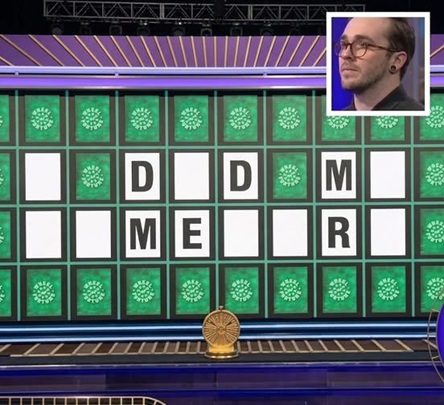
A Valentine’s Day episode of Wheel of Fortune produced an unexpectedly lively debate after contestant Conner Kemmsies reached the Bonus Round but was unable to solve the final puzzle. The episode aired on February 14, 2025, during Season 42 of the long-running game show. Kemmsies, a commercial pilot from Lakeside, California, had already performed well enough to become the night’s winner and advance to the final stage. Waiting for him was an opportunity to increase his winnings substantially. Instead, four familiar words became the obstacle that ended his chance at an additional $40,000.
The final answer was “I DID MY HOMEWORK,” a sentence made entirely from ordinary words that most viewers would immediately recognize once the completed puzzle was shown. Under Bonus Round conditions, however, Kemmsies had only seconds to identify it from an incomplete arrangement of letters. He managed to recognize the beginning of the answer, saying “I did my,” but the final word never came to him before time expired. Once “HOMEWORK” was revealed, the seemingly simple puzzle became the subject of disagreement among viewers.
Some of the reaction focused on Kemmsies himself, with viewers saying they had solved the puzzle quickly from home. Other viewers defended him and pointed out that solving a puzzle from a couch is very different from standing under television lights while a countdown is running. A separate group focused less on his performance and more on the category chosen for the answer. Because the Bonus Round category was “Phrase,” several commenters argued that “I DID MY HOMEWORK” sounded more like an ordinary sentence than the type of expression they expected to see classified as a phrase.
That distinction became the central point of the online discussion. It is important, however, not to transform viewers’ opinions into a factual claim that the program used an invalid category. Wheel of Fortune officially presented the answer under “Phrase,” and the disagreement came from viewers reacting afterward. Some considered the category perfectly acceptable, while others thought it provided too little guidance. The divided reaction is therefore more accurately described as a debate over puzzle construction and expectations rather than evidence that the game itself was conducted improperly.
Kemmsies had entered the episode alongside contestants Noor Ramay and Shameca Freeman. By the end of the main game, he had accumulated enough winnings to advance to the Bonus Round. Official episode recaps list his total at $19,080 in cash and prizes. Ramay finished with $14,950, while Freeman received the show’s $1,000 minimum. Those results made Kemmsies the clear winner of the regular portion of the episode even before he faced the final puzzle.
The episode featured several puzzles before the dramatic ending. The $1,000 Toss-Up was “MAKING A HOLE IN ONE,” categorized as “Fun & Games,” while the $2,000 Toss-Up was “FORGETTING MY PASSWORD” under “What Are You Doing?” Other answers during the game included “GENTLY FALLING SNOWFLAKES,” “THE BIG BAD WOLF BLITZER,” “SPOTTING A GRAY WHALE,” and “CHIEF OF STAFF.” The Triple Toss-Up puzzles used three separate “Phrase” answers: “WATCH OUT BELOW,” “WATCH YOUR STEP,” and “WATCH YOUR LANGUAGE.”
After winning the main game, Kemmsies moved to the Bonus Round with host Ryan Seacrest. Contestants in this stage choose from available categories before receiving the standard letters R, S, T, L, N and E. They then select three additional consonants and one additional vowel. Kemmsies chose C, M, D and A. Those selections helped reveal portions of the board, but they did not expose the crucial letters that would have made “HOMEWORK” immediately recognizable.
After the letters appeared, the puzzle displayed enough information for Kemmsies to recognize its opening. He quickly arrived at “I DID MY,” demonstrating that he had already solved three of the four words. The difficulty was concentrated almost entirely in the final eight-letter word. Without the O’s in “HOMEWORK,” that last part proved considerably harder to identify within the limited time.
The moment illustrates an important feature of Wheel of Fortune. Knowing most of a sentence does not necessarily guarantee that the final word will become obvious. A pattern such as “I DID MY…” can lead to numerous possible completions before enough letters are available to narrow the choices. Under normal circumstances, someone could think through those alternatives carefully. During the Bonus Round, a contestant instead has only a short countdown in which to test possibilities aloud.
Once the timer expired, the completed answer appeared: “I DID MY HOMEWORK.” Kemmsies responded with humor, remarking that he no longer did homework because he was not in school. The reaction showed that he understood how ordinary the answer looked once it was revealed, even though he had been unable to produce it under pressure.
The next reveal made the miss more significant. The envelope Kemmsies had selected contained $40,000. Had he solved the puzzle within the allotted time, that amount would have been added to what he had already earned. Instead, he left without the Bonus Round money but retained the $19,080 in cash and prizes accumulated during the game.
Kemmsies again reacted with perspective rather than visible anger. After learning that the missed prize was $40,000, he noted that at least the envelope had not contained $100,000. Seacrest also emphasized that the contestant was still leaving with $19,080. That exchange helped keep the on-air ending light even as viewers later debated the puzzle online.
The $40,000 reveal also generated a separate discussion among some regular viewers. At the time, $40,000 was the minimum cash amount available on the Bonus Wheel, and fans had already been noticing how frequently contestants encountered that amount. TV Insider reported that some commenters were frustrated about seeing the $40,000 envelope appear so often during Season 42. That complaint was distinct from the debate over “I DID MY HOMEWORK,” but both conversations became attached to the same episode.
According to statistics cited by TV Insider at the time, the $40,000 amount had appeared far more often than some of the higher-value prizes during that season. That did not mean anything improper had happened; it simply contributed to the perception among some dedicated viewers that the minimum Bonus Round cash prize was appearing frequently. The Valentine’s Day episode therefore generated discussion about both the puzzle and the prize behind it.
The strongest debate, however, remained centered on the answer itself. Some viewers claimed they solved “I DID MY HOMEWORK” before Kemmsies’ time had even begun. Others said it took them longer or acknowledged that they might also have struggled under the same circumstances. Those differing reactions demonstrate why evaluating game-show puzzles after the answer is known can be misleading.
Once every letter is visible, the solution seems straightforward. Before that reveal, contestants are processing incomplete information. The human brain naturally makes the completed phrase appear more obvious after learning the answer, a phenomenon that can make it easy for viewers to underestimate the difficulty of arriving there from the original board.
The studio environment adds another variable. Contestants are standing on a nationally televised set, interacting with the host and audience while knowing significant money may depend on the next few seconds. Every letter choice matters, and there is no opportunity to pause the game, reconsider possibilities or return to the puzzle later.
Kemmsies’ profession became a lighthearted part of the coverage surrounding the episode. He was identified as a commercial pilot and was described in one recap as having recently earned his commercial pilot’s license. His ability to handle the earlier rounds successfully had already demonstrated that the final miss did not reflect his overall performance during the episode. He had won the game and earned a five-figure total before encountering the Bonus Round puzzle.
That context is useful because viral clips can sometimes reduce an entire game-show appearance to one missed answer. A contestant may have spent most of an episode solving difficult puzzles correctly, yet the moment circulated online is often the one where something went wrong. In Kemmsies’ case, the full results show that he had already defeated the other contestants before reaching the controversial final puzzle.
The Valentine’s Day broadcast also arrived during Ryan Seacrest’s first season as the regular host of the syndicated program. Seacrest had taken over following Pat Sajak’s departure from the daily syndicated hosting role. By February 2025, viewers were still experiencing many familiar Wheel of Fortune traditions under the newer hosting arrangement. The Bonus Round itself retained the recognizable structure that had long made it one of the show’s most suspenseful segments.
That structure is deliberately unforgiving. A contestant begins with R, S, T, L, N and E and can add only three consonants and a vowel. Good selections can make a puzzle suddenly obvious. Unfortunate selections can leave large portions of important words blank. The contestant then receives only a brief period to solve the entire answer.
Kemmsies chose C, M, D and A. The selection was not unreasonable; D and M proved particularly useful because they helped clarify the opening words. But none of those choices supplied the O, H, W or K needed to make the last word immediately recognizable.
With hindsight, an H or an O could have transformed the puzzle dramatically. But contestants do not know the answer when selecting letters, so letter choices necessarily involve strategy mixed with chance. They must choose characters they believe are likely to appear while having no information about the unseen phrase beyond its category and basic word pattern.
This combination of skill and uncertainty has always been central to the program. Contestants decide which letters to call and when to solve during the main game, but wheel results introduce chance. The Bonus Round removes most of the spinning while preserving uncertainty through the hidden prize and restricted letter selections.
That is also why two audiences can look at exactly the same puzzle and reach different conclusions about its difficulty. Someone who quickly thinks of “HOMEWORK” may find the answer obvious. Someone whose mind moves toward a different group of words can become stuck despite seeing the same letters.
The disagreement over the “Phrase” category adds a separate linguistic question. In ordinary language, the word “phrase” is sometimes used broadly to describe a group of words or an expression, while in formal grammar a phrase is distinguished from a complete clause or sentence. Some viewers were applying the narrower expectation when they objected to “I DID MY HOMEWORK.” Their argument was essentially that the answer looked like a complete sentence rather than the kind of familiar expression they associated with the show’s category.
Other viewers did not see that classification as a problem. For them, the challenge was simply identifying the words shown on the board within the rules of the game. This difference in expectations explains why the reaction was divided rather than uniformly critical.
Calling the episode an example of proven unfairness would therefore go beyond the available evidence. What is documented is that viewers disagreed about the puzzle and its classification. Some considered it easy, some difficult, and some disputed whether the answer belonged under “Phrase.”
There is no evidence from the episode recaps that Kemmsies was denied letters he had earned or that normal Bonus Round procedures were changed for him. His loss resulted from not producing the complete answer before time expired. The controversy developed afterward around subjective assessments of the puzzle rather than an established rules violation.
That distinction is particularly important when discussing game-show controversies online. Strong social-media reactions do not necessarily establish that a contestant was treated incorrectly. They show what viewers thought about the situation. Responsible reporting should preserve that difference.
The Valentine’s Day theme also made the ending particularly memorable. Holiday broadcasts often receive additional attention because episodes are promoted around a recognizable event. February 14 offered a naturally celebratory setting, but the Bonus Round ultimately became notable for a different reason.
Instead of ending with Kemmsies celebrating an additional cash prize, the audience watched him get extremely close to the solution before running out of time. He already had three words—“I DID MY”—but could not unlock the final one.
That kind of near miss can be more compelling to viewers than a puzzle where the contestant never gets close. The audience can see exactly how little separates a major win from a loss. One word changed the outcome.
It also demonstrates why the last few seconds of the Bonus Round are so effective as television. The rules are simple enough that viewers can play simultaneously at home. Everyone sees the board. Everyone hears the category. Everyone can mentally test possible answers.
At home, however, there is no real financial consequence for failing to solve the puzzle. The person onstage knows tens of thousands of dollars may be inside the envelope next to the host.
That difference cannot be measured precisely, but it is reasonable to recognize that television-studio pressure and financial stakes create conditions different from casual home viewing. Some commenters explicitly acknowledged that even though they eventually solved the puzzle, they did not blame Kemmsies for failing to do so quickly.
Others took the opposite view and believed the answer should have been obvious. Their comments reflected another longstanding part of game-show culture: audiences enjoy judging how they might have performed in the contestant’s position.
That participatory quality has helped Wheel of Fortune remain recognizable for decades. Its puzzles are accessible enough for viewers to attempt from home without complicated trivia knowledge. Success depends primarily on word patterns, letter recognition, vocabulary and the ability to think quickly.
“I DID MY HOMEWORK” was almost perfectly suited to generating debate because of its simplicity after the reveal. There were no obscure names or unusual vocabulary words. Every word was familiar.
Yet familiar does not mean predictable.
Before the final letters appear, “I DID MY” can lead in many directions. Only when “HOMEWORK” becomes visible does the entire sentence feel inevitable.
The Valentine’s Day puzzle therefore became a useful demonstration of the difference between recognizing an answer and producing it from incomplete information.
Recognition happens after someone shows you the solution.
Solving requires reaching that solution before anyone does.
Kemmsies had the opening portion but could not bridge that final gap in time.
The missed $40,000 made the moment more dramatic, but it did not erase what he had already achieved. He had won the main game and finished with $19,080 in cash and prizes.
That result also provides a more complete picture than describing the appearance simply as a costly failure. Kemmsies was the episode’s winning contestant. The Bonus Round was an opportunity for an additional prize rather than the only measure of his performance.
His final reaction supported that perspective. After seeing that the envelope contained $40,000 rather than one of the game’s larger possibilities, he joked that at least it was not $100,000.
The comment turned disappointment into humor and helped the broadcast conclude on a positive note. Seacrest reminded him of the $19,080 total he was already taking home.
Online, though, the debate continued.
Some viewers remained focused on the phrase-versus-sentence distinction.
Others questioned how Kemmsies had failed to see “HOMEWORK.”
Another group defended him.
Some discussed the frequency of $40,000 Bonus Round envelopes.
The same short television segment therefore produced several separate conversations.
That variety is part of why the episode continued attracting attention beyond its original February 14, 2025 broadcast.
It is also worth noting exactly what is established and what remains opinion.
The air date is documented.
Kemmsies’ identity and profession are documented.
The category was “Phrase.”
His letters were C, M, D and A.
The solution was “I DID MY HOMEWORK.”
He did not solve it in time.
The envelope contained $40,000.
He finished with $19,080 in cash and prizes.
Whether the puzzle was “too difficult,” “too easy,” or incorrectly categorized is a matter of viewer interpretation rather than an independently established fact.
That distinction gives the episode a more interesting story than simply saying fans were angry.
They were divided.
Some thought the contestant should have solved it instantly.
Some thought the missing letters made it legitimately challenging.
Some were less concerned with difficulty than with what they believed the “Phrase” category should represent.
Those differing opinions demonstrate how game-show puzzles can continue entertaining audiences even after the actual competition has ended.
Once a controversial board appears online, people can replay it, pause it and debate their own solutions.
The contestant never had those advantages.
Kemmsies had seconds.
Viewers had as long as they wanted.
That does not make either perspective invalid, but it provides necessary context when comparing performance.
There is another element that often influences these discussions: hindsight.
Once viewers know the final word is “HOMEWORK,” every visible letter suddenly seems to point toward it.
Before the reveal, however, the missing spaces can correspond to many possible letter combinations.
Psychologically, knowing an answer makes it difficult to recreate the uncertainty that existed beforehand.
That is part of why people frequently describe game-show answers as obvious immediately after seeing them.
Kemmsies’ experience is therefore relatable even for viewers who eventually solved the puzzle themselves. Most people have experienced the moment when an answer becomes instantly clear only after someone else says it.
The difference here was that the realization happened on national television with $40,000 attached to it.
Despite the disappointment, nothing in the available coverage indicates that Kemmsies reacted bitterly toward the program.
His comments after the reveal were humorous.
He retained his earlier winnings.
The controversy primarily came from the audience rather than the contestant himself.
That is another reason to describe the episode carefully.
Saying Kemmsies accused the show of unfairness would be inaccurate.
Saying viewers debated the fairness or appropriateness of the puzzle accurately reflects the documented reaction.
Similarly, claiming that all fans were outraged would exaggerate what happened.
Published reactions included both criticism and comments describing the puzzle as easy.
The audience response was mixed.
That mixture ultimately made the story more interesting.
If everyone had immediately agreed that the puzzle was unfair, there would be little debate.
If everyone had considered it easy, the moment might simply have become a clip of an unfortunate miss.
Instead, “I DID MY HOMEWORK” sat directly between those interpretations.
For some people, it was a perfectly normal Bonus Round answer.
For others, it was too ordinary to function effectively under the “Phrase” label.
For Kemmsies, it was simply the answer that did not arrive quickly enough.
The episode also shows how a four-word sentence can become memorable when the stakes are high enough.
On an ordinary day, “I did my homework” is one of the least dramatic sentences imaginable.
On Wheel of Fortune, it represented $40,000.
That contrast helped the puzzle travel beyond the original broadcast.
Nearly anyone could understand the frustration without needing detailed knowledge of game-show strategy.
Kemmsies had reached the game’s final stage.
He had solved most of the answer.
One common word remained.
The timer reached zero.
Then “HOMEWORK” appeared.
That sequence created the kind of television moment viewers instinctively replay in their minds.
Could he have chosen different letters?
Could the category have guided him differently?
Would someone watching at home have solved it under studio pressure?
Those questions cannot produce one definitive answer.
They are exactly why people continued discussing the puzzle.
What can be stated definitively is that Kemmsies left the studio as the episode’s main-game winner with $19,080 in cash and prizes, even though the $40,000 Bonus Round opportunity slipped away.
His experience also reinforced one of the fundamental truths of Wheel of Fortune: familiar language can become unexpectedly difficult when most of its letters disappear.
A phrase does not need rare words to create a challenging board.
Sometimes the simplest answer is the one a contestant cannot see.
The February 14, 2025 episode produced exactly that situation.
Conner Kemmsies knew “I DID MY.”
The final word remained hidden.
When time expired, “I DID MY HOMEWORK” was revealed.
Behind the unsolved puzzle was another $40,000.
Kemmsies did not take home that additional prize, but he did leave with $19,080 and a memorable appearance on one of television’s longest-running game shows.
And for viewers, the final puzzle accomplished something almost as enduring as a big win.
It created an argument.
Was the puzzle easy?
Was it difficult?
Was “I DID MY HOMEWORK” appropriately categorized as a phrase?
Different viewers reached different conclusions.
The documented facts of the game remain unchanged, while the judgment surrounding the puzzle belongs to the audience.
That is ultimately what made the Valentine’s Day episode stand out.
It was not evidence that Wheel of Fortune had broken its rules, nor proof that Kemmsies had performed poorly overall.
It was a close Bonus Round loss involving an ordinary-looking answer, a $40,000 envelope and a category that some viewers questioned.
For a program built around solving incomplete words, that combination was enough to keep people talking long after the letters had finally filled the board.
