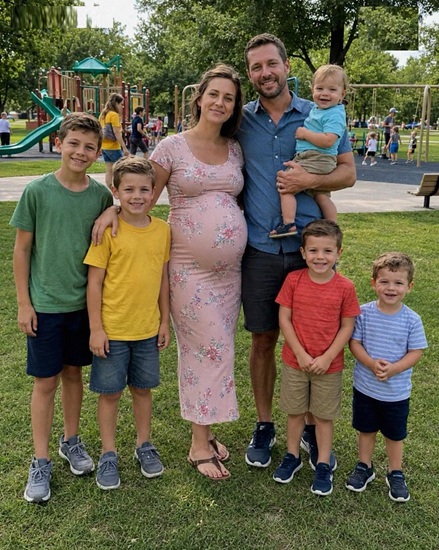
Our home had never known silence. With five boys under one roof, there was always somebody running down the hallway, somebody searching for a missing shoe, and somebody insisting that his brother had taken something that belonged to him. At thirty-four, I had become surprisingly good at sleeping through arguments, cartoons, slammed doors, and the occasional crash coming from the kitchen. Claire sometimes joked that we were not raising a family but managing a small sports team.
Yet beneath all the chaos, there was one dream she had quietly carried for years: she had always hoped to have a daughter. Claire loved our sons more deeply than anything in the world, and she never allowed them to believe otherwise. Still, every now and then, usually when the house was quiet late at night, she would admit that she wondered what raising a little girl might have been like. After our fifth son was born, she told me she had accepted that it probably would never happen.
We had five healthy children, a busy home, and more responsibilities than either of us could count. We agreed that our family was complete. At least, that was what we believed. Two years later, Claire walked out of the bathroom holding a pregnancy test. She looked stunned rather than excited, and for several seconds neither of us spoke. I thought about diapers, sleepless nights, car seats, school schedules, and the fact that our youngest had only recently stopped waking us before sunrise. Then Claire laughed. I started laughing too, and before long we were standing in the hallway holding each other while five curious boys demanded to know what was happening.
At the ultrasound appointment several weeks later, the technician studied the screen before turning toward us with a smile. “It looks like you’re having a girl.” Claire squeezed my hand so hard that I almost laughed from the pain. Instead, I watched tears appear in her eyes. She repeated the words quietly to herself, almost as though she needed to hear them several times before believing them. After five sons, the daughter she had dreamed about was finally on the way.
For the first few days, Claire seemed happier than I had seen her in years. She began looking at paint colors for the nursery and carefully stored away tiny dresses that friends and relatives brought us. The boys argued about who would be the best older brother and who would teach their sister to ride a bicycle. But slowly, Claire’s excitement began changing into something I couldn’t understand. She became distracted, restless, and unusually quiet. Sometimes I caught her standing alone in the nursery, staring at the empty crib.
When I asked what was wrong, she always had an explanation. She was tired. Pregnancy hormones were making her emotional. Five children were exhausting enough without another baby on the way. All of those answers sounded reasonable, yet something about her expression told me there was more she was not saying. I had learned during our marriage that there was one part of Claire’s life she rarely discussed: the years immediately after high school and her complicated relationship with her parents.
Her mother and father, Margaret and Robert, lived less than an hour away. Despite the short distance, I had met them only a handful of times. Claire had never completely explained the distance between them. She once told me that she had gone through a difficult period when she was young and that her parents had made choices she struggled to forgive. Whenever I asked for details, she became uncomfortable. Eventually I decided that if she wanted me to know, she would tell me when she was ready.
During the final months of her pregnancy, Claire started attending prenatal yoga. Strangely, those classes seemed to be the one thing that improved her mood. She would leave the house tense and return calmer, sometimes humming while she made dinner. One Saturday I asked if I could join her. Her hesitation lasted only a second, but I noticed it. She finally agreed, telling me I would probably be bored but was welcome to come.
At the studio, I immediately noticed one of the instructors, a tall man named Ethan. Claire greeted him warmly, and he greeted her with the comfortable familiarity of someone who had spoken with her many times. He accidentally called me Steve before correcting himself when Claire reminded him that my name was Sam. It was a tiny mistake, yet my already unsettled mind turned it into something larger. During the class, I watched Claire relax and laugh in a way I had rarely seen during the previous months.
On the drive home, I tried not to sound jealous. I asked how well she knew Ethan. Claire explained that they sometimes talked after class because he was easy to speak with and did not expect anything from her. She could tell immediately where my questions were heading. “He’s my friend, Sam,” she said firmly. “Nothing else.” I wanted to believe her, and most of me did. Still, the memory of how relaxed she had seemed around him remained with me.
Three weeks later, Claire woke me shortly after two in the morning and told me her water had broken. Everything after that happened quickly. We called my mother to stay with the boys and drove to the hospital through nearly empty streets. Hours later, after exhaustion, fear, encouragement from nurses, and Claire nearly crushing every bone in my hand, we heard the cry we had waited months to hear. Our daughter had arrived.
The nurse placed the baby in Claire’s arms. I expected my wife to laugh or cry with happiness. Instead, her entire body seemed to freeze. Our daughter had fine blonde hair, a tiny round face, and unusual eyes. One appeared soft green while the other seemed closer to hazel-brown. Claire stared at them without blinking. Then the color seemed to disappear from her face.
“Claire?” I whispered.
She didn’t respond immediately.
Finally, she said something so quietly that I almost missed it.
“I’ve seen those eyes before.”
I assumed she meant that the baby resembled someone in her family. I asked whether the eyes reminded her of her mother, an aunt, or perhaps a childhood photograph. Claire shook her head. Tears appeared, but they were nothing like the joyful tears I had expected. She looked frightened. “I know those eyes,” she repeated. “I just don’t know how.”
During the remaining days at the hospital, Claire became increasingly withdrawn. She held our daughter, whom we named Lily, but sometimes stared at her with a complicated expression that I could not interpret. Whenever I asked what she was thinking, she answered that she was exhausted. I wondered whether the strain of childbirth and weeks of anxiety had overwhelmed her. I wanted to support her without forcing her to explain something she did not yet understand herself.
Once we returned home, the mystery only deepened. Claire sometimes stood beside Lily’s bassinet in complete silence. At other times she avoided the nursery altogether. Then I began hearing quiet phone conversations from the laundry room after the boys had gone to bed. Whenever I entered, the conversation ended. Fear began transforming into suspicion, and unfortunately I allowed that suspicion to point toward Ethan.
One morning, I woke and discovered that Claire’s side of the bed was empty. Her keys were gone, her phone was unreachable, and Lily was no longer in the bassinet. Panic moved through me faster than reason. I called my mother, who lived close enough to come stay with the boys. Our oldest appeared in the kitchen while I was grabbing my keys and asked where his mother had gone. I told him only that I was going to find her.
My first destination was the yoga studio.
Ethan had just finished a morning class when I walked inside. I didn’t greet him politely. I demanded to know where Claire was. His confused expression only made me angrier. Finally, I asked the question that had been growing in my mind for weeks: Was he having an affair with my wife?
Ethan stared at me for several seconds before answering.
“No.”
He said he had never been romantically involved with Claire and had never touched her inappropriately. Their relationship, he insisted, was simply friendship. When I mentioned the late-night phone calls, his expression changed. “She called me because she was frightened,” he said. “Not because we were having an affair.”
That answer stopped me.
“Frightened of what?”
Ethan hesitated. He explained that shortly before Lily’s birth, Claire had begun experiencing fragments of memories she could not place. Images, emotions, and faces seemed familiar even though she could not remember when she had encountered them. Seeing Lily’s unusual eyes had intensified everything. Claire had confided in Ethan because she was terrified that I would think something was wrong with her.
I asked him where she had gone.
“Her parents’ house,” he finally said.
That made no sense. Claire avoided her parents whenever possible. But Ethan said something I would remember for a long time.
“Whatever she’s trying to understand,” he told me, “she thinks it started there.”
I drove directly to Margaret and Robert’s house.
When I reached their street, I immediately recognized Claire’s car. But it was not parked outside her parents’ home. It was across the street, in the driveway of another house. That detail made my stomach tighten. I parked quickly and walked into Margaret and Robert’s home after barely knocking.
Lily was sleeping safely in a bassinet near the living-room sofa. The sight of her allowed me to breathe again. Margaret and Robert sat nearby, both looking as though they had been crying.
“Where’s Claire?” I demanded.
Margaret looked toward her husband.
Neither answered.
Then I noticed photographs arranged along a shelf. Several included a blonde girl at different ages: as a child holding a birthday cake, as a teenager dressed for school, and as a young woman smiling beside the couple who apparently lived across the street. Something about her face felt strangely familiar.
“Who is she?” I asked.
Margaret began crying.
Before she could answer, Claire rushed through the door. She looked terrified and immediately asked where someone was. Then she noticed me and stopped.
“Who are you looking for?” I asked.
Nobody answered at first.
Eventually Margaret whispered a name.
“Emma.”
“Who is Emma?”
Claire closed her eyes.
Margaret’s next words changed everything in this fictional family’s story.
“She is Claire’s daughter.”
For several seconds I could not understand the sentence. Claire and I had been married for years. We had raised five sons together and had just welcomed Lily. How could she have another daughter without ever telling me?
Then Claire looked at me and whispered, “I didn’t know.”
According to the story Margaret finally told us, Claire had been nineteen when she became pregnant by her boyfriend, Daniel. They had planned to build a life together. During the final weeks of the pregnancy, they were involved in a serious accident. Daniel died, while Claire survived with severe injuries. Their daughter was delivered early while Claire remained unconscious.
Claire eventually woke, but in this fictional narrative she had lost memories covering a significant period of her young life, including her relationship with Daniel and the pregnancy. Her parents had been forced to make decisions while she was recovering. Instead of eventually telling their daughter everything, they arranged for another couple to adopt the baby.
The couple lived across the street.
Their daughter was Emma.
I stared at Margaret and Robert, struggling to understand how such a secret could remain hidden for so many years. Margaret admitted that she and Robert had convinced themselves they were protecting Claire. They believed that reminding her of Daniel’s death, the pregnancy, and the trauma surrounding the accident would destroy the new life she was trying to rebuild.
But there was another part of their decision that hurt Claire even more.
They had remained near Emma as she grew up.
They saw birthdays, holidays, school events, and ordinary afternoons. Emma knew Margaret and Robert simply as kind older neighbors who had always taken a special interest in her. She never knew they were her biological grandparents. Claire, meanwhile, occasionally encountered the girl without understanding why looking at her created such an intense feeling of recognition.
“That was why she always seemed familiar,” Claire whispered.
I remembered all the years when Claire had refused to discuss her parents. Perhaps even without conscious memories, something inside her had always connected them with pain she could not explain.
Claire then told me what had happened after Lily’s birth. Looking into our newborn daughter’s differently colored eyes had triggered the first clear fragment of memory. She remembered another pair of eyes. Then came the image of a young man laughing, the sensation of being inside a car, and bright hospital lights.
The memories arrived slowly and without context.
She had called Ethan because she feared she was imagining everything.
Eventually she came to her parents and demanded answers.
For the first time, Margaret and Robert told her about Daniel and Emma.
Before I could process what that meant for our family, footsteps came from the staircase.
A young woman appeared.
It was the girl from the photographs.
Emma.
She looked at Claire first, then at Lily in the bassinet, and finally at Margaret and Robert. Her expression made it immediately clear that Claire was not the only person whose understanding of the past had just been changed.
Emma had apparently learned the truth that same day.
Her anger was immediate.
She demanded to know why the adults around her had allowed her to grow up without knowing where she came from. Margaret tried to explain that Emma’s adoptive parents had loved her completely and that none of this changed the family that had raised her.
Emma agreed that she loved her parents.
That was not what hurt.
What hurt was discovering that people close to her had known a significant part of her history and had chosen not to tell her.
Claire stepped toward her.
Emma moved away.
“Please,” Claire said.
“I can’t do this right now,” Emma replied.
Claire began crying, but she stopped herself from moving closer. For perhaps the first time that day, she understood that discovering the truth did not automatically give either of them a relationship. Emma had grown up with parents, memories, traditions, and an identity of her own. Claire could not simply appear and expect twenty years of separation to disappear.
Emma left.
Claire wanted to follow, but I encouraged her to give the young woman space.
We returned home with Lily that evening.
Nothing about our family felt simple anymore.
For the next several days, Claire moved between grief and hope. She grieved Daniel, a person she had once loved but could remember only in fragments. She grieved the years of Emma’s childhood she had never experienced. She was angry with her parents and uncertain whether she would ever forgive them.
At the same time, she refused to blame Emma’s adoptive parents for loving and raising her.
“They’re her parents too,” Claire said one night.
That sentence mattered.
Claire was beginning to understand that rebuilding a connection with Emma could not require destroying the family Emma already had.
She did not call repeatedly.
She did not arrive uninvited.
She sent Emma one message containing her phone number and a simple promise: if Emma ever wanted to talk, Claire would be there.
Then she waited.
Twelve days later, Claire’s phone vibrated while we were eating breakfast.
She read the message once.
Then again.
Her hands began shaking.
Emma had written only a few words.
Could I meet my brothers?
The following Sunday, Emma came to our home for dinner.
The boys had been warned not to overwhelm her, which naturally meant they spent the entire afternoon asking us questions about what they were allowed to ask. When Emma finally stepped through the doorway, five boys suddenly became unusually quiet.
Our second-oldest looked at her for several seconds.
“So you’re really our sister?”
Emma gave a nervous smile.
“I guess I am.”
That was enough to break the tension.
Within minutes, the boys were showing her photographs, arguing over who resembled whom, and telling embarrassing stories about one another. Emma laughed, and I saw Claire watching her from across the room with tears in her eyes.
But Claire did not interrupt.
She did not try to force an emotional reunion.
She simply watched.
Later that evening, Emma asked if she could hold Lily.
Claire carefully placed the baby in her arms.
Emma studied Lily’s face for a long time, paying particular attention to the mismatched eyes that had started Claire’s search for answers.
Then she smiled.
“She really does have unusual eyes,” Emma said.
Claire laughed softly.
“So do you.”
Emma looked up.
For a moment neither woman spoke.
There was no dramatic embrace and no instant solution to everything that had happened. Too many years, questions, and complicated emotions stood between them. Trust would have to be built slowly, and some wounds might never disappear completely.
But Emma stayed for dessert.
Then she stayed another hour.
Before leaving, she hugged each of the boys.
When she reached Claire, she hesitated.
Claire didn’t move toward her.
Finally, Emma stepped forward and hugged her.
Only briefly.
But it was enough.
After she left, Claire sat beside me on the couch while Lily slept nearby and the boys argued upstairs about something completely unimportant.
For the first time since our daughter’s birth, Claire looked peaceful.
“Are you okay?” I asked.
She considered the question.
“No,” she said.
Then she took my hand.
“But I think someday I might be.”
Our family had not become the perfect picture Claire once imagined. The truth had made everything more complicated, not less. There were conversations still to come, relationships that needed patience, and decisions that belonged to Emma as much as they belonged to Claire.
But something important had changed.
Claire was no longer carrying a feeling she could not explain.
Emma finally knew the history that had been hidden from her.
And our five sons had discovered that the sister they had always joked about wanting had been part of the family’s story long before any of us understood it.
Nothing was magically repaired that Sunday.
But something had begun.
Sometimes learning the truth does not immediately heal a family. Sometimes it creates new questions and forces people to confront choices that should have been discussed years earlier. Reconciliation, when it is possible, can require patience, honesty, boundaries, and respect for everyone involved.
For Claire and Emma, that first dinner was not an ending.
It was simply their first opportunity to decide what came next.
And as I watched Claire check on Lily before going upstairs that night, I understood something I had missed throughout the entire ordeal.
The arrival of our daughter had not destroyed the shape of our family.
It had revealed a part of that shape that had been hidden all along.
