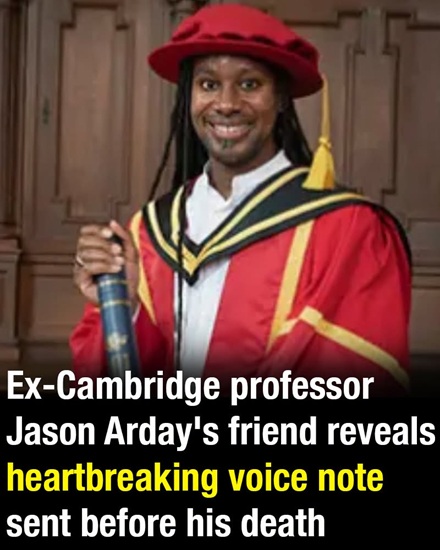
The death of former University of Cambridge professor Jason Arday at the age of 41 has prompted grief, reflection and an intense debate about the extraordinary public scrutiny he faced during the final weeks of his life. Arday, an academic known for his work on education, inequality and social mobility, had recently resigned from Cambridge amid allegations concerning plagiarism and other aspects of his academic record. He disputed accusations of deliberate dishonesty while acknowledging errors in some of his previous work.
Arday was found dead at his home in south London in August 2026. The Metropolitan Police said his death was unexpected but was not believed to be suspicious. Officers said his next of kin had been informed and that information would be prepared for the coroner. Those official statements are important because they establish limits on what can currently be said about the circumstances of his death. Public speculation should not be treated as an official determination.
In the days afterward, people who knew Arday began describing the distress they believed he had experienced before his death. Among them was Sir Simon Baron-Cohen, professor of developmental psychopathology at Cambridge and director of the university’s Autism Research Centre. Baron-Cohen discussed conversations and voice messages he had received from Arday during an appearance on BBC Radio 4’s Today programme.
According to Baron-Cohen, the pressure surrounding Arday had become extremely difficult for him to manage. He described an academic facing scrutiny that had expanded beyond questions about particular pieces of scholarship into extensive examination of his professional history and personal story. Baron-Cohen said Arday had communicated that he felt unable to continue coping with what was happening.
The recollection is significant but should be reported carefully. Baron-Cohen was describing what Arday communicated privately to him and offering his own understanding of his friend’s condition. His comments do not establish an official cause of death, nor do they prove that one institution, newspaper, critic or controversy caused Arday’s death. Those distinctions are essential when discussing a recent death that remains subject to formal processes.
The controversy surrounding Arday had intensified during the weeks before he died. Questions were raised about passages in his doctoral thesis and other aspects of his academic work. Additional scrutiny focused on parts of his publicly reported biography and professional achievements. Arday rejected the characterization that he had deliberately deceived people, although he acknowledged that mistakes had been made in some academic work.
Cambridge announced investigations as the controversy expanded.
Arday eventually resigned from his professorship on August 5, saying publicly that the continuing accusations, speculation and commentary had taken a profound toll on him and the people close to him. His resignation represented an extraordinary reversal for an academic whose appointment had attracted considerable attention only a few years earlier.
In 2023, Arday became the youngest Black person appointed to a professorship at the University of Cambridge at that time. His appointment was widely reported because of both his academic work and the personal story associated with his route into higher education. He had spoken publicly about being autistic and about educational and communication difficulties during childhood.
His career eventually centered on education and inequality.
Before Cambridge, Arday held academic positions at other British universities and developed a public profile through research and commentary concerning race, educational opportunity and social mobility. His rise within academia made him a particularly visible figure in discussions about representation in British higher education.
That visibility later became part of the controversy surrounding him.
As allegations concerning his academic work appeared, the dispute expanded into arguments about institutional standards, race, diversity initiatives and the way universities evaluate prominent appointments.
Different observers reached sharply different conclusions.
Some argued that scrutiny of academic work was legitimate and necessary regardless of an academic’s background. Universities have an obligation to maintain standards concerning attribution, research integrity and professional qualifications.
Others argued that legitimate scrutiny became entangled with excessive personal attacks and racially charged hostility.
Those questions became even more contentious following Arday’s death.
His family issued a strongly worded statement saying he had endured sustained abuse for years after accepting the Cambridge professorship. They described him as a gentle person and said the pressure and misinformation surrounding him had become overwhelming.
The family’s statement represents their perspective on what Arday experienced.
It deserves accurate attribution rather than being transformed into an independently established conclusion about who or what caused his death.
The family also asked for privacy.
They described their loss not primarily in professional terms but in personal ones. Arday was a father, partner, brother, uncle and son to the people mourning him.
That distinction can easily disappear during a public controversy.
An academic may become a symbol in arguments about universities, journalism, race or research standards.
A family experiences the death of an individual.
Baron-Cohen similarly attempted to bring attention back to the person behind the headlines.
He emphasized Arday’s history of disability and argued that vulnerability and safeguarding should form part of the discussion about how institutions respond when someone is experiencing extraordinary pressure.
Arday had publicly discussed autism and developmental difficulties as important parts of his life story.
Some aspects of that story also became subjects of scrutiny during the controversy.
That created an especially difficult situation in which questions about academic work increasingly overlapped with examination of deeply personal claims.
The dispute was no longer limited to whether particular passages had been properly attributed.
Articles and online discussions examined different stages of Arday’s life, his educational history and claims associated with his achievements.
Supporters argued that the cumulative scrutiny became dehumanizing.
Critics maintained that public academics and universities should be accountable when serious questions arise.
Those positions do not have to be reduced to a simple choice between accountability and compassion.
Academic allegations can be investigated rigorously without assuming guilt before evidence has been examined.
At the same time, concern for someone’s welfare does not require abandoning legitimate standards.
The challenge is maintaining both principles.
Arday’s case demonstrates how difficult that becomes once a dispute moves beyond institutional procedures and becomes a major online controversy.
Social media can dramatically increase the intensity of scrutiny.
Individual allegations can be repeated thousands of times.
Old interviews can be rediscovered.
Personal details can be separated from their original context.
People who have never met the individual involved can begin speaking with absolute certainty about motives, character and mental state.
That environment can affect everyone differently.
In Arday’s case, people close to him say the impact was severe.
Baron-Cohen’s account of the voice messages provides one of the clearest personal descriptions of how distressed Arday had reportedly become.
But it remains important not to use those messages to make a medical or legal determination that authorities themselves have not made.
The Metropolitan Police have said the death is not believed to be suspicious.
A file is being prepared for the coroner.
Until formal findings provide additional information, responsible reporting should not go further.
The same caution applies when discussing the plagiarism allegations.
Arday denied deliberate plagiarism and rejected descriptions of himself as dishonest.
At the same time, he acknowledged mistakes in his academic work.
Those facts can be reported together.
There is no need to erase the allegations because he has died.
There is equally no justification for treating every allegation as proven simply because it was widely repeated before his death.
Cambridge itself faced difficult questions.
The university had celebrated Arday’s appointment and his achievements.
As questions about his record intensified, it announced further inquiries into his qualifications and appointment.
Following his death, university representatives expressed condolences.
The episode also prompted calls for reflection about institutional responsibility.
Public figures joined the discussion.
London Mayor Sadiq Khan criticized what he regarded as destructive public shaming surrounding Arday.
Other politicians and academics called for a broader examination of what had happened.
These statements represent political and personal assessments rather than official findings about responsibility for Arday’s death.
That difference should remain explicit.
A tragedy can provoke legitimate questions without providing immediate answers.
Was every piece of reporting proportionate?
Did institutions provide sufficient support?
Were legitimate academic questions sometimes mixed with personal hostility?
Did racial prejudice influence some of the commentary?
These are questions that can be examined.
They should not be answered automatically simply because emotions are understandably intense after a death.
The controversy also raises a broader question about how society treats public figures accused of professional wrongdoing.
Accountability is necessary.
Evidence matters.
Corrections matter.
Institutional standards matter.
But the person at the center of an investigation remains a human being while those processes unfold.
Public criticism can be rigorous without becoming humiliation.
An allegation can be examined without encouraging strangers to attack every part of someone’s identity.
Likewise, compassion does not mean that academic standards should disappear.
Both principles can coexist.
Arday’s death has made that balance especially difficult to discuss because his career had become intertwined with broader political arguments about diversity in universities.
His Cambridge appointment had been celebrated as a significant milestone for Black representation within elite British academia.
Later criticism of his academic record was consequently interpreted through several competing frameworks.
Some viewed the affair principally as a research-integrity issue.
Others saw evidence of unequal scrutiny applied to a prominent Black academic.
Still others argued that both institutional mistakes and racialized attacks could have occurred simultaneously.
The available evidence does not require reducing the entire affair to one explanation.
Arday was an accomplished academic whose work and personal story inspired many people.
Serious questions were also raised about portions of his academic record.
He disputed accusations of intentional dishonesty.
He experienced intense public scrutiny.
People close to him say that scrutiny caused him profound distress.
And he subsequently died unexpectedly at 41.
Each statement can be acknowledged without pretending that one automatically proves another.
That careful approach matters particularly because Arday can no longer respond.
His family has asked for the public attacks to stop.
Colleagues and friends have begun remembering the person they knew rather than the figure constructed through competing headlines.
Many of those tributes emphasize his kindness.
Others focus on his commitment to students and his interest in improving educational opportunities.
His academic legacy will undoubtedly continue to be debated.
The investigations and questions raised before his death do not automatically disappear.
But his death changes the human context in which those discussions occur.
There is now a grieving family.
There are friends replaying their final conversations.
There are colleagues asking whether anything could have been handled differently.
Baron-Cohen’s recollection is particularly painful because it involves communication from someone he believed was reaching the limits of what he could tolerate.
It is tempting to take those messages and construct a simple chain of cause and effect.
Responsible reporting should resist that temptation.
Human distress can be complex.
Deaths require formal investigation.
The experiences of a person’s final days cannot necessarily be reduced to one controversy, even when that controversy was clearly significant to them.
Arday himself had publicly said the scrutiny was taking a profound toll.
That statement establishes how he described his own experience.
It does not authorize others to claim knowledge they do not possess about every factor affecting his mental state.
The most accurate account therefore leaves some questions unanswered.
Jason Arday was found dead at 41 after an extraordinary period of professional and public turmoil.
Police do not believe the death was suspicious.
The coroner process will address the circumstances formally.
His family says he endured sustained abuse.
His friend Simon Baron-Cohen says Arday communicated severe distress shortly before his death.
Cambridge had been investigating questions concerning his academic history.
And Arday himself denied being deliberately dishonest while acknowledging errors.
Those facts provide a complicated picture.
They do not produce a simple villain.
Perhaps the most responsible response is therefore the one many people have called for since his death: reflection rather than immediate certainty.
Academic institutions can examine whether their procedures are sufficiently rigorous before high-profile appointments are made.
Journalists can examine where legitimate public-interest investigation ends and unnecessary intrusion begins.
Universities can consider how safeguarding and employee welfare should operate during major professional investigations.
And social-media users can remember that participating in mass ridicule is different from discussing documented evidence.
None of those lessons requires deciding in advance who is legally or morally responsible for Arday’s death.
They require recognizing that accountability and humanity are not opposites.
Jason Arday’s story had already become larger than one academic before he died.
He represented achievement to some people, controversy to others and a flashpoint in arguments about race and higher education to many more.
But to the people closest to him, those public identities were secondary.
They lost someone they loved.
As investigations and institutional reviews continue, the strongest reporting will keep those different realities separate.
The plagiarism allegations can be examined according to evidence.
The conduct of institutions and media organizations can be debated according to documented actions.
Claims of harassment can be investigated.
But the cause and circumstances of Arday’s death should be left to the appropriate formal process rather than determined through headlines or social-media speculation.
His final voice messages, as described by Baron-Cohen, offer a painful indication of the distress a friend says he was experiencing.
They should encourage seriousness and compassion.
They should not become another piece of material used to make claims beyond what the evidence establishes.
Jason Arday was 41.
His career had reached extraordinary heights and then entered an equally extraordinary period of scrutiny.
Only days separated his resignation from the news of his death.
That timing inevitably raises difficult questions.
But difficult questions deserve careful answers.
For now, the clearest facts are also the most sobering: a prominent academic faced intense professional controversy, told people close to him that the experience was taking a profound toll, and died unexpectedly soon afterward.
Everything beyond those established facts deserves the same standard that should have governed the controversy from the beginning—evidence before certainty, accuracy before accusation, and recognition that behind every public story is a human being whose life cannot be reduced to a headline.
