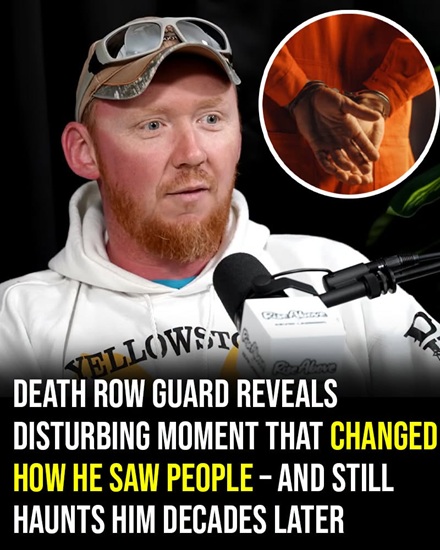
David Beechy once entered correctional work thinking of it primarily as a job, but his experience inside a Tennessee prison eventually left him with memories and habits that continued long after he walked away. Beechy has publicly discussed working as a correctional officer around prisoners on Death Row, describing an environment where remaining alert became part of everyday life. His account does not attempt to minimize the crimes that brought prisoners there. Instead, his reflections focus on what prolonged exposure to such an unusual environment did to the people living and working inside it.
Beechy has described the atmosphere as one of constant anticipation. Correctional officers could spend long periods performing ordinary duties while knowing circumstances might change unexpectedly. That combination created a particular kind of tension: nothing necessarily had to happen for an officer to remain prepared for something to happen. Watching people’s movements, recognizing changes in behavior and remaining aware of the surroundings gradually became automatic. Years later, Beechy said some of those habits had followed him into ordinary life.
One thing that surprised him was the everyday behavior of many prisoners he encountered. Some had already spent 15, 20 or even 30 years incarcerated, according to Beechy’s recollections. He believed that decades in confinement could produce substantial differences between an older prisoner and the younger person who had originally entered the correctional system. This did not erase responsibility for past crimes, but it complicated the way Beechy thought about identity, punishment and the passage of time.
Beechy also recalled that correctional officers were expected to maintain professional standards when interacting with Death Row prisoners. Legal scrutiny surrounding their treatment meant officers needed to pay close attention to their own conduct. He said supervisors also tried to select staff who were capable of working in the unit without unnecessarily provoking confrontations. In an already tense environment, creating conflict simply for the sake of demonstrating authority could make a difficult situation more dangerous for everyone involved.
The job gradually challenged some of Beechy’s assumptions about the prisoners themselves. Spending time around people every working day was different from knowing them only through descriptions of their crimes. He remembered looking at one prisoner and realizing that there was not a dramatic difference between them in age. The thought forced him to consider how two people who were relatively close in age could have arrived at extraordinarily different places in life.
That observation did not lead Beechy to dismiss or excuse violent behavior. Instead, it made him think more carefully about whether a person remains psychologically identical to the individual who committed a crime many years earlier. He has said that some prisoners who had spent decades on Death Row appeared very different from the younger men they had once been. Time, aging and years of incarceration had changed them, even though those changes did not undo the consequences of their earlier actions.
Beechy has said that he actually thought more about Death Row prisoners after leaving corrections than he did while working there. During the job, procedures and immediate responsibilities demanded most of his attention. Officers had tasks to complete and rules to follow, leaving limited time to analyze the philosophical meaning of everything happening around them. Distance eventually gave him more opportunity to consider what he had witnessed and how it had influenced his understanding of other people.
One of the most difficult periods he remembers involved an execution that occurred while he was working at the prison. According to Beechy’s account, the atmosphere throughout the unit changed significantly as the scheduled date approached. The environment became unusually quiet, and that change was noticeable not only immediately before the execution but also during the surrounding weeks. Some prisoners reportedly became less interested in leaving their cells for recreation.
Beechy described the period as intensely stressful. An execution was not simply an isolated event occurring in another part of the institution. Everyone in the unit knew that a specific date was approaching, including prisoners who were themselves living under death sentences. That knowledge affected the atmosphere in ways Beechy found difficult to forget. The usual rhythms of prison life continued, but the awareness of what was approaching remained in the background.
Another memory involved interacting with a prisoner after the man learned that his execution date had been established and his available appeals had reached their end. Beechy remembered a striking change in the prisoner’s demeanor. In his recollection, the man seemed physically present but emotionally distant, as though the reality of what was coming had fundamentally changed his engagement with the people and environment around him.
Soon afterward, according to Beechy, the prisoner began giving away personal possessions. Objects that mattered during ordinary prison life suddenly had little practical purpose to someone expecting to die. Watching that process affected Beechy because the prisoner was not dying from an illness. His physical health did not eliminate the significance of a date determined through the legal process, and Beechy found the experience difficult to comprehend even from his position as an officer.
Beechy has also spoken about witnessing severe mental-health crises inside the institution. In one particularly disturbing incident, he recalled a prisoner experiencing an apparent psychotic episode and seriously harming himself. The inmate survived, received medical treatment and, according to Beechy’s account, was subsequently treated with medication. The episode remained memorable because it demonstrated how quickly a mental-health emergency could become a serious physical emergency within a correctional environment.
Experiences like these contributed to Beechy’s eventual realization that correctional and law-enforcement work was not the right long-term path for him. He did not portray that conclusion as evidence that everyone would react in the same way. Some officers, he observed, were apparently better able to separate their professional environment from their private lives. Beechy became concerned that he personally might carry too much of the prison mentality into life outside the institution.
His background made the contrast particularly striking. Beechy has discussed growing up Amish before eventually moving into a dramatically different environment. The transition from that upbringing to working around maximum-security prisoners and Death Row exposed him to circumstances far removed from the world in which he had been raised. A separate 2025 podcast description of his story similarly identifies his path from an Amish upbringing into correctional work in Tennessee.
Beechy has explained that he did not want constant exposure to a high-stress environment to permanently determine how he viewed other human beings. Correctional work required vigilance, skepticism and attention to potential threats. Those skills could be useful inside a prison, but carrying the same level of suspicion into every ordinary interaction outside work could make normal relationships considerably more difficult.
Even after leaving the job, some habits remained.
Beechy has said that he tends to prefer sitting where his back is protected rather than exposed to an entire room. He also notices body language and pays attention to people’s movements in ways connected to his correctional experience. These behaviors illustrate how occupational habits can remain after the occupation itself has ended. Something practiced repeatedly for safety at work can eventually become an instinct that follows a person elsewhere.
Looking back also changed as Beechy’s own life changed. He has said that becoming a parent contributed to the way he reconsidered what he experienced. Events that once felt like part of a demanding workday could appear different years later when examined from another stage of life. He began thinking more about the individuals involved, the decisions that had brought them there and the families connected to both prisoners and correctional employees.
His reflections on former colleagues are similarly complicated. Beechy has said some officers were capable of leaving the correctional environment behind when their shifts ended. Others, in his view, allowed the culture and stress surrounding the job to become deeply intertwined with their personal lives. He described seeing relationships and family connections suffer in some cases, although those observations represent his personal assessment rather than evidence that correctional work produces the same outcome for everyone.
The distinction matters because correctional officers do necessary and difficult work under circumstances unfamiliar to most members of the public. Beechy’s decision that the career was not right for him should not be interpreted as a judgment about everyone who remains in the profession. His account is personal: it describes how one former officer processed an unusually demanding period of his own working life.
The same care is necessary when discussing the prisoners.
Recognizing that a person may change over decades does not erase a crime, invalidate a conviction or remove the suffering experienced by victims and their families. Beechy’s reflections instead raise a separate human question: how should someone understand a person after decades have passed since the actions that defined the most consequential moment of that person’s life?
Beechy did not encounter that question in an academic setting. He encountered it while working around prisoners whose daily lives were governed by strict procedures and, in some cases, the possibility of execution. Seeing those individuals repeatedly gave him a perspective fundamentally different from reading about them from a distance.
That proximity appears to have become one of the lasting themes of his experience.
A prisoner could be responsible for an extremely serious crime and still participate in ordinary conversations or routines inside the institution. A correctional officer could understand the gravity of someone’s criminal history while simultaneously observing that person’s everyday behavior. Holding both realities at once made the environment more psychologically complicated than a simple division between officers and inmates.
The execution Beechy witnessed appears to have intensified that complexity. According to his recollection, the approaching event affected the atmosphere of an entire unit. People who normally followed established routines became quieter, and some withdrew from activities. The experience demonstrated that a legal event involving one prisoner could have psychological consequences extending to many people around him.
Years afterward, Beechy was able to examine those experiences with more distance.
He no longer had to concentrate on completing a shift or continuously watching his surroundings. Instead, he could think about what the job had taught him about stress, identity and human behavior. Some conclusions were uncomfortable. He recognized that constantly expecting potential trouble could change the way a person interpreted strangers even outside the prison environment.
That was one reason he ultimately concluded the career was not for him.
Beechy wanted to retain the ability to encounter people without automatically viewing every interaction through the same defensive framework required inside a correctional institution. His Amish upbringing and later experiences represented dramatically different environments, and navigating the distance between them helped him understand what kind of life he wanted after leaving corrections.
His account is therefore about more than unusual stories from Death Row.
It is also about occupational stress and the way repeated exposure to extreme circumstances can influence perception. The habits Beechy developed were useful in an environment where vigilance mattered, but he did not want those habits to become his entire way of understanding humanity.
That perspective became clearer only after he left.
Beechy has acknowledged that while he was actually doing the work, many extraordinary situations simply felt like responsibilities that had to be handled. Looking back gave them a different meaning. Experiences that had once been absorbed as part of another shift became memories he could analyze from the perspective of a former officer, parent and person living outside that environment.
His recollections do not provide simple conclusions about capital punishment, corrections or criminal justice, nor should they be treated as representing every correctional officer or every Death Row institution. They are the reflections of one former officer describing how his own experiences affected him.
Perhaps the clearest theme in Beechy’s story is that proximity complicated his assumptions.
Before working there, prisoners on Death Row could be understood primarily through the crimes associated with them. Inside the institution, Beechy encountered people who had aged, developed routines and sometimes changed substantially over decades of incarceration. He did not forget why they were imprisoned, but he found that the reality of seeing them every day was more complicated than the abstract image he had carried beforehand.
Leaving corrections did not erase those experiences.
Some remained in his physical habits, such as where he prefers to sit and how carefully he observes a room. Others remained as questions about punishment, change and the psychological cost of spending years inside a high-security environment.
Beechy ultimately decided he wanted a different life.
His account does not ask readers to excuse serious crimes or ignore the experiences of victims. Instead, it describes how working inside Tennessee’s Death Row changed one man’s understanding of the people around him—including his understanding of himself.
Years after leaving the prison, that may be the part of the experience that remains most significant. Beechy entered corrections expecting to perform a job. He left recognizing that an environment built around constant vigilance, extreme sentences and human beings living under extraordinary circumstances could continue influencing a person long after the uniform came off.
As Beechy has reflected in interviews, the experience changed the way he saw human beings. That change was ultimately one of the reasons he chose not to make correctional or law-enforcement work his lifelong career. His memories remain personal recollections, but they offer a rare perspective on what prolonged exposure to Death Row looked and felt like to one former officer who eventually decided that the environment was changing him in ways he did not want to carry into the rest of his life.
