To a child, adulthood can sometimes look surprisingly simple. There is a home to live in, electricity whenever a light switch is flipped, food in the refrigerator, internet access, clean clothes and countless everyday comforts that can easily be taken for granted. What children do not always see is the work, planning and money required to provide those things. In 2015, one mother decided to turn that invisible reality into a memorable lesson after her 13-year-old son declared that he was earning his own money and no longer wanted to follow her rules.
Her response eventually became one of the internet’s most widely discussed examples of parental “tough love.” The mother was Heidi Johnson, and her son was Aaron. At the time, Aaron was 13 and going through a period in which, according to Johnson, he was pushing boundaries and challenging her authority. One disagreement centered on schoolwork. Johnson expected him to complete his homework and household responsibilities before enjoying screen time, but Aaron resisted those expectations.
He was also making a small amount of money from YouTube and apparently believed that earning money gave him a greater degree of independence. Johnson later explained that he told her he should not have to follow certain rules because he was making money himself. Rather than simply continuing the argument, Johnson decided to illustrate what genuine independence actually involves. She wrote Aaron a letter that was deliberately structured more like an agreement between roommates than a typical note from a parent.
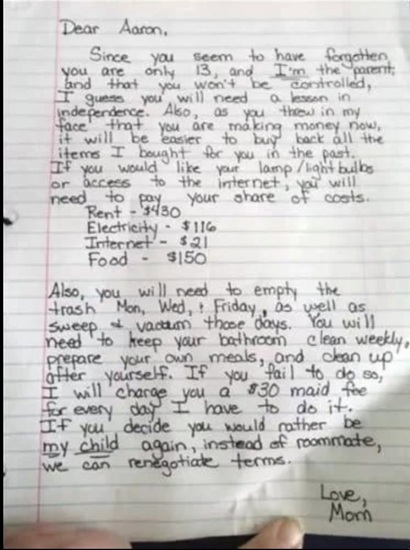
Her message began by reminding him that he was only 13 and that she was still the parent. Since he had insisted that he wanted greater independence and had pointed to his own earnings as justification, Johnson told him he could experience some of the financial responsibilities that normally accompany adult independence.
The note then presented Aaron with a list of household expenses. Johnson wrote that his monthly share would include $430 for rent, $116 for electricity, $21 for internet access and $150 for food. Together, those figures amounted to $717 before any additional charges were considered. The numbers were intentionally far beyond what a 13-year-old earning a small amount from YouTube could realistically afford. That was largely the point. Johnson wanted her son to understand that having a little income was very different from being capable of supporting an independent adult life.
Her proposed arrangement went beyond money. Aaron would also have responsibilities around the home. The letter instructed him to empty the trash on specified days, sweep and vacuum, clean his bathroom and prepare his own meals. Johnson also warned that if she had to perform work he was expected to complete himself, she would charge him a $30 “maid fee” for each day. At the end of the note, she made clear that there was another option: if Aaron preferred to return to being treated as her child rather than as an independent roommate, they could renegotiate the arrangement.
The letter was strict, but Johnson later emphasized that she never actually intended to evict her 13-year-old son or require him to pay hundreds of dollars in household bills. She explained that the exercise was designed to demonstrate how much daily life costs and how much parents routinely provide without handing children an invoice. Her goal, she said, was gratitude and responsibility rather than financial punishment. In later explanations, she stressed that Aaron would always have food and shelter and that she was not planning to put him out of the home if he could not pay the fictional bill.
Aaron’s first reaction showed that the lesson was not immediately welcomed. According to Johnson’s later account, he came home, saw the note and crumpled it onto the floor. He then left the apartment while angry. Johnson said she had previously encouraged him to take walks when he was upset so that both of them could calm down before trying to discuss a disagreement. She followed the same principle herself, explaining that sometimes stepping away temporarily was better than continuing an argument while emotions were high.
When Aaron returned, however, he was still angry. Johnson recalled that he entered her room and challenged whether she could really take away his possessions. At that point, she asked him to leave her room until they could speak respectfully and calmly. Rather than escalating the confrontation indefinitely, mother and son took more time apart. What happened next became one of the most important parts of Johnson’s explanation of the incident.
About an hour later, Aaron apparently began reconsidering his position. According to Johnson, he removed some electronics and other belongings from his room that he believed he should have to earn back because of his behavior. He apologized and asked what he could do to improve the situation. Johnson said he quickly earned back some basic comforts and clothing while other privileges would be restored gradually. The point was not permanent deprivation, she explained, but connecting privileges with responsibility and respectful behavior.
Johnson later said Aaron also recognized something important almost immediately: the small amount of money he was earning would never cover the costs she had listed. Rent, electricity, internet service and groceries quickly added up to far more than he could afford. The realization helped make visible something parents often handle in the background. Household expenses do not disappear simply because children do not see the bills being paid.
The situation might have remained a private family story if Johnson’s Facebook post had stayed within her intended audience. She later explained that she had meant to share the letter with friends, but the post was accidentally made public. Once strangers discovered it, sharing and commenting accelerated rapidly. The family disagreement suddenly became an international parenting debate, with people who had never met Johnson or Aaron offering strong opinions about whether her approach was appropriate.
Many commenters supported Johnson. They viewed the letter as a creative way to explain the difference between enjoying the privileges of adulthood and accepting adult responsibilities. Supporters argued that teenagers benefit from understanding that housing, food, utilities and internet service require money and work. To them, Johnson’s approach was not a literal demand for rent but an exaggerated financial demonstration designed to help a young teenager understand what independence actually costs.
Others strongly disagreed. Critics worried that presenting shelter and food as expenses a child might owe could send the wrong message about parental responsibility. Some argued that teenagers should not be made to feel indebted to their parents for necessities that caregivers are responsible for providing. Others were uncomfortable with the fact that a private conflict between a parent and child had become public on social media. Parenting experts cited in later coverage have generally cautioned against publicly airing family conflicts involving children.
Johnson responded to those criticisms in a follow-up explanation. She said she was not ashamed of the letter and emphasized again that she had no intention of putting her child on the street or demanding actual rent from him. She wanted Aaron to appreciate his home, his belongings and the work required to maintain them. In her view, the lesson was about respect and gratitude rather than making a teenager financially responsible for necessities.
She also provided additional information about the ordinary expectations she already had for her son. According to Johnson, her household rules included doing his best in school, asking for help when he did not understand something and completing homework and chores before recreational screen time. She did not demand perfect academic performance, but she expected genuine effort. Those expectations placed the viral letter in a broader context: the dispute had developed from disagreements over routine household and school responsibilities rather than from an attempt to make a child financially self-sufficient.
Aaron’s usual chores were also fairly typical household tasks. Johnson said he was expected to empty the trash, unload the dishwasher, throw away rubbish he created in the kitchen, rinse dirty dishes, make his bed and straighten his bedroom. He was also responsible for cleaning his bathroom once a week. In addition, there were household cleaning days when he was expected to select two tasks connected to the room being cleaned, such as vacuuming, dusting, washing windows or mopping.
Respectful communication was another major part of Johnson’s rules. She expected Aaron to avoid cursing at her or responding disrespectfully, maintain good personal hygiene, use appropriate manners and listen when someone was speaking to him. Johnson’s explanation suggested that the dramatic roommate letter was not intended to replace those ordinary expectations. Instead, it was an attempt to make a point after Aaron rejected the idea that his mother had authority to impose them.
Johnson summarized the conflict as a 13-year-old telling his mother that she could not control him while wanting to continue receiving everything that came with being her dependent child. Her response was essentially to ask what the arrangement would look like if she stopped acting as his parent and instead behaved like an ordinary roommate. A roommate, unlike a parent, would expect someone to contribute financially, prepare meals, clean shared spaces and pay for services they used.
That distinction ultimately became the central lesson of the story. Independence is not simply freedom from rules. It involves responsibility for choices, bills, work, schedules and obligations. Adults may decide when they go to bed or how they spend their money, but they also have to make sure rent is paid, food is available and household tasks are completed. Johnson wanted Aaron to recognize both sides of that equation rather than focusing exclusively on the freedom he associated with adulthood.
The dispute also demonstrated how quickly parent-teen conflicts can intensify. Adolescence is a period when young people naturally seek greater autonomy, test boundaries and increasingly want control over their own decisions. Parents, meanwhile, remain responsible for setting limits, ensuring school responsibilities are met and helping teenagers develop the skills required for adulthood. Those two realities can easily collide, particularly when a teenager feels ready for independence before having experienced many of its practical consequences.
Johnson’s approach was intentionally dramatic, and reasonable people can disagree about whether they would use the same strategy. What became clearer later, however, was that the incident did not destroy her relationship with Aaron. Johnson said that they continued speaking openly, that he apologized and that he gradually earned privileges back. She described him as becoming more appreciative after the conflict.
Years later, Aaron himself also pushed back against suggestions that the incident had permanently damaged his relationship with his mother. In later coverage of the viral story, he indicated that he and Johnson still had a good relationship and acknowledged that his 13-year-old self had been difficult. His response provided useful context to a story that was often reduced online to a photograph of a strict letter without the later reconciliation between mother and son.
That later context matters because viral posts often freeze one emotional moment in time. A reader may see a parent’s angry letter without seeing the apology that happened afterward, the conversation that followed or the relationship years later. Social media is especially effective at preserving dramatic moments while removing the less sensational details around them. Johnson’s original letter became famous precisely because it was surprising, but the complete story included negotiation, reflection and reconciliation.
The incident also opened a broader discussion about whether family discipline belongs on social media. Johnson said the post becoming public had not been her original intention. Nevertheless, once it spread, strangers were able to comment on a conflict involving a 13-year-old who had not chosen to become the subject of an international parenting discussion. That concern became one of the strongest criticisms of the episode and remains relevant in an era when parents routinely share stories and images involving their children online.
At the same time, supporters saw educational value in the story. The fictional household bill provided a straightforward way of showing teenagers how expensive ordinary life can be. A young person might understand that electricity costs money in an abstract sense while still having little idea how several bills combine each month. Rent, groceries, utilities and internet service can quickly consume a substantial portion of an adult’s income.
There is also a larger lesson about the difference between income and financial independence. Aaron was earning some money through YouTube, but having income does not automatically mean someone can support themselves. Adults must consider recurring expenses, unexpected costs, taxes, transportation, clothing, healthcare and many other financial obligations. Johnson’s exaggerated roommate arrangement effectively confronted the difference between having spending money and paying the costs required to maintain a household.
The letter also highlighted another aspect of adulthood that children may overlook: household labor. Food does not simply appear on a table, dirty dishes do not clean themselves and rubbish does not automatically disappear. Someone is responsible for shopping, cooking, cleaning and maintaining the home. By including chores alongside rent and utilities, Johnson treated responsibility as something broader than simply paying money.
Her approach therefore combined two different lessons. One involved financial literacy and understanding how much ordinary necessities cost. The other involved contributing to the shared work of a household. Even a teenager who cannot reasonably be expected to pay rent can still learn that being part of a family means contributing in age-appropriate ways.
Johnson repeatedly emphasized that she was not trying to deny Aaron necessities. She said he still had appropriate clothing, bedding and basic needs while privileges and preferred items were temporarily tied to improved behavior. Her follow-up explanation was intended partly to counter interpretations suggesting she planned to make a 13-year-old genuinely responsible for his own housing and food.
The phrase “nothing comes free” also became central to the way Johnson described the lesson. Her point was not necessarily that children must financially repay parents for raising them. Rather, she wanted Aaron to recognize that every comfort requires effort from someone. A meal requires ingredients and preparation. Electricity requires payment. A home requires rent or a mortgage, maintenance and cleaning. Even an internet connection that feels limitless to a child appears each month on somebody’s bill.
That reality can be difficult to communicate to children because good parenting often makes the work behind everyday stability almost invisible. When bills are consistently paid and food is always available, children can understandably experience those things as normal features of life rather than as results of planning and sacrifice. Johnson’s unconventional strategy made those invisible responsibilities temporarily visible.
Her story also reflects the delicate balance parents face when preparing teenagers for adulthood. Too little responsibility can leave young people unprepared for independence. Too much responsibility too soon can place unfair burdens on children. Families therefore have to find approaches appropriate for their own circumstances, values and relationships.
That is one reason the viral letter produced such sharply divided opinions. Some parents saw an inventive teaching tool. Others saw a method they would never use with their own children. Both reactions demonstrate that parenting decisions cannot always be separated from family context. A strategy that works in one relationship may be ineffective or harmful in another.
Johnson herself did not claim that every parent should copy her exact method. Her later explanations focused primarily on why she had used it with Aaron and what she hoped he would understand. She described a child pushing strongly for independence and a parent responding by showing him what that independence would actually require.
What makes the story endure more than a decade after the original incident is probably its recognizable central conflict. Teenagers commonly want more freedom as they get older. Parents commonly want them to demonstrate responsibility before receiving that freedom. Arguments about homework, chores, screen time and respect therefore take place in homes everywhere, even if few of them end with an itemized $717 monthly bill taped to a bedroom door.
The story also has an unexpectedly positive ending. After the initial anger subsided, Johnson said Aaron apologized and began asking how he could regain privileges. The disagreement became a conversation about expectations instead of an endless fight. In later years, both mother and son indicated that their relationship had survived the episode.
That outcome does not mean every detail of Johnson’s method should be treated as universal parenting advice. It simply provides important context for understanding what actually happened. The viral image captured the strictest part of the episode, but the complete story involved a parent who said she never intended to collect the money and a teenager who eventually understood the point she was trying to make.
For parents reading the story today, perhaps the most useful takeaway is broader than the letter itself. Children gradually need opportunities to understand money, responsibility and the effort required to maintain a household. Those lessons can be taught through chores, budgeting exercises, savings goals, conversations about expenses and increasing responsibility as children mature.
Johnson happened to communicate that message through a dramatic “roommate contract,” and the internet turned her private family lesson into a worldwide debate. More than a decade later, people are still discussing whether her approach represented effective tough love or went too far. What is documented is that she never intended to make her son genuinely pay hundreds of dollars in rent and that both later described their relationship as intact.
Aaron wanted the freedom associated with being grown up. His mother wanted him to understand the other half of that equation: responsibility. For Johnson, adulthood meant more than earning a little money and deciding that parental rules no longer applied. It meant understanding work, bills, respect, commitments and the consequences of personal choices.
Her unconventional lesson turned a difficult argument into a story millions of people would eventually read. Whether people agree with every part of her approach or not, the principle she hoped to communicate remains easy to understand. Independence brings freedom, but genuine independence also comes with responsibilities that children may not fully see until someone finally shows them what those responsibilities involve.
