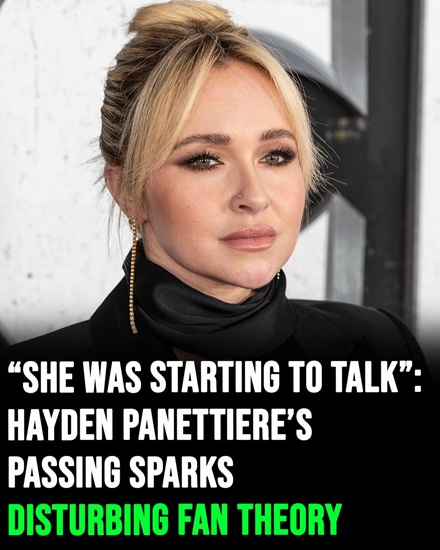
The sudden death of Hayden Panettiere at the age of 36 has shocked people who followed the actress through more than three decades in entertainment. Panettiere, widely recognized for playing Claire Bennet in Heroes and Juliette Barnes in Nashville, died on August 16, 2026, after being found unresponsive in Greenville, South Carolina. Her family confirmed her death, while authorities began investigating the circumstances surrounding it. Initial information from law enforcement indicated that investigators had found no signs of foul play.
An official cause of death had not been publicly established in the immediate aftermath, making it important to distinguish confirmed information from speculation circulating online. Panettiere’s father, Alan “Skip” Panettiere, announced the devastating loss in a statement that reflected the family’s grief. He described his daughter as an extraordinary source of light and energy who brought happiness to the people around her and to millions who had watched her work.
The family also requested privacy while processing the unexpected loss. For those closest to Panettiere, her death represents a personal tragedy rather than simply another celebrity story. For audiences, however, the announcement has also resulted in renewed attention to the unusually candid interviews Panettiere gave during the final months of her life. That renewed attention has produced questions and theories across social media.
Some users have attempted to connect the timing of Panettiere’s death with the publication of her memoir, This Is Me: A Reckoning, and interviews in which she discussed painful experiences from her past. A number of posts have gone considerably further, suggesting without evidence that Panettiere might have been deliberately “silenced” because she had begun speaking publicly about difficult experiences in Hollywood. No verified evidence has emerged supporting that allegation, and authorities have not announced findings suggesting that another person was responsible for her death.
The distinction matters because unusual timing alone is not evidence of a connection between two events. Panettiere had indeed recently spoken publicly about deeply personal experiences, and she had revealed information about difficult periods of her life that audiences had not previously known in detail. However, the fact that those disclosures occurred months before her death does not establish that the events were connected. Until investigators provide additional verified information, theories alleging that Panettiere was targeted remain speculation rather than established fact.
Panettiere’s memoir was published in May 2026 and represented one of the most extensive accounts she had ever given of her life away from television and movie sets. The actress discussed growing up in the entertainment industry, the pressures surrounding childhood fame, relationships, motherhood, postpartum depression, addiction, recovery, trauma and the death of her younger brother, Jansen. She wanted the public to understand that the celebrity image people had seen for decades represented only part of her experience. The book allowed her to tell that story from her own perspective rather than having it reconstructed entirely through entertainment headlines.
Some of the experiences Panettiere described were disturbing. She discussed being exposed to substances while she was young and recalled how people around her could influence her behavior as she navigated the demands of celebrity. Panettiere had previously said that someone in her professional circle gave her pills before an event when she was a teenager, describing them as something intended to make her energetic during appearances. She later experienced serious problems involving opioids and alcohol, subjects she addressed publicly rather than attempting to hide them.
Those revelations deserve to be understood in their proper context. They were part of Panettiere’s account of how addiction developed during her life and how she eventually attempted to recover. They are not, by themselves, evidence that the entertainment industry as a whole was responsible for her death. Nor do they establish the existence of a conspiracy surrounding what happened in Greenville. Panettiere was describing experiences from earlier periods of her life and reflecting on how those experiences affected the person she became.
One of her most significant interviews connected to the memoir occurred on May 11, 2026, when she appeared on Jay Shetty’s On Purpose podcast. The conversation lasted more than two hours and gave Panettiere considerable space to discuss her life in her own words. She reflected on becoming famous as a child, feeling different from other children, learning to trust herself, dealing with anxiety, experiencing postpartum depression, confronting addiction and recovering from traumatic experiences.
The conversation also included Panettiere’s recollection of a troubling experience from when she was 18. She described being placed in an uncomfortable situation involving a famous man while aboard a boat and explained how she removed herself from the situation. She did not publicly identify the man. Her account was framed as part of a broader discussion about vulnerability, boundaries, trust and the complicated situations she encountered while growing up around fame.
Following Panettiere’s death, clips and excerpts from that interview began circulating again. Because the conversation dealt openly with painful experiences, some social-media users interpreted it through the lens of what subsequently happened to her. Comments appeared suggesting that she had revealed too much or that the timing of her death was suspicious. Others went further and directly alleged that unidentified people within the entertainment industry had caused her death.
Those allegations currently lack supporting evidence. No publicly reported findings from investigators have established that Panettiere was killed because of her memoir, podcast appearances or disclosures about Hollywood. Police said their preliminary investigation showed no signs of foul play. The investigation into her death nevertheless remains important because an official determination about the cause requires appropriate medical and investigative procedures.
Online speculation following the unexpected death of a public figure is not unusual. When someone young and famous dies suddenly, unanswered questions can create an environment in which theories spread faster than verified information. Social-media posts can then be repeated by thousands of people even when their original authors provide no supporting evidence. Repetition can make an allegation appear established when it remains only a theory.
That is particularly relevant in Panettiere’s case because her memoir contained serious and emotional material. Readers learned more about experiences she had previously discussed only partially, while her promotional interviews allowed her to revisit those experiences publicly. The combination of major disclosures followed several months later by an unexpected death can understandably cause people to ask questions. Asking questions, however, is fundamentally different from claiming that a particular explanation has already been proven.
Panettiere had also been speaking about the future during the months before her death. In interviews surrounding her memoir, she discussed continuing her professional life and pursuing additional creative opportunities. She had plans extending beyond simply recounting her past. That context complicates attempts to reduce her final months to a narrative suggesting that she was solely focused on exposing wrongdoing.
Her memoir instead covered an enormous range of personal experiences. It explored what it was like to enter entertainment as a very young child and eventually become internationally famous. Panettiere had been working professionally for much of her life before she reached adulthood. By the time she became Claire Bennet on Heroes in 2006, she already possessed years of television and film experience.
Her early credits included appearances on One Life to Live and Guiding Light. She voiced Dot in Pixar’s A Bug’s Life and appeared in Remember the Titans alongside Denzel Washington. Other projects followed before Heroes transformed her into one of television’s most recognizable young stars. The enormous popularity of the series brought Panettiere international attention while she was still a teenager.
Claire Bennet became one of the defining characters of Heroes. Panettiere portrayed a cheerleader who discovered that she possessed an extraordinary ability to heal from injuries. The show’s famous “Save the cheerleader, save the world” storyline placed her character at the center of the series and turned Panettiere into a familiar face far beyond American television audiences.
Her career later entered another major phase when she joined Nashville in 2012. Panettiere played country singer Juliette Barnes, an ambitious performer whose personal difficulties often unfolded alongside professional success. The role gave Panettiere an opportunity to demonstrate her dramatic and musical abilities and ultimately earned her two Golden Globe nominations.
Panettiere would later explain that aspects of Juliette’s struggles became uncomfortably close to difficulties she was experiencing in her own life. She had been dealing with addiction and later experienced postpartum depression following the birth of her daughter, Kaya, in 2014. Panettiere eventually became increasingly open about those experiences, explaining that what audiences saw on television did not necessarily reflect what was happening behind the scenes.
Her struggles with alcohol and opioids became particularly serious. Panettiere discussed periods in which addiction damaged both her personal and professional life. At one point, she said she received a stark medical warning about the potential consequences if she continued drinking. She subsequently entered treatment and spent considerable time working toward recovery.
Those documented struggles have inevitably become part of public discussion following her death. However, they should not be used to establish an official cause before authorities do so. A person’s history of addiction can be relevant biographical information without automatically explaining a later death. The same principle applies to reports concerning the emergency call made on the day Panettiere died. Initial emergency information is not equivalent to a final medical determination.
Another deeply painful chapter in Panettiere’s life was the death of her younger brother, Jansen Panettiere, in February 2023 at the age of 28. Jansen was an actor and artist, and his family said his death resulted from an enlarged heart combined with complications involving the aortic valve. Hayden later spoke openly about how profoundly his death affected her.
She described losing her only sibling as an experience that changed her permanently. Grief affected her emotionally and physically, and she acknowledged struggling with guilt and the feeling that she should have been able to protect him. Her interviews demonstrated that she was still learning how to live with the loss rather than claiming that she had simply moved beyond it.
Motherhood was another central part of Panettiere’s life and memoir. She shared daughter Kaya with her former fiancé, Ukrainian boxing champion Wladimir Klitschko. Kaya was born in December 2014, after which Panettiere experienced postpartum depression. She later spoke about seeking treatment and about the complicated circumstances that eventually resulted in Kaya living primarily with her father.
Panettiere rejected simplistic interpretations suggesting that she did not care about her daughter. She described decisions made during a period when her own health and stability were serious concerns and explained the emotional difficulty involved. Her discussions of motherhood were often painful, but they also demonstrated how important her relationship with Kaya remained to her.
The memoir therefore was not simply an attempt to “expose Hollywood,” as some online commentary has characterized it. It was a much broader personal account covering family relationships, fame, motherhood, addiction, trauma, recovery, grief and identity. Panettiere discussed troubling experiences connected to the entertainment world, but she also discussed her own choices and acknowledged mistakes she believed she had made.
Her conversation with Jay Shetty followed a similar pattern. It was not presented as an investigation into a secret Hollywood conspiracy. Instead, it centered on Panettiere attempting to understand her life, the experiences that shaped her and the work she had done to recover from painful periods. She discussed learning to trust herself after feeling that other people had controlled important parts of her life.
This context is important when old clips circulate after her death. A short excerpt removed from a two-hour conversation can appear dramatically different from the full discussion. When those clips are paired with claims about an unexplained death, viewers may infer a connection that the available evidence does not demonstrate.
Some social-media users have nevertheless argued that Panettiere’s disclosures made the timing of her death suspicious. Those opinions can be reported as examples of online reaction when clearly labeled as unverified claims. They should not be presented as evidence or as conclusions reached by authorities.
Statements claiming that Panettiere was deliberately killed are substantially more serious than simply asking what happened. At present, there is no publicly verified evidence supporting such claims. Police have not announced that her memoir or interviews were connected to her death, and preliminary findings have not indicated foul play.
The appropriate approach is therefore to allow the investigation to continue while recognizing the limits of currently available information. If authorities release additional findings, those facts can change the understanding of what happened. Until then, presenting speculation as certainty would risk spreading misinformation during a period when Panettiere’s family is already grieving.
Her death also should not erase the hopeful aspects of what she said during her final months. Panettiere spoke about rebuilding, healing and pursuing additional opportunities. She had spent years confronting addiction and other difficulties and was attempting to use what she had experienced to connect with people facing struggles of their own.
Before her death, she also discussed future creative ambitions. She expressed interest in continuing to work and exploring projects beyond acting. Those plans are particularly poignant in retrospect because they demonstrate that Panettiere was thinking about chapters of her life that she expected still to come.
At only 36, she had already accumulated a career spanning more than three decades. Audiences had watched her develop from a child performer into a teenage star and then an adult actress. Her work included family movies, television dramas, superhero storytelling, music and horror films.
She also became closely associated with the Scream franchise after appearing as Kirby Reed in Scream 4. More than a decade later, Panettiere returned to the role in Scream VI, bringing back a character that had developed a devoted following among horror fans.
Her career was therefore much larger than the difficult experiences described in her memoir. Those experiences were important because Panettiere herself decided they were part of the story she wanted to tell, but they did not define everything she accomplished or hoped to accomplish.
The same principle should guide discussion after her death. Panettiere’s final months should not be transformed into evidence for a conspiracy simply because she had recently spoken openly about Hollywood. Her statements deserve to be heard in the context in which she made them, while the circumstances surrounding her death should be established through evidence.
The facts currently provide a clearer and more responsible framework. Hayden Panettiere died at 36 after being found unresponsive in Greenville, South Carolina. Authorities opened an investigation. Police reported no preliminary signs of foul play. Her official cause of death had not initially been publicly determined.
It is also established that she had recently published a deeply personal memoir and participated in interviews discussing difficult experiences from her past. Those disclosures included addiction, postpartum depression, trauma, relationships, motherhood and experiences associated with growing up in entertainment.
What has not been established is that those disclosures caused her death, that someone targeted her for speaking publicly, or that an entertainment-industry conspiracy was responsible. Social-media users have made such allegations, but allegations are not evidence.
That distinction is particularly important in an era when speculation can spread globally within hours. Responsible reporting can acknowledge that theories exist without endorsing them. It can explain why people are discussing Panettiere’s final interviews while simultaneously making clear that investigators have not substantiated claims of foul play.
For Panettiere’s family, the focus is now on an enormous personal loss. Her parents had already endured the death of their son only three years earlier. Her daughter, Kaya, has now lost her mother. Those realities make accuracy and restraint particularly important when discussing unanswered questions surrounding the actress’s death.
Hayden Panettiere spent nearly her entire life in the public eye. She became famous as a child, achieved international recognition as a teenager and continued acting into adulthood. During her later years, she increasingly attempted to reclaim ownership of her story by discussing experiences that had previously remained private.
This Is Me: A Reckoning became an important part of that effort. Her interviews surrounding the book allowed audiences to hear directly from Panettiere about how she understood her childhood, career, mistakes, trauma and recovery. Those conversations now form part of the public record she left behind.
They should be remembered for what Panettiere actually said rather than transformed into evidence for claims she never made. Her willingness to discuss painful experiences was significant on its own and does not require an unsupported conspiracy narrative to make those experiences meaningful.
As investigators continue their work, more verified information may eventually provide answers about Panettiere’s final hours. Until that happens, the most accurate conclusion is also the simplest: important questions remain unanswered, but authorities have not reported evidence supporting claims that she was deliberately “silenced” because of her memoir or interviews.
Hayden Panettiere’s death is tragic without embellishment. She was a 36-year-old mother, daughter, sister and performer whose professional life had already stretched across several generations of television and film audiences. She had experienced extraordinary success as well as serious personal difficulties and profound grief.
Her final months showed her attempting to tell that complicated story in her own words. Whether discussing childhood fame, addiction, motherhood, trauma or recovery, Panettiere presented a life that was considerably more complicated than the celebrity image audiences had known.
Remembering that story accurately means acknowledging both what is known and what remains unknown. It means taking her documented experiences seriously while refusing to convert unverified online theories into facts.
For now, the investigation into Hayden Panettiere’s death remains the proper source for determining what happened. Until official findings provide further answers, claims that she was killed or “silenced” because she spoke about her experiences in Hollywood remain unsupported speculation rather than established fact.
Her performances in Heroes, Nashville, Remember the Titans and the Scream franchise, together with the deeply personal account she eventually chose to publish, leave behind a substantial record of an extraordinary and complicated life. At 36, that life ended far earlier than anyone expected, but the story she chose to tell should be remembered according to the evidence and her own words—not theories that have yet to be proven.
