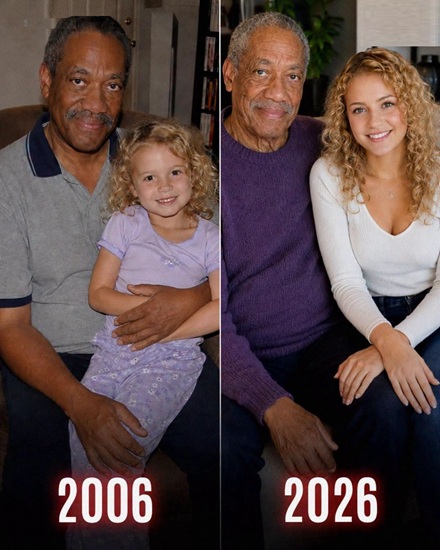
Martin was fifty years old when one winter evening divided his life into a before and an after. Until then, Christmas had always represented the happiest part of the year for his family. His son Michael usually arrived early, carrying bags of groceries and presents, while Michael’s wife, Rachel, helped prepare dinner. Their eight-year-old son, Sam, filled the house with questions and laughter, and five-year-old Emily rarely stayed awake long enough to see the evening end.
Martin had no reason to imagine that this particular family gathering would become the last one they would ever share together. Snow had begun falling before sunset, but the fictional weather reports within this story suggested that the accumulation would remain relatively light. From Martin’s kitchen window, the neighborhood still looked peaceful rather than dangerous.
A thin white layer covered the lawn, porch railing, and branches of the trees. Michael occasionally looked outside while the family ate, but nothing about the conditions seemed alarming enough to change their plans. The children were more interested in Christmas decorations and presents than in the weather developing beyond the windows.
By early evening, however, the snowfall had become noticeably heavier. Martin suggested that Michael and Rachel stay overnight rather than make the drive home. There was plenty of room, he reminded them, and nobody needed to be anywhere early the following morning. Michael considered the suggestion but believed they could make the relatively short journey safely. Rachel was tired as well and wanted to get the children home before the roads became worse. Their decision seemed ordinary at the time, which was one reason Martin would replay it in his mind for years afterward.
Sam pulled on his winter coat while Emily had already fallen asleep on the sofa. Michael carefully lifted his daughter without waking her and carried her toward the car. Her small face was almost hidden inside the hood of her puffy jacket. Before getting into the driver’s seat, Michael turned toward his father and assured him that everything would be fine. Martin watched the vehicle disappear through the falling snow and remained at the window several seconds longer than necessary.
He could never adequately explain why he felt uneasy after they left. Nothing specific had happened, and there was no dramatic warning that something terrible was approaching. It was simply the familiar concern of a parent watching family members travel during worsening weather. Martin eventually cleaned the kitchen, turned off several Christmas lights, and tried to distract himself. As the evening continued, however, he found himself checking the clock more frequently.
Several hours later, a knock came at the front door.
Standing outside was Officer Reynolds, a fictional police officer created for this story. Martin immediately understood from the man’s expression that something serious had happened. Reynolds explained that Michael’s vehicle had been involved in a crash on a rural road several miles away. According to the initial account, the car had left the roadway during the snowstorm and struck trees. Emergency crews had responded, but Michael, Rachel, and Sam had not survived.
Emily was alive.
For several moments, those were the only words Martin could fully understand. Everything else seemed distant and disconnected. He remembered grabbing his coat and asking repeatedly where his granddaughter had been taken. Reynolds drove him to the hospital, where doctors explained that Emily had suffered a concussion, broken ribs, extensive bruising from the restraint, and other injuries requiring observation. Her condition was serious, but the medical team expected her to recover physically.
The emotional consequences were far less predictable.
When Emily eventually became alert enough to communicate consistently, her memories of the crash were fragmented. She remembered being carried to the car. She remembered snow against the window and the sound of the heater. After that came isolated sensations rather than a continuous memory: bright lights, a sudden movement, an unfamiliar noise, and then darkness. In the fictional circumstances of this story, her doctors advised Martin not to pressure her into reconstructing events she could not clearly remember.
Martin followed that advice.
Within days, he found himself grieving three members of his family while simultaneously becoming responsible for a frightened five-year-old child. There was no preparation period. One evening he had been a grandfather living alone, and shortly afterward he was responsible for school schedules, meals, clothes, medical appointments, bedtime routines, and the emotional security of a child who had lost almost everyone she knew.
He made mistakes at first.
He had never been particularly skilled at styling a child’s hair, and Emily sometimes laughed when he produced an uneven ponytail before school. Cooking presented another challenge. Martin knew how to prepare meals for himself, but he quickly discovered that feeding a five-year-old involved negotiations he had never encountered. He learned which vegetables Emily would eat, how she preferred her sandwiches cut, and why having the correct breakfast cereal could occasionally seem like the most important issue in the world.
Those ordinary responsibilities gradually gave structure to their grief.
Martin attended parent-teacher meetings and school performances. He sat in the front row when Emily participated in her first school play, even though she had only a few lines. He helped with homework and learned enough about children’s books to discuss the stories she brought home from the library. Every Christmas remained difficult, but he refused to allow the anniversary of the crash to transform the entire holiday into something Emily feared.
When she asked what had happened to her parents and brother, Martin gave her the explanation he believed was true.
There had been a terrible snowstorm. Their car had lost control on an icy road. It was an accident. Nobody had wanted it to happen, and nobody was responsible for taking her family away from her.
For many years, Emily accepted that explanation.
She grew into a quiet and observant teenager who preferred books to large social gatherings. Mystery novels became her favorite. She enjoyed stories in which apparently insignificant details eventually revealed a larger explanation. Martin occasionally joked that she would become a detective, although Emily eventually discovered that her interests were equally suited to legal research.
After finishing college, she returned to the town where she had grown up and began working as a paralegal.
Her work taught her how much information could disappear inside ordinary paperwork. She learned to search court databases, compare versions of reports, follow filing histories, and notice when a document that should exist was mysteriously absent. Those skills initially had nothing to do with her family’s tragedy. The crash belonged to another part of her life, something painful but apparently settled.
As the twentieth anniversary approached, that began to change.
Emily started experiencing memories she could not easily place. They were not complete scenes, and she understood that memories formed during childhood trauma could be uncertain. She therefore refused to treat every image in her mind as reliable evidence. Still, several details troubled her. She remembered lights appearing through the rear window. She remembered her father saying something sharply. Most importantly, she had an impression that another large vehicle had been somewhere ahead of them shortly before everything went dark.
She began asking Martin questions.
What time had they left his house?
Had anyone called afterward?
Had police interviewed him more than once?
Had investigators mentioned another vehicle?
Had anyone ever explained precisely where Michael’s car first began leaving its lane?
Martin answered everything he could remember. He also told Emily that he had spent years asking himself similar questions before eventually accepting the official explanation. The road had been covered with snow and ice. Michael had apparently lost control. Martin saw no reason to reopen a wound that had taken both of them decades to survive.
Emily did not argue with him.
Instead, she started researching.
Because this is a fictional narrative rather than a real investigation, the records and discoveries that follow are invented elements of the story. Emily’s fictional search led her through archived court materials connected with unrelated civil litigation involving a transportation company. Among several boxes was an old silver flip phone that appeared to have been preserved with evidence but inadequately catalogued.
Emily initially assumed the phone had nothing to do with her family.
Then she discovered its date.
It corresponded with the night of the crash.
The device contained several damaged audio files. Most were useless fragments consisting of static, wind, or incomplete speech. One recording, however, contained enough recognizable dialogue to make Emily listen repeatedly. Two male voices could be heard beneath engine noise. One appeared frightened and said he could not continue because nobody was supposed to get hurt. Another voice responded sharply, telling him to keep driving and mentioning a missed turn.
The recording did not prove what had happened to Michael’s family.
Emily knew that.
She also understood from her legal work that a mysterious recording was not automatically evidence of a conspiracy. The conversation might have concerned something completely unrelated. Rather than constructing a theory first and forcing the evidence to support it, she searched for independent records that might explain why the phone existed.
That search led her to Officer Reynolds.
Within the fictional world of the story, Reynolds had faced an internal investigation years after the crash. Investigators suspected that he had accepted money from a private trucking company in exchange for altering reports concerning vehicle maintenance and road incidents. No allegation had been publicly connected with Michael’s crash, and the investigation had ended without answering every question.
Emily continued searching.
She eventually discovered references to a tractor-trailer that had jackknifed on the same rural road earlier on the day her family died. Temporary barricades had reportedly been placed to keep ordinary traffic away from the hazardous area while arrangements were made to move the disabled vehicle. Yet those barricades were apparently no longer in their intended positions by the time Michael drove onto the road.
That discrepancy changed everything.
Emily compared diagrams, timestamps, archived photographs, and descriptions from the fictional records. The more she studied them, the less convincing the original explanation appeared. Michael’s tire marks did not seem consistent with a vehicle simply drifting from the roadway after losing traction. They suggested a sudden attempt to change direction.
Emily developed a different possibility.
Michael might have encountered the disabled truck through heavy snow and swerved to avoid it.
If that interpretation was correct, the storm had contributed to the tragedy, but it had not been the only cause.
Emily returned to Martin’s house one evening carrying a folder of documents. She placed them on the kitchen table, followed by a handwritten note containing four words:
“It wasn’t an accident.”
Martin stared at the sentence for a long time.
Emily immediately clarified what she meant. She was not claiming someone had deliberately targeted their family. She had found no evidence of an intentional attack, and she did not want Martin believing otherwise. What she believed she had uncovered was negligence compounded by deliberate corruption: a dangerous road may have been left accessible because people were attempting to conceal problems involving a trucking company.
For Martin, the distinction was enormous.
An intentional attack would have meant someone had wanted his family dead. Emily’s evidence suggested something different but still devastating. If her reconstruction was correct, people had made selfish decisions without caring enough about the possible consequences, and those decisions had placed an unsuspecting family in danger.
There was another obstacle.
Reynolds had died three years earlier.
There could therefore be no confrontation between Emily and the man she suspected of altering the truth. There would be no dramatic courtroom moment in which he was forced to answer questions about the night of the crash. Emily found that frustrating, but she reminded Martin that her search had never been solely about punishment.
She wanted to understand what happened.
Eventually, Emily located Reynolds’s widow.
Their first conversation was uncomfortable. Emily explained that she was not accusing the widow of participating in anything and did not expect her to defend her husband’s conduct. She simply wanted to know whether Reynolds had left documents relating to the transportation company or the crash.
The widow did not answer immediately.
Several days later, she contacted Emily again.
While sorting through her husband’s belongings after his death, she had discovered papers he apparently never intended to file officially. Among them were copied reports, handwritten notes, and a sealed letter addressed to Martin.
The fictional letter supplied the final piece of the story.
According to Reynolds’s written account, he had accumulated substantial personal debts years earlier. A representative associated with the trucking company began paying him to minimize damaging details in reports concerning mechanical failures and other incidents. What began as seemingly small alterations became progressively more serious.
On the day of Michael’s crash, a truck connected with the company became disabled on the rural road.
The road should have remained restricted.
Instead, decisions were made that allowed the barricades to be removed before the hazard had been fully resolved. Reynolds apparently believed the road would remain quiet long enough for the situation to be corrected without attracting attention. He had not anticipated the rapidly worsening snowstorm, nor had he known that Michael and his family would travel that route.
By the time he understood how dangerous the situation had become, it was too late.
Michael entered the road.
Through blowing snow, he apparently saw the obstruction only when he was dangerously close to it. He swerved. His vehicle left the roadway, and the consequences became irreversible within seconds.
Reynolds later allowed the storm to carry most of the blame.
That decision haunted him.
His letter did not ask Martin for forgiveness. Instead, it acknowledged that an apology could not restore the people who had died. Reynolds wrote that his actions had contributed to circumstances that should never have existed and that his decision to conceal information afterward had denied the surviving family an honest explanation.
Martin finished reading and remained silent.
For almost twenty years, he had believed nature alone had taken his family. Now he faced the knowledge that human choices had contributed to the tragedy. Strangely, the discovery did not produce the explosive anger Emily had expected. Martin was angry, but beneath the anger was something more complicated.
He felt relief.
For years he had privately wondered whether Michael had made a mistake.
Had his son been driving too quickly?
Had he ignored obvious danger?
Should Martin have insisted that the family stay overnight?
The unanswered questions had quietly followed him through decades of birthdays, school events, Christmas dinners, and sleepless nights.
The new information did not erase his grief, but it changed the questions.
Michael had not simply driven recklessly into a storm. In the fictional reconstruction Emily uncovered, he had encountered a danger that should not have been there and had tried to protect his family in the few seconds available to him.
Emily also began reconsidering her childhood memories.
The bright lights she remembered may have belonged to the disabled truck or another vehicle. Her father’s sudden movement may have been his attempt to avoid the obstruction. Yet she resisted turning uncertain memories into definite facts. What mattered was that documentary evidence offered an explanation independent of what a frightened five-year-old remembered.
That distinction helped her finally stop fighting her own mind.
For years, Emily had wondered whether some forgotten detail was hidden inside her memory, waiting to explain everything. She eventually understood that surviving did not make her responsible for remembering every second of the tragedy. She had been a child. The burden of preserving the truth should never have belonged to her.
Martin told her the same thing.
“You were five,” he said. “Your job was to survive.”
Those words affected Emily more deeply than she expected.
The following Christmas, they continued the tradition they had maintained for nearly two decades. Martin placed three candles near the window: one for Michael, one for Rachel, and one for Sam. In previous years, they had often lit them quietly and allowed the evening to pass without discussing the crash.
This year was different.
They talked.
Martin told stories about Michael as a boy, including several Emily had never heard. He described the time Michael tried to repair a bicycle using kitchen utensils and the afternoon he accidentally painted part of the garage floor while attempting to build a school project.
Emily laughed.
Then she cried.
She talked about Sam, whose face she remembered more clearly than his voice. She admitted that for years she had felt guilty because she survived while her brother did not. Martin reminded her that survival was not a choice she had made and certainly not something for which she needed forgiveness.
They spoke about Rachel as well.
Martin remembered how patiently she had handled family disagreements and how she always brought far too much food to holiday gatherings. Emily remembered the smell of her mother’s coat and the songs she used to sing while driving.
None of those memories solved anything.
That was precisely why they mattered.
For years, the crash had threatened to become the defining story of the people they lost. Emily’s investigation unexpectedly reminded both of them that Michael, Rachel, and Sam had lived full lives before that winter road became part of their history.
Martin eventually retrieved his wallet.
Inside was an old drawing Emily had made when she was six. The paper had been folded so many times that the edges had nearly disappeared. It showed five figures standing beside a house beneath an enormous yellow sun.
Emily smiled when she saw it.
“You still carry that?”
“Every day,” Martin answered.
The investigation had provided information, but this small piece of paper represented something equally important. Martin had spent twenty years ensuring that Emily’s life would not end emotionally on the same night her childhood family was lost. He had become her guardian, parent, teacher, and eventually her closest friend.
Emily had done something similar for him.
Without realizing it, the frightened little girl Martin brought home from the hospital had given him a reason to continue participating in life when grief might otherwise have consumed him.
Neither of them described the discovery as closure.
They disliked the word.
Some losses did not close neatly, and knowing the truth did not magically remove pain. There were still Christmas songs Martin sometimes found difficult to hear. Emily still occasionally dreamed about snow-covered roads. Certain anniversaries remained heavy.
But the truth changed the shape of their grief.
Martin no longer imagined an endless collection of mistakes his son might have made. Emily no longer believed that a missing childhood memory held the secret she was
