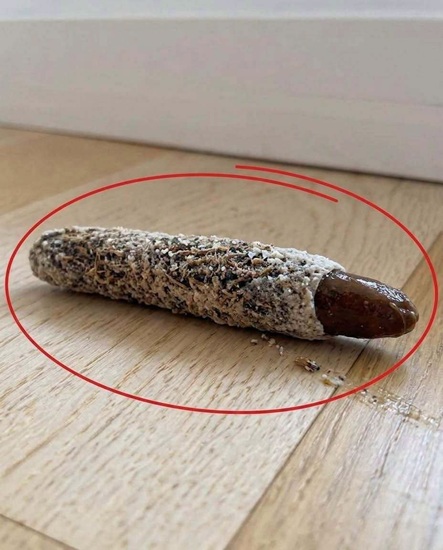
At first glance, the tiny object hardly seems worth noticing. It may sit quietly on a wall, near a bedroom doorway, beside a baseboard, or beneath a piece of furniture. Its dull gray or brown surface can make it look like a piece of dried mud, lint, or dust that somehow became stuck together. Most people would probably sweep or vacuum it away without ever wondering what it was. Yet if the object is examined closely, its unusually organized shape provides the first clue that it may be something more interesting than ordinary household debris.
The small structure is often narrow, flattened, and slightly wider through the middle. Bits of fibers, tiny particles, and other material may be visible across the outside. Instead of looking randomly scattered, everything seems to have been deliberately assembled. That is because it has been. In many warm regions, objects fitting this description are cases created by the larva of the household casebearer, Phereoeca uterella, a small moth related to clothes moths. The insect is also widely called the plaster bagworm, although entomologists note that true bagworms belong to a different moth family.
The case is not simply an empty shell that the insect discovers and occupies. The larva constructs it itself. It produces silk and combines that silk with small materials available in its surroundings. Depending on the environment, the outside can contain sand, soil, dust, fibers, tiny insect remains, and other debris. The result is a protective structure that blends remarkably well with indoor surfaces.
This camouflage explains why people can live near household casebearers without noticing them for a surprisingly long time. The cases do not usually have bright colors or obvious insect features. They resemble the material commonly found in neglected corners. Against a dusty wall or along a baseboard, a case can disappear visually into its surroundings.
Inside that small structure is a caterpillar-like moth larva.
The larva does not permanently abandon its shelter when it needs to move.
Instead, it carries the case with it.
The household casebearer’s case has openings that allow the larva to extend part of its body, grip the surface, and pull the shelter forward.
Mississippi State University Extension describes the mature case as a flattened brown-to-gray structure around half an inch long, with an opening at each end.
Having openings at both ends gives the larva an unusual advantage.
It can turn around within the case and emerge from the opposite side rather than having to reverse the entire shelter.
When moving, the larva stretches out far enough to grasp the surface with its legs and mouthparts.
It then draws the case behind it.
To someone watching carefully, what initially looked like a dead piece of debris suddenly begins traveling across the wall.
That moment is often what alerts homeowners that the object is alive.
When disturbed, the larva can retreat farther inside the case.
The protective covering helps shield its softer body from environmental conditions and potential predators.
It also provides camouflage.
Instead of exposing itself continuously while moving around the house, the insect remains largely hidden inside material resembling the surrounding environment.
The scientific common name “household casebearer” describes this lifestyle more accurately than “plaster bagworm.”
Phereoeca uterella belongs to the moth family Tineidae, which also contains several species associated with natural fibers indoors.
True bagworms belong to the family Psychidae.
Because of that taxonomic distinction, University of Florida entomologists note that household casebearer is now the preferred common name for the species.
Nevertheless, “plaster bagworm” remains extremely common in everyday conversation.
People searching online after discovering small gray cases on walls are therefore likely to encounter both names.
In practical household terms, the two labels often refer to the same insect being discussed.
Understanding the scientific distinction simply helps prevent confusion with other moths that also build protective cases.
Household casebearers are particularly associated with warm climates.
They are frequently reported in tropical and subtropical regions and can live indoors where suitable food and shelter are available.
This helps explain why they are especially familiar to residents of warmer, more humid areas.
Climate alone, however, does not determine whether they appear inside a particular home.
Food sources and indoor conditions are also important.
One of the most interesting things about these larvae is what they eat.
They are often associated with spiderwebs.
The larvae can feed on the silk in webs as well as dried insect remains caught there.
Mississippi State University Extension specifically notes that household casebearers commonly occur around spiderwebs and consume both the web and dried insect material.
That makes overlooked corners particularly attractive.
A spiderweb beneath furniture may contain silk, insect fragments, hair, and other organic material.
To a person, the area looks like something that needs cleaning.
To a household casebearer larva, it may represent both food and construction material.
The larva can remain nearby while slowly moving its portable case from one feeding location to another.
Human and animal hair can also become part of the environment used by these insects.
University of Florida information notes that larvae may feed on fallen human hair and other animal-derived material.
They can also consume wool and similar natural fibers.
That explains why closets deserve attention when household casebearers repeatedly appear.
Wool garments, felt, animal hair, and other natural materials can provide potential food.
However, one small case on a wall does not mean an entire wardrobe is being destroyed.
The number of insects and the materials available determine how significant the problem becomes.
Cotton and many synthetic materials are different from animal-based fibers such as wool.
These moth larvae are associated more strongly with materials containing animal proteins.
That is one reason woolens, fur, feathers, silk-related material, and similar items deserve particular attention when case-bearing moth activity is found.
Household casebearers should therefore not be confused with insects that eat almost any textile indiscriminately.
Their feeding preferences are more specific.
The presence of spiderwebs is often especially important.
Removing abandoned webs eliminates both a potential food source and the dead insects that accumulate in them.
Regular cleaning around ceiling corners, behind furniture, and beneath shelves can therefore make rooms less favorable to developing larvae.
This approach is simple but directly related to the insect’s biology.
Vacuuming is one of the most practical responses when only a few cases are present.
The case and larva can be physically removed while nearby lint, hair, dust, and insect remains are removed at the same time.
Vacuum attachments make it easier to reach baseboards, closet corners, furniture edges, and other sheltered locations.
Discarding or emptying the vacuum contents afterward prevents removed insects from simply remaining elsewhere in the home.
Cleaning should extend beyond the single place where the case was discovered.
A larva found openly on a wall may have originated from a more sheltered feeding location.
Checking nearby spiderwebs, corners, storage areas, and furniture can reveal additional cases.
The objective is not to tear apart the entire home.
It is simply to identify whether the discovery is isolated or part of repeated activity.
Finding one case is usually very different from finding dozens.
An occasional household insect can enter or develop in a home without establishing a large population.
Repeated discoveries across several rooms, however, justify closer inspection.
Homeowners can then look for persistent food sources and conditions allowing the insects to continue developing.
Natural-fiber clothing is another area worth checking.
Wool sweaters, blankets, rugs, or stored fabrics should be inspected if many household casebearer cases are appearing nearby.
Look for direct damage rather than assuming damage must be present simply because an insect was found.
Properly cleaning and storing vulnerable materials can help reduce opportunities for fabric-feeding pests.
Sealed storage containers or appropriate garment bags can protect items that are rarely used.
Cleaning clothing before long-term storage can also remove substances that may attract insects.
These steps are useful not only for household casebearers but for several indoor textile pests.
Humidity is frequently mentioned in discussions about plaster bagworms because the insects are commonly encountered in warm, humid environments.
Reducing excessive indoor moisture can make conditions less favorable for various household pests.
Ventilation, air conditioning, dehumidification where appropriate, and repairing persistent moisture problems can therefore be sensible parts of general pest prevention.
Still, humidity reduction alone should not be presented as a guaranteed cure.
A home with relatively low humidity can still contain food materials capable of supporting indoor insects.
Likewise, finding a household casebearer does not prove that the building has a serious moisture problem.
Multiple environmental factors interact.
Good identification comes before dramatic conclusions.
The insect’s life cycle is another fascinating part of the story.
The caterpillar-like larval stage is the phase responsible for constructing and carrying the distinctive case.
As the insect develops, it continues using the shelter.
Eventually, pupation also occurs in the case.
After development is complete, an adult moth emerges.
The adult looks much more like a conventional tiny moth than the strange portable object people first notice on their walls.
This is one reason homeowners sometimes fail to connect the two forms.
The crawling gray case and the small adult moth look completely different.
Yet they are different stages in the same life cycle.
Understanding that connection can help explain why cases may appear even when people do not remember seeing moths flying around the room.
Adults can be small and inconspicuous.
The female moth lays eggs in suitable protected locations.
After hatching, larvae begin producing silk and creating their characteristic cases.
The case expands as the larva grows.
Materials collected from the surrounding environment become attached to the silk structure.
This means two cases from different rooms may not look exactly alike.
One built near a dusty corner could incorporate pale lint and hair.
Another produced near a darker surface might contain different debris.
Each portable shelter can therefore reflect the microenvironment in which the larva developed.
That is one of the most remarkable aspects of the insect.
The larva is not following an architectural blueprint requiring identical construction material.
It uses what is available.
Silk provides the basic structural framework.
Local particles supply camouflage and additional covering.
The finished result functions simultaneously as shelter, disguise, and portable protection.
For an animal only millimeters long, this is an impressive adaptation.
It also illustrates why people initially mistake the case for something nonliving.
Many insects survive by being visually obvious enough to warn predators or by escaping quickly.
Household casebearers use another strategy.
They conceal themselves in a structure that resembles the debris already present around them.
The case effectively makes the animal less noticeable in the very environment where it lives.
This does not make household casebearers dangerous to people.
They are not known for biting humans or attacking household occupants.
Their significance is primarily as a nuisance and, under suitable circumstances, as a potential pest of natural fibers.
The unsettling appearance of a moving case can produce more fear than the actual insect warrants.
That is why correct identification matters.
An unfamiliar object near a bed can trigger fears about parasites, dangerous spiders, or other harmful animals.
A household casebearer is a very different situation.
Recognizing its distinctive case can prevent unnecessary alarm.
At the same time, identification should not be guessed from a vague description when there is genuine uncertainty.
Many insects construct cases, cocoons, or other protective structures.
Photographs or specimens can be evaluated by extension services, pest-management professionals, or knowledgeable entomologists when necessary.
The phrase “plaster bagworm” is sometimes used so broadly online that unrelated objects are incorrectly labeled.
A narrow dusty case is therefore suggestive, not absolute proof without seeing the insect or characteristic structure.
The household casebearer’s distinctive flattened, spindle-like shape and openings at both ends are useful identifying features.
Fully developed cases may reach roughly half an inch in length.
Their color usually reflects the debris incorporated into the surface.
Brown, gray, and dusty shades are common.
The appearance can resemble a tiny seed or flattened bag.
People often notice cases attached vertically to walls.
Others are seen moving slowly across surfaces.
Some remain tucked into corners where they are difficult to notice.
Cases can also be encountered around ceilings, storage spaces, garages, closets, and sheltered outdoor areas in suitable climates.
The surrounding food sources often provide the best clue to why they are there.
A wall covered with abandoned spiderwebs offers different resources from a frequently cleaned open surface.
Likewise, a closet containing undisturbed wool or animal fibers can offer more food than a location containing only synthetic material.
Cleaning changes those conditions.
It removes food and reduces construction debris.
That is why physical sanitation is often emphasized as a first-line response.
There is rarely a need for panic after discovering a single case.
Remove it.
Inspect the surrounding area.
Vacuum thoroughly.
Clear abandoned webs.
Check nearby natural-fiber materials if appropriate.
Then observe whether additional cases appear.
This measured approach provides useful information about the scale of the issue.
If nothing else appears, the original discovery may have been isolated.
If cases continue appearing regularly, investigation can expand.
Repeated activity may justify professional pest identification and management, especially when valuable textiles are being damaged.
A qualified professional can distinguish household casebearers from other clothes-moth species or unrelated pests.
That prevents unnecessary pesticide use based on a mistaken identification.
Pesticides should not automatically be the first response to every tiny case.
Physical removal and sanitation often address important parts of the insect’s habitat.
If chemical control becomes necessary for a larger infestation, products should be used only according to their labels and applicable safety instructions.
Treatment choices depend on the location, target pest, and materials being protected.
There is no benefit in spraying random surfaces simply because one dusty case appeared.
Prevention is much less dramatic.
Regular vacuuming removes accumulated hair and lint.
Cleaning spiderwebs removes feeding sites.
Inspecting natural-fiber clothing catches potential damage early.
Keeping storage spaces reasonably clean reduces the debris available for both feeding and case construction.
Managing persistent moisture contributes to broader household pest prevention.
These steps are ordinary household maintenance rather than specialized extermination techniques.
They also have benefits beyond controlling one moth species.
Reducing dust and insect remains can discourage several scavenging pests.
Cleaning behind furniture can reveal moisture or pest problems before they become larger.
Protecting wool garments also helps against conventional clothes moths and carpet beetles.
Good housekeeping is therefore less about creating a perfectly sterile home and more about removing concentrated resources that indoor pests can exploit.
No normal house is biologically empty.
Even exceptionally clean buildings occasionally contain insects.
Doors open.
Windows provide entry points.
Microscopic food particles accumulate.
Spiders catch other arthropods.
Moths and flies sometimes enter from outside.
The presence of one small insect should therefore not be treated as proof that a home is dirty.
Household ecosystems exist largely because buildings provide shelter from weather and relatively stable temperatures.
Some species exploit human food.
Others feed on fabric.
Still others survive by consuming the remains of other insects.
Household casebearers fit into this last category particularly well because spiderwebs and animal-derived debris can provide important food.
Their presence illustrates how one small household organism can depend on another.
A spider captures insects.
Dead prey remains in the web.
A case-bearing moth larva later consumes parts of the web and the trapped remains.
What looks like an abandoned corner to us can therefore contain a miniature food chain.
Most of this activity happens unnoticed.
Only when the small moving case crosses an exposed wall does the hidden system suddenly become visible.
That discovery can turn disgust into curiosity.
Instead of asking only, “How do I get rid of this?” someone may begin wondering how the case was made.
The answer reveals surprisingly sophisticated behavior for such a small organism.
The larva produces silk.
It selects and attaches environmental debris.
It carries the finished structure.
It retreats inside when threatened.
It grows and eventually pupates within the same protective architecture.
Nothing about that requires human planning or conscious design in the way people normally understand those concepts.
The behavior is an evolved survival strategy.
Generation after generation, case-bearing moth larvae capable of effectively protecting themselves survived and reproduced.
The result is the unusual little structure people now discover on walls.
That perspective does not require homeowners to welcome an infestation.
A biological adaptation can be fascinating while the insect remains undesirable indoors.
Understanding a pest and controlling it are not contradictory goals.
In fact, understanding its biology often leads to more effective control.
If larvae feed around spiderwebs, removing spiderwebs makes sense.
If they use hair and debris, vacuuming makes sense.
If they can damage natural fibers, protecting wool makes sense.
Biology explains the practical recommendations.
It also helps separate useful actions from myths.
For example, finding one case does not mean a dangerous worm has emerged from the plaster inside the walls.
Despite the old nickname “plaster bagworm,” the insect does not originate from plaster.
The name reflects its frequent appearance on walls and building surfaces, not a requirement to consume the wall itself.
Likewise, the larva does not construct its case entirely from household dust.
Silk forms an essential part of the shelter.
Debris is incorporated around that silk structure.
This explains why the case holds together rather than crumbling like ordinary lint.
Another misconception is that every case indicates an active larva.
Some cases may already be empty after the adult moth has emerged.
Others may contain living larvae or pupae.
Physical inspection can sometimes reveal activity, but there is rarely a reason to handle unknown cases directly with bare hands.
Vacuuming or using a tissue or tool is simple and hygienic.
The insect itself poses little direct threat, but ordinary cleanliness still makes sense.
The tiny case can therefore teach two different lessons.
The practical lesson is that regular cleaning, removal of spiderwebs, proper storage of vulnerable fabrics, and attention to repeated cases can help manage household casebearers.
The biological lesson is more surprising.
A creature most people never notice is capable of turning loose fragments of its environment into a mobile protective structure.
That second lesson is why the discovery can become fascinating after the initial discomfort fades.
The object may have seemed lifeless.
It may have looked like something that fell from a shoe or blew in under a door.
Then it moved.
Suddenly, ordinary household debris became evidence of an animal’s entire survival strategy.
The surrounding fibers were not attached randomly.
They had been incorporated into a shelter.
The tube was not an abandoned piece of dirt.
It was architecture on a miniature scale.
That does not mean every strange object on a wall is a household casebearer.
Identification still requires attention to appearance, location, and sometimes professional confirmation.
But when the distinctive flattened case begins crawling, the explanation becomes much stronger.
The larva carrying its shelter is one of those examples of nature occurring directly inside human spaces.
People often imagine wildlife as something found in forests, oceans, or parks.
In reality, some remarkable adaptations occur a few feet from our beds and kitchen tables.
The species living indoors may be tiny, but their biology can be just as unusual as animals encountered outdoors.
A household casebearer is a perfect example.
Its entire shelter may be shorter than a fingernail.
Yet within that tiny space, the larva can move, hide, grow, and eventually transform into an adult moth.
The object on the floor therefore deserves neither panic nor romanticization.
If it is unwanted, remove it.
If several appear, investigate.
Protect susceptible fabrics.
Clean likely feeding areas.
Seek professional identification when repeated activity cannot be explained.
Those actions address the practical problem.
But there is also nothing wrong with taking a moment to appreciate what was discovered.
A few strands of silk.
Particles of dust.
Tiny pieces of discarded material.
And one larva capable of combining them into a portable shelter.
What looked like trash was actually evidence of adaptation.
The most useful response combines curiosity with sensible housekeeping.
Look carefully before assuming an unfamiliar object is dangerous.
Identify it as accurately as possible.
Learn what it eats and why it is present.
Then remove the conditions supporting it if necessary.
That approach works far better than fear.
The household casebearer is small enough to escape notice for most of its life.
Its case is designed to help it do exactly that.
Only occasionally does it cross an open wall or floor and reveal itself.
When that happens, the mystery has a surprisingly straightforward answer.
It is not a mysterious parasite.
It is not something growing out of the wall.
And it is not simply a clump of dust.
It may be a household casebearer larva, commonly called a plaster bagworm, quietly carrying a shelter made from silk and fragments of the environment around it.
