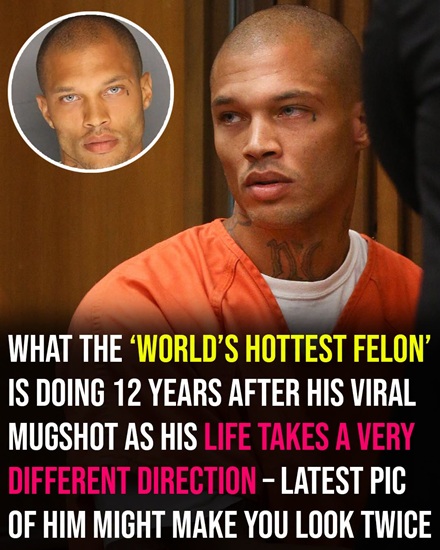
In June 2014, Jeremy Meeks was known primarily to law enforcement and the people in his community. Within hours of one photograph appearing online, that changed dramatically. The Stockton Police Department posted his booking photograph after his arrest during a law-enforcement operation in California, and internet users quickly began sharing and commenting on the image. Meeks was 30 years old at the time, and his blue eyes and distinctive facial features became the focus of enormous online attention.
The attention eventually produced nicknames including the “Hot Felon,” a label that continued following him long after the original arrest. The extraordinary internet reaction did not change the seriousness of the legal situation Meeks was facing. He had been arrested on June 18, 2014, during an operation in Stockton, and his case was eventually handled by federal prosecutors. In February 2015, a federal judge sentenced him to 27 months in prison after his conviction for being a felon in possession of a firearm.
He was also ordered to participate in a Bureau of Prisons substance-abuse treatment program. The viral attention surrounding his appearance therefore unfolded while he was still dealing with real criminal consequences. What made the case unusual was that the photograph began producing professional opportunities before Meeks had even completed his sentence. Modeling representatives noticed the same image that millions of people had encountered online.
Meeks ultimately signed with White Cross Management, creating the possibility of an entirely different career once he left prison. In interviews from that period, he expressed hope that the opportunity would allow him to provide for his family and change the direction of his life. His release came in March 2016 after he had served approximately 13 months of the federal sentence.

The transition from incarceration to professional modeling did not remain theoretical for long. After his release, Meeks began appearing in fashion projects and eventually walked major runways. His work included appearances for designer Philipp Plein as well as participation in a Tommy Hilfiger fashion show in Milan. What had begun as an internet reaction to a police photograph was developing into a legitimate career within an industry that had nothing to do with the circumstances that originally made him famous.
That career eventually expanded beyond simply appearing in other designers’ clothing. In 2019, Fashion Concept GmbH announced a reported $15 million collaboration with Meeks to develop a fashion line under his name. Fashion-industry publications reported the agreement at the time, and his collection subsequently debuted for the fall/winter 2020 season. He later continued designing and launched another collection with Canon Mitchell in January 2024. These developments allowed Meeks to move from being the subject of fashion campaigns into participating more directly in the business and design side of the industry.
Acting became another part of his professional life. Meeks accumulated roles in productions including Secret Society, Dance for Me, Beach Chain, Love After Holidays, and entries in the Dutch film series. His screen career did not replace modeling, but it broadened the range of projects connected to his name. By 2026, the description of Meeks simply as the man from a viral mugshot no longer captured everything he had done professionally.

The contrast between those opportunities and his earlier life is a major theme in the way Meeks himself now discusses his story. In interviews, he has described growing up amid addiction, violence and instability. He has said that both of his parents struggled with heroin addiction and has described himself as having been born dependent on the drug. He has also said that his father received a life sentence for murder when Jeremy was only nine months old. These are Meeks’ own accounts of his childhood and should therefore be understood as autobiographical statements rather than independent conclusions about every detail of his family history.
Meeks has said that difficulties during childhood eventually contributed to years involving crime, detention and imprisonment. According to later reporting about his life, he spent considerable time in juvenile and adult correctional facilities before the arrest that made him internationally recognizable. That background complicates any simple version of his transformation. His later success did not erase the legal history that preceded it, and he has increasingly discussed both parts of his life rather than pretending the earlier years never occurred.
The sudden fame created unusual complications even while he was incarcerated. In a 2026 appearance on Matthew Cox’s Inside True Crime podcast, Meeks recalled receiving enormous quantities of mail after his photograph went viral. He said strangers also attempted to use his limited visitor opportunities, sometimes preventing relatives from being able to visit him. According to Meeks, the public attention that looked glamorous from outside could be disruptive and frustrating while he was still behind bars.

His difficulties also did not disappear simply because his professional life improved. Meeks has spoken publicly about addiction struggles that continued after he entered fashion and entertainment. In his 2026 podcast appearance, he described a period in which his drug use had become extremely dangerous. He recalled that the mother of his second child recorded him while he slept because his breathing had slowed and his lips were changing color, which he described as an apparent overdose. According to his account, that frightening episode led to intervention and treatment.
That part of the story is particularly important because it challenges the idea that external success automatically solves personal problems. By then, Meeks had traveled internationally, appeared at fashion events and become a recognizable celebrity. Yet he has described simultaneously struggling with addiction behind the scenes. His account presents recovery as a separate process from fame rather than an automatic result of it.
His personal relationships also became part of public attention. Meeks had been married to Melissa Meeks, with whom he shares a son, Jeremy Jr. Their divorce became final in June 2018. Meeks later had a widely publicized relationship with Chloe Green, whose family is associated with the Topshop retail business. The pair welcomed their son Jayden Meeks-Green on May 29, 2018, before ending their relationship in 2019.
In later interviews, Meeks described a period of focusing more deliberately on himself rather than relationships. In April 2024, he told People that he was single and concentrating on his own life. Then in an August 2025 interview, he said he had been celibate for almost three years because he did not want to be distracted. That statement describes his situation and mindset at the time of the interview and should not automatically be treated as a permanent description of his private life.
Another major step in Meeks’ attempt to explain his life in his own words came through his memoir, Model Citizen: The Autobiography of Jeremy Meeks. The book recounts his childhood, encounters with violence and crime, incarceration, unexpected fame and the professional opportunities that followed. Before publication, Meeks told People that he wanted to be extremely vulnerable and tell what he described as his whole story so readers could understand how he reached his current place in life.
The memoir marked an important shift in how his public identity was presented. The mugshot that made him famous showed one moment without explaining the decades that preceded or followed it. A memoir offered him an opportunity to supply his own narrative rather than allowing a booking photograph and internet commentary to remain the primary description of his life. That does not mean readers must ignore his convictions or accept every autobiographical interpretation without question. It means there is considerably more documented history to his life than the image that first made him internationally recognizable.
By 2026, Meeks was 42 and remained active across several areas of entertainment and fashion. Recent reporting continued to describe him as a model, actor, author and fashion designer. His acting résumé had expanded beyond his earliest film appearances, while his fashion projects and memoir gave him professional identities separate from the nickname attached to him in 2014.
His story is sometimes reduced online to the phrase “from prison to runway,” but that description leaves out substantial complexity. It omits the earlier convictions, family instability and addiction he has discussed. It also leaves out the fact that professional success did not prevent later struggles. A more accurate account recognizes both the consequences of his past and the unusual opportunities that emerged after his photograph became viral.
It is equally important not to describe Meeks’ later career as though becoming famous erased accountability for his criminal history. His 2015 federal sentence was real, and the viral response to his appearance did not make the underlying firearm conviction insignificant. At the same time, completing a criminal sentence does not prevent someone from pursuing lawful work afterward. Those two facts can exist together without turning his biography into either condemnation or uncomplicated celebration.
That balance helps explain why his biography continues attracting attention more than a decade after the mugshot first circulated. It combines the early power of social-media virality with questions about celebrity, second opportunities and personal reinvention. In 2014, few people commenting beneath the police photograph could have predicted that Meeks would later appear on international runways, develop clothing collections, act in films and publish an autobiography.
The transformation was also not immediate. Meeks first had to complete the incarceration associated with his federal conviction. His modeling opportunities then developed over years rather than overnight, followed by acting, fashion design and writing. Even after reaching those milestones, he has described dealing with addiction and other challenges that were largely invisible behind professional photographs and public appearances.
For Meeks himself, fatherhood appears repeatedly in the way he discusses what he wants from the next stage of his life. He has two sons, Jeremy Jr. and Jayden, from his relationships with Melissa Meeks and Chloe Green respectively. His public comments have emphasized providing for his family and attempting to move away from patterns that characterized his earlier life.
His history therefore resists the easiest interpretation. He was not simply an unknown man who became successful because strangers considered him attractive. His mugshot undeniably created extraordinary visibility and gave him access to opportunities that most people leaving prison never receive. But taking advantage of those opportunities required building an actual career after release, while his own accounts show that fame introduced new pressures rather than automatically creating a perfect life.
The phrase “one photograph changed his life” is unusually accurate in Meeks’ case, provided it is not allowed to become the entire story. Before June 2014, he had already lived through a difficult childhood, legal trouble and incarceration. After the photograph, there was another prison sentence, global attention, professional modeling, fashion work, acting roles, relationships, fatherhood, addiction struggles and eventually a memoir.
His later career does not rewrite the record that came before it. Nor does the record prevent acknowledgment that his life moved in a dramatically different direction after he completed his sentence. Those facts are not contradictory. They are simply different chapters in the same biography.
More than twelve years after the Stockton Police Department photograph became an internet phenomenon, Jeremy Meeks remains one of the clearest examples of how unpredictable viral fame can be. A booking photograph intended to document an arrest unexpectedly became the first image in a completely different public career. Modeling followed. Acting followed. Fashion design and writing followed. And through his memoir and interviews, Meeks has increasingly attempted to explain the parts of his story that no photograph could capture.
His story is therefore best understood without exaggeration. Jeremy Meeks was convicted and imprisoned, and those facts remain part of his history. He also later established work in modeling, acting and fashion, published an autobiography, and publicly discussed his efforts to address addiction and change the direction of his life.
The viral mugshot may always remain the image most closely associated with his name, but it no longer represents everything that happened afterward. Whatever conclusions people draw about Jeremy Meeks, the documented timeline demonstrates something straightforward: the moment that first brought someone public attention does not necessarily describe every chapter that follows.
