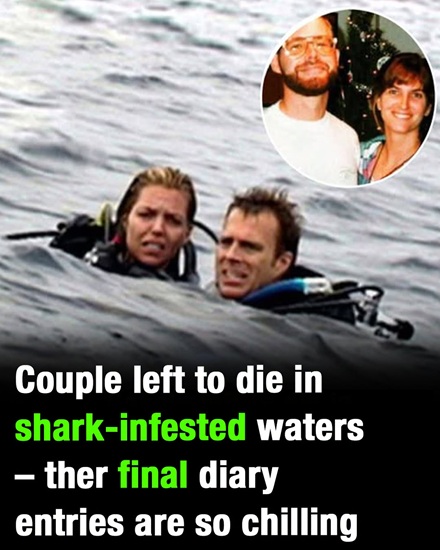
On January 25, 1998, American couple Tom and Eileen Lonergan joined a recreational scuba-diving excursion to St. Crispin’s Reef on Australia’s Great Barrier Reef. By the end of the afternoon, the dive vessel MV Outer Edge had departed without them. The mistake was not recognized immediately, and the couple were never seen again. Their disappearance became one of the most disturbing accidents associated with recreational diving in Australia, generated years of speculation, and later inspired filmmaker Chris Kentis when he developed the survival thriller Open Water.
Tom was 33 at the time of the disappearance, while Eileen was 28. They were from Louisiana and had considerable international experience before arriving in Australia. Reporting on the case says they had served with the U.S. Peace Corps in the Pacific and were experienced recreational divers rather than people attempting scuba diving for the first time. Their experience made the circumstances even more unsettling, because the central failure was not an inability to dive but the fact that the vessel left while they were still in the water.
The couple boarded the Outer Edge for a day of diving from the Port Douglas area. They were part of a larger group traveling to the reef, where divers entered the water at designated locations before returning to the vessel. St. Crispin’s Reef lies within the enormous Great Barrier Reef system off northeastern Australia. It offers the clear water, coral formations, and abundant marine life that have made the region internationally popular with recreational divers.
What should have been an ordinary diving excursion instead became a fatal chain of errors. At the end of the diving session, the vessel departed without Tom and Eileen aboard. Contemporary and later accounts focused heavily on the passenger-counting procedures used that day. The critical fact established by the investigation was simple: the boat left the site while two customers were still missing.

The couple’s absence was not discovered that afternoon. It was not noticed that evening either. Two days passed before the seriousness of the situation became clear. A bag containing their belongings remained on the vessel, eventually prompting questions about why its owners had never collected it. Once the contents were examined and the couple could not be located, authorities were alerted.
That delay dramatically changed the possibilities available to rescuers. A missing diver reported immediately can become the subject of an urgent search near a known location. After roughly two days, however, currents, wind, weather, exhaustion, and the enormous size of the ocean vastly expand the possible search area. By the time authorities understood that Tom and Eileen had not returned, whatever had happened to them had already been unfolding for many hours.
Police, aircraft, boats, and other search resources were mobilized once the alarm was raised. News accounts describe an extensive air-and-sea operation over the waters off Queensland. Searchers hoped the couple might still be afloat, perhaps drifting after using their buoyancy equipment to remain on the surface. No rescuers found them alive, and the search eventually ended without locating either person.
The absence of bodies initially left room for extraordinary theories. Some wondered whether the Lonergans had somehow reached land. Others suggested they had intentionally disappeared. There was even speculation that the entire incident might have been staged so the couple could begin a new life somewhere else. These theories attracted attention largely because the disappearance seemed so unusual and because investigators initially had no bodies that conclusively demonstrated what had happened.
Evidence recovered later made a deliberate disappearance increasingly difficult to reconcile with the known facts. Pieces of diving equipment belonging to the couple were eventually recovered along the Queensland coast. Among the items were buoyancy equipment and other gear marked with their names. The condition and location of these objects became important evidence in reconstructing what may have happened after the boat departed.

One of the most powerful discoveries was a diver’s slate recovered months after the disappearance. Divers use such slates to write messages underwater or around diving operations. The writing on the recovered slate stated that the writers had been abandoned by the Outer Edge on January 25 and urgently requested rescue. Investigators regarded the message as evidence that the couple had survived the boat’s departure and understood exactly what had happened to them.
That message significantly weakened the idea that the Lonergans had deliberately staged their disappearance. Someone attempting to create a fake vanishing would have had to explain why a desperate rescue request apparently written after the vessel left later washed ashore with their equipment. Investigators also found no financial pattern supporting the theory that the couple had quietly started another life. Their bodies were never found, but evidence increasingly pointed toward an accidental abandonment followed by death at sea.
The exact manner of their deaths remains unknown.
That point is essential.
No witness saw their final moments.
No bodies were recovered for forensic examination.
No medical examiner could determine whether they died specifically from drowning, exposure, dehydration, an animal encounter, or some combination of circumstances.
The official findings therefore did not identify one precise mechanism with certainty.
At the 1998 inquest, Queensland coroner Noel Nunan concluded that Tom and Eileen had died at sea. The possible causes considered included drowning, exposure, or shark attack. Importantly, the coroner rejected the suggestion that the pair had intentionally disappeared or died through a coordinated suicide plan. That official conclusion is considerably more reliable than the dramatic theories that continued circulating afterward.
Sharks became part of the public fascination with the case because the Great Barrier Reef supports numerous shark species and because some people familiar with the area believed an attack was possible. A diver who testified at the inquest reportedly offered the opinion that a tiger shark could have been responsible. But an expert opinion about what might have happened is not proof that it did happen. No physical evidence established that sharks killed either Tom or Eileen.
Some recovered clothing initially encouraged speculation about an animal attack. Later examination complicated that interpretation. Reports of the inquest indicated that damage to a recovered wetsuit could have resulted from contact with coral rather than shark teeth. Other equipment reportedly did not show the kind of damage that would conclusively demonstrate a violent animal attack.
Exposure and dehydration present another plausible scenario. Even in warm tropical waters, remaining at sea for a prolonged period can become physically exhausting. Divers stranded on the surface face sun exposure, limited drinking water, waves, currents, fatigue, and eventually impaired judgment. Their diving equipment can help with buoyancy, but it cannot provide unlimited protection from the physical consequences of being stranded at sea. The coroner therefore left multiple possibilities open rather than pretending the available evidence could identify a single cause.
The discovery of Tom and Eileen’s personal diaries introduced another controversial dimension to the investigation. Selected passages described pessimistic thoughts about the future and concerns about death. One entry attributed to Eileen expressed anxiety about Tom’s state of mind and referred to what she perceived as a “death wish.” These writings received substantial media attention because they appeared, in isolation, to provide a possible motive for intentional disappearance or self-harm.
However, the interpretation of the diaries was strongly disputed by their families. Relatives argued that passages publicized by the media were incomplete and removed from broader context. Reporting on the investigation states that the families, police, and coroner did not accept the diaries as proof that the couple had planned to die. The coroner ultimately rejected the suicide theory despite the existence of those writings.
This is an important distinction when discussing historical cases involving private writings. A diary can reveal genuine sadness, frustration, fear, or existential thoughts without automatically establishing a plan to act on them. Investigators must consider context, behavior, additional evidence, and the totality of circumstances. In the Lonergan case, the official investigation did not conclude that the couple intentionally entered the water intending never to return.
The staged-disappearance theory also produced speculation about questions Tom reportedly asked before the diving trip. Some witnesses later described him as particularly interested in which reefs certain boats would visit. In isolation, those conversations sounded suspicious to some observers. But planning details for a diving excursion are not evidence of a secret escape plan, and investigators ultimately found no confirmed trail demonstrating that the couple left Australia under new identities.
Their financial circumstances provided another problem for the disappearance theory. Accounts of the investigation note that their bank accounts were not subsequently used and that insurance policies were not claimed as part of an apparent scheme. There were also no verified sightings establishing that either person had survived. Taken together with the recovered diving gear and rescue slate, those facts left the accidental-stranding explanation far better supported than a carefully staged disappearance.
Attention then returned to the Outer Edge and the procedures used aboard it.
The key safety question was how two passengers could remain in the ocean while the vessel departed.
Evidence presented during the investigations indicated that the head-counting process had failed.
A dive vessel carrying groups into open water depends on reliable systems for confirming that every person who enters the water has returned before the boat moves away.
In this case, that protection failed catastrophically.
The skipper, Geoffrey Ian “Jack” Nairn, was eventually committed to stand trial in connection with the deaths. The case centered on allegations of negligence and responsibility for the couple being left behind. Nairn was later acquitted of the criminal charge. The acquittal is important and should be included in any accurate retelling rather than implying that he was criminally convicted.
The dive company itself faced consequences. Outer Edge Dive pleaded guilty to negligence-related charges and was fined, according to accounts of the proceedings. The company subsequently ceased operating. The disaster also intensified scrutiny of procedures used throughout Queensland’s recreational diving industry.
One of the lasting consequences involved passenger-accounting procedures. The case became a powerful demonstration of why an informal headcount can be inadequate when people repeatedly enter and exit the water. Queensland authorities tightened safety expectations, and dive operators increasingly relied on stronger systems for confirming that every diver who leaves a vessel is physically accounted for again before departure.
That legacy may be the most important part of the case beyond the mystery itself.
The Lonergans’ disappearance was not simply an inexplicable vanishing in a dangerous ocean.
It exposed how one administrative mistake can become catastrophic in an environment where rescue becomes difficult almost immediately.
A miscount on land may create inconvenience.
A miscount on a dive boat miles offshore can become a matter of life and death.
The case also generated what contemporary coverage described as a serious crisis of confidence in the North Queensland diving industry. Tourism operators depended on visitors trusting that professional crews would keep track of them in remote marine environments. The idea that two customers could disappear without anyone noticing for two days naturally raised questions extending far beyond a single company.
The haunting aspect of the Lonergan case is therefore not primarily the presence of sharks.
It is the delay.
Tom and Eileen apparently surfaced expecting the boat that had transported them to be nearby.
At some point, they would have realized that the vessel was no longer there.
The recovered slate indicates that they understood they had been abandoned and hoped someone would find them before it was too late.
No reliable evidence tells us what they said to one another after that realization.
No witness can describe how long they remained together.
We cannot know precisely when exhaustion overtook them or whether they could still see reef structures, vessels, or distant coastline.
These unanswered questions are part of why the story has remained so powerful for more than a quarter-century.
But responsible retellings should resist filling those gaps with invented scenes.
The known evidence is disturbing enough without fictionalizing their final hours.
Years later, filmmaker Chris Kentis drew inspiration from the Lonergans’ disappearance for Open Water. Kentis said the real incident had stayed with him after he heard about it. The movie follows a fictional couple abandoned after a diving excursion, but it is not a documentary reconstruction of Tom and Eileen’s exact experience. Its characters, setting, dialogue, and eventual events were created for dramatic purposes.
That distinction is particularly important because viewers sometimes remember the film’s ending and assume it represents established facts about the Lonergans. It does not. The real couple’s final fate remains uncertain. The film uses the basic premise of divers being forgotten at sea and develops a fictional survival-horror story from it.
In reality, investigators never proved that sharks attacked the couple.
They never proved that Tom and Eileen intentionally removed their equipment.
They never found their bodies.
They never established one precise moment or mechanism of death.
The responsible historical conclusion is therefore narrower: the couple were left behind during a Great Barrier Reef diving trip, apparently survived long enough to recognize and document their abandonment, and subsequently died at sea.
Their recovered equipment also became a kind of physical timeline.
Objects carried away by currents demonstrated that belongings could travel considerable distances from the original dive site.
That movement further complicated reconstruction.
Finding an item dozens of miles from the reef did not necessarily mean the couple themselves had traveled to that exact location alive.
Ocean currents could carry floating equipment after it had been lost or removed.
The dive slate is different because its written message provides evidence of conscious action after the abandonment. It records the basic circumstances from the perspective of someone who believed the boat had left them behind and urgently wanted rescue. Few pieces of evidence in unresolved disappearances provide such a direct connection between the victims and the critical event.
The couple’s families were left with unusually painful uncertainty.
They knew Tom and Eileen had almost certainly died.
They knew how the emergency began.
But they never received bodies to bury or a definitive forensic explanation for the final cause of death.
Cases without recovered remains can leave families caught between factual certainty about loss and uncertainty about exactly how that loss occurred.
The later circulation of sensational theories added another burden.
The diaries became particularly controversial because private thoughts written months or weeks earlier were suddenly examined publicly as potential clues.
Family members argued that the material had been selectively presented.
The official conclusion ultimately did not support a planned suicide or staged disappearance.
That is why modern summaries should avoid using the diary passages as though they conclusively explain the tragedy.
The same caution applies to descriptions such as “shark-infested waters.”
Sharks do inhabit the Great Barrier Reef.
Some witnesses discussed noticeable shark activity and experts considered attack among the possible outcomes.
But describing shark attack as the established cause of death would go beyond the available evidence.
The coroner specifically preserved multiple possible causes.
What is not speculative is the failure to account for the divers.
Tom and Eileen entered the water during an organized excursion.
The vessel left.
Their absence was not recognized until much later.
Those facts are enough to explain why the case transformed safety conversations within Australian recreational diving.
Modern dive operators commonly use more systematic procedures for tracking customers, although exact requirements depend on jurisdiction and operation.
The basic principle is universal: everyone who enters the water must be positively accounted for before a vessel leaves.
The Lonergan tragedy became one of the clearest historical examples of what can happen when that seemingly ordinary procedure breaks down.
The case continues to attract new generations because it involves a fear that is easy to understand.
For a diver surfacing from deep water, the boat is the expected connection back to safety.
Seeing open sea where that boat should be changes an ordinary recreational experience into an emergency instantly.
The simplicity of that scenario is what makes the story more disturbing than many elaborate mysteries.
There was no evidence of a complicated criminal plot.
There was no confirmed secret identity.
There was no verified escape.
Instead, the strongest evidence points to a preventable human error followed by an unforgiving natural environment.
That combination explains why the disappearance still feels extraordinary even decades later.
Theories will probably continue because the couple’s bodies were never recovered.
Unresolved physical evidence almost always creates room for speculation.
But unresolved does not mean every theory deserves equal weight.
Some possibilities fit the documented record better than others.
In this case, investigators and the coroner concluded that Tom and Eileen died at sea after being left behind, while rejecting intentional disappearance as the explanation.
That conclusion also explains why the case should not be framed as a mysterious disappearance in the same sense as someone vanishing without any indication of where they went.
Authorities knew where the Lonergans had last been.
They knew the vessel had departed without them.
They later found equipment consistent with prolonged exposure to the sea.
And they recovered a written plea for rescue.
The unresolved question concerns their exact final fate, not the basic event that placed them in danger.
For the diving industry, the most enduring message was procedural rather than mysterious.
Safety systems cannot depend on casual assumptions.
Counts must be accurate.
Records need to be checked.
Missing equipment or unclaimed personal belongings should be treated seriously.
Small discrepancies can indicate much larger problems.
The Lonergan case demonstrated those principles in the most painful possible way.
For readers, there is another lesson in how historical tragedies are retold.
Dramatic details can gradually become detached from their original level of certainty.
A possible shark attack becomes “they were eaten by sharks.”
A troubling diary entry becomes “they planned to die.”
An unexplained disappearance becomes “they staged a new life.”
None of those stronger statements is justified simply because it has been repeated many times.
Accurate reporting requires preserving uncertainty where uncertainty genuinely exists.
Tom and Eileen Lonergan were real people, not characters created for a horror film.
Their disappearance later inspired fiction, but the real event deserves separation from the film’s imagined ending.
The evidence indicates that they were accidentally abandoned during a scuba-diving trip on January 25, 1998.
Their absence was discovered approximately two days later.
A major search failed to locate them.
Their bodies have never been recovered.
Pieces of their diving equipment later washed ashore.
A dive slate contained an urgent message stating that they had been abandoned and needed rescue.
The coroner concluded that they died at sea, potentially through drowning, exposure, or shark attack.
He rejected the more sensational theories that they had intentionally disappeared or planned their deaths.
Skipper Jack Nairn faced criminal proceedings but was ultimately acquitted.
The company associated with the excursion pleaded guilty to negligence-related offenses and faced a fine.
The disaster helped drive stronger safety practices within Queensland’s diving industry.
And several years later, Open Water transformed the basic nightmare of being forgotten at sea into a fictional film watched by audiences around the world.
For many viewers, the movie’s premise seemed almost too frightening to be plausible.
Yet the essential event behind it really did happen.
Two experienced American divers entered the Great Barrier Reef expecting to return to their boat.
The boat left without them.
By the time anyone recognized the mistake, the opportunity for an immediate rescue had disappeared.
More than the sharks, rumors, diaries, or film adaptations, that simple sequence remains the defining fact of the case.
Tom and Eileen Lonergan were not conclusively shown to have engineered their disappearance.
There is no verified evidence that they secretly escaped.
There is no conclusive proof that a shark killed them.
What the evidence supports is far more direct and tragic.
They were left behind in open water.
They attempted to summon help.
And help arrived too late.
