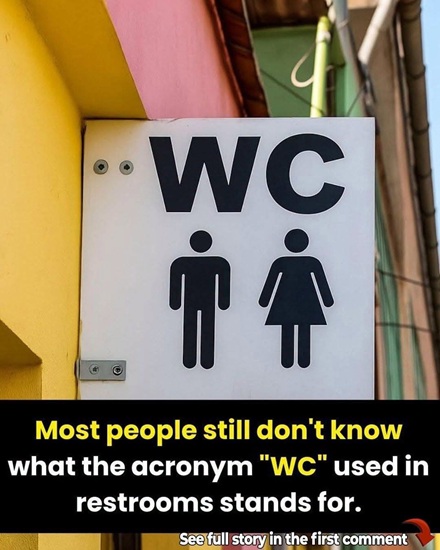
Most people have seen the letters “WC” on a restroom door at some point. They appear in hotels, restaurants, train stations, airports, shopping centers, cafés, and other public places around the world. The meaning is usually understood from context, so few people stop to ask what the two letters actually stand for. The answer is simple: WC is an abbreviation for “water closet,” a traditional English term referring to a toilet or a room containing one. Major dictionaries still define the abbreviation this way today.
The expression can sound strange to modern English speakers because neither “water” nor “closet” is commonly used in everyday conversation to mean a public restroom. In contemporary American English, people are more likely to say “restroom” or “bathroom.” In British English, “toilet,” “loo,” and sometimes “WC” remain familiar terms. The abbreviation has survived even as everyday vocabulary has changed, which explains why many people recognize the sign without necessarily knowing where the letters came from.
The word “closet” has not always meant exactly what many people think of today. Modern speakers often imagine a wardrobe or storage space when they hear the word. Historically, however, “closet” could refer more broadly to a small private room or enclosed space. A “water closet” was therefore a small private compartment containing a toilet connected to a water-based flushing system.
Merriam-Webster defines a water closet as a compartment or room with a toilet and lists “WC” as its abbreviation. The dictionary records use of the expression going back to the eighteenth century. That history helps explain why the abbreviation feels old-fashioned in some English-speaking regions while remaining completely normal on signs elsewhere.
Cambridge Dictionary gives essentially the same explanation. It defines WC as an abbreviation for “water closet” and describes it as a toilet or a room containing a toilet. Cambridge also notes that the expression is associated particularly with British usage and older American usage.
Understanding the expression requires looking back at the development of indoor sanitation. Before modern plumbing became widespread, toilets often looked very different from what people use today. Various cultures had developed sanitation and drainage systems long before modern Europe, and the history of toilets stretches back thousands of years. The familiar flushing toilet evolved gradually rather than appearing as the invention of one single person at one exact moment.
That point is worth emphasizing because internet posts sometimes oversimplify toilet history. One common claim says that a particular Victorian plumber invented the modern toilet or even created the expression “water closet.” Historical reality is more complicated. Flush mechanisms existed earlier, and improvements accumulated across generations of inventors, engineers, manufacturers, and sanitation reformers.
A well-known early flushing design is associated with Sir John Harington, an English courtier who lived during the reign of Queen Elizabeth I. Later developments made flushing toilets more practical, reliable, and suitable for widespread use. Improvements in plumbing, traps, sewage systems, water supplies, and manufacturing all contributed to the modern toilet.
The term “water closet” helped distinguish these newer plumbing fixtures from older sanitation arrangements. The word “water” reflected the use of water to remove waste, while “closet” referred to the private enclosed space where the fixture was located. Over time, the full expression became commonly shortened to WC.
That abbreviation had an advantage: it was short and easy to place on doors and directional signs.
Even as language changed, the symbol remained recognizable.
This is one reason travelers may encounter WC signs in countries where English is not the primary language.
The abbreviation became internationally familiar through travel, tourism, hotels, transportation, and European signage.
In some places, people may use the letters WC almost as a standalone word without regularly thinking about their English origin.
That is a common feature of language.
Words and abbreviations can survive long after speakers stop thinking about their literal origins.
Consider familiar expressions such as “OK,” “ATM,” or “TV.”
People often understand what they mean instantly without consciously expanding every abbreviation.
WC functions similarly in many places.
Someone looking for a restroom does not normally pause to translate “water closet.”
They simply recognize the sign and understand where it points.
The terminology surrounding toilets also varies dramatically from one English-speaking region to another.
In the United States, “restroom” is very common for public facilities.
“Bathroom” is also widely used, even when the room contains no bathtub.
In Canada, “washroom” is especially common.
British speakers commonly use “toilet” or “loo.”
“Lavatory” also appears, especially in formal settings or transportation.
Then there is “WC,” which remains visible even when it is not the expression people would choose in conversation.
This variation often surprises language learners.
A student may learn the word “toilet” in class and then travel to another country only to see “restroom,” “washroom,” “lavatory,” or WC on signs.
All can refer to similar facilities, but their usage depends on geography, formality, and context.
There is also a technical distinction between a toilet and a bathroom.
A bathroom may contain a bathtub, shower, sink, and toilet.
A water closet can refer specifically to the toilet compartment itself.
In some modern homes, especially larger ones, a water closet may be a small enclosed room inside a larger bathroom containing the toilet separately from the shower, bathtub, and sinks.
That arrangement can provide additional privacy.
For example, one person may use the shower while another person uses the enclosed toilet compartment.
Architects, builders, designers, and real-estate professionals may therefore use “water closet” more precisely than ordinary speakers.
In everyday signage, however, WC generally just tells people where the toilet facilities are.
That difference between technical and everyday meaning is common in language.
A term can have a precise architectural meaning while simultaneously functioning as a familiar public label.
The abbreviation is especially common in many parts of Europe.
Visitors may see signs such as “WC,” “Public WC,” “Ladies WC,” or “Men WC.”
Sometimes the letters appear beside familiar male and female restroom symbols.
In those contexts, virtually no explanation is necessary.
Travelers understand the purpose immediately.
This widespread recognition has helped WC remain useful even as the full phrase “water closet” has become less common in everyday conversation.
The abbreviation is compact.
It fits easily on signs.
It can also be understood by people who may know very little English beyond a few internationally familiar words and symbols.
That makes it practical for transportation hubs and tourist areas.
Yet the simplicity of the sign also explains why many people never learn its original meaning.
A child may first see WC on a restaurant door and immediately associate the letters with toilets.
Nobody necessarily tells them that W means “water” and C means “closet.”
Years later, they may still understand the sign perfectly without knowing the phrase behind it.
This is why social-media posts asking “Do you know what WC means?” often attract attention.
The question takes something extremely familiar and reveals a detail many people have simply never considered.
There is nothing mysterious or secret about the answer.
It is simply an example of historical language continuing to exist in modern life.
Another interesting part of the story is the history of the word “toilet” itself.
The English word did not originally refer directly to the fixture people use today.
Merriam-Webster explains that “toilet” came from the French “toilette” and was originally connected with cloth, dressing, grooming, and personal preparation. Its meaning gradually developed over time until it became associated with the room and eventually the sanitation fixture itself.
Language often evolves this way.
A word begins with one meaning, becomes associated with a related activity, and eventually develops a completely different everyday use.
If someone from several centuries ago heard modern speakers talking about “going to the toilet,” the expression might not carry exactly the same meaning it carries today.
“Bathroom” presents another interesting example.
Strictly speaking, a bathroom should contain facilities for bathing.
Yet American English commonly uses the word as a polite general term for a room containing a toilet.
Someone in a restaurant might ask, “Where is the bathroom?” even though nobody expects the restaurant to provide a bathtub.
Context makes the intended meaning obvious.
“Restroom” is similarly indirect.
People do not normally enter a public restroom because they need to rest.
The term developed as a polite way of referring to toilet facilities.
“Washroom” focuses on washing.
“Lavatory” has its own linguistic history.
“Loo” is another informal British term whose exact origin has been debated.
All these expressions demonstrate how societies often develop indirect or polite vocabulary around private bodily functions.
“Water closet” was once part of that evolving vocabulary.
Today, the full expression can sound formal or historical.
But its two-letter abbreviation remains alive and well.
There is also a practical reason abbreviations survive.
Signs have limited space.
Two letters are easier to read quickly than a longer sentence.
Imagine walking through an unfamiliar railway station while urgently searching for a restroom.
A large “WC” sign can communicate the destination immediately.
The same logic explains the worldwide use of pictograms.
Simple symbols overcome language barriers.
A person does not need to speak the local language to understand familiar restroom icons.
WC frequently appears beside these icons, creating an additional clue.
The continued international use of WC is therefore partly linguistic and partly practical.
It comes from English, but it no longer functions exclusively as an ordinary English phrase.
In many countries, it has become a conventional public symbol.
That does not mean everyone uses it identically.
Regional differences remain important.
An American visitor may understand WC but rarely say “Where is the WC?” at home.
A British speaker may recognize the expression more naturally.
A European speaker whose native language is not English might actually use “WC” more frequently than many Americans do.
That can produce amusing situations for language learners.
Someone may study American English and learn “restroom,” travel in Europe and encounter WC everywhere, then visit Britain and hear “loo.”
All three can point toward the same basic destination.
This variety is not a sign that one term is correct and the others are wrong.
Languages naturally develop regional vocabulary.
The important factual point is that WC specifically originates as the abbreviation of “water closet.”
Nothing more sensational is required.
There is no hidden code.
It does not stand for “wash center.”
It does not mean “women and children.”
It is not an acronym invented specifically for hotels or restaurants.
Those alternative explanations sometimes circulate online, but standard dictionaries clearly identify the meaning as “water closet.”
The historical phrase also makes more sense when we remember how unusual indoor plumbing once was.
Today, many people turn a handle or press a button and barely think about the engineering involved.
Clean water enters buildings.
Wastewater leaves through underground pipes.
Sewage is transported and treated through enormous infrastructure systems.
For earlier generations, reliable indoor sanitation represented a major technological change.
A dedicated room containing a water-flushing toilet was therefore significant enough to deserve its own terminology.
It separated the fixture from older arrangements that did not use the same type of plumbing.
Eventually, however, the technology became ordinary.
The special terminology became less necessary.
People shortened the phrase.
New words became common.
The abbreviation survived.
That is the pattern visible today.
You can walk through a modern airport filled with electronic displays, automated doors, smartphones, and sophisticated security systems and still encounter the initials of an expression that goes back centuries.
In that sense, a WC sign is a tiny linguistic artifact.
It connects modern public spaces with the history of sanitation and the history of English vocabulary.
Most people pass it without noticing.
That does not make the history any less interesting.
It simply demonstrates how language can become invisible through familiarity.
The more frequently we encounter something, the less likely we are to question it.
This happens far beyond restroom signs.
Elevators contain unexplained symbols.
Road signs use abbreviations whose origins many drivers never learn.
Technology is filled with terms that survive from older inventions.
People use expressions every day whose original meanings have largely disappeared.
WC belongs to that broader category.
There is also no reason to feel embarrassed if you never knew what it meant.
Understanding the sign and knowing its etymology are two different things.
A person can successfully use a word or symbol for decades without ever studying where it came from.
Native speakers themselves frequently discover surprising facts about familiar vocabulary.
That is one of the reasons etymology can be enjoyable.
Ordinary words suddenly reveal connections to older technologies, customs, or social practices.
WC happens to provide an especially clear example.
The letters are everywhere.
The phrase behind them is much less visible.
Once you know the answer, however, the abbreviation becomes obvious.
W stands for “water.”
C stands for “closet.”
Together they form “water closet.”
Historically, that referred to a private compartment containing a water-flushed toilet.
Modern dictionaries continue to record exactly that meaning.
There is one additional nuance worth remembering.
“Water closet” can refer either to the room or compartment containing the toilet or, in some uses, to the toilet fixture and associated plumbing itself.
Context determines which meaning is intended.
In public signage, however, nobody expects travelers to make that distinction.
WC simply tells them where the toilet facilities are located.
That simple purpose is why the abbreviation has been so durable.
It is short.
It is familiar.
It crosses linguistic boundaries reasonably well.
And decades of repeated use have made it instantly recognizable.
People may forget what the letters originally meant, but they rarely forget what direction the sign is pointing them.
The history also offers a useful reminder about viral “Did you know?” content.
A surprising fact does not need to be exaggerated to be interesting.
The accurate explanation is already worth sharing.
When a familiar object has an unfamiliar history, curiosity naturally does the rest.
There is no need to invent mysterious origins or unsupported stories.
In this case, the verified answer can be found directly in respected dictionaries.
So the next time you see WC written on a restroom door, you will know exactly why those two letters are there.
They are remnants of the expression “water closet.”
The term arose in an era when water-based indoor sanitation was a notable technological development and a dedicated private toilet compartment needed a name.
Language changed.
Buildings changed.
Plumbing improved dramatically.
But the abbreviation remained.
Today, millions of people can understand WC without ever saying “water closet” aloud.
That may be the most interesting part of the story.
Two small letters survived while the full expression behind them became increasingly uncommon.
They traveled across countries, appeared on public signs, and became so familiar that their origin almost disappeared from everyday awareness.
Sometimes the most surprising facts are not hidden in distant history.
They are printed directly on a door we have walked past hundreds of times.
And in this case, the answer is refreshingly straightforward:
WC means “water closet” — the traditional term for a toilet or a room containing one.
