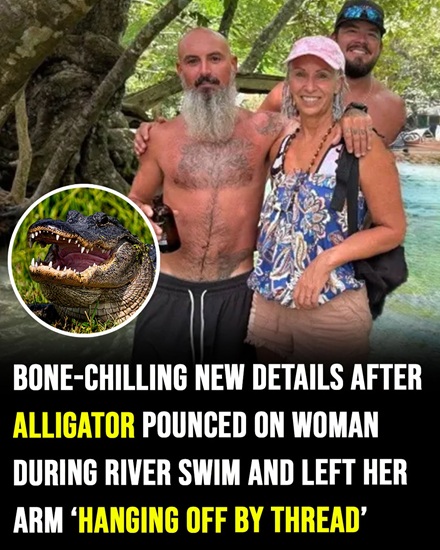
A family outing on Florida’s Silver River turned into a medical emergency on August 8, 2026, when 58-year-old Dina Spann was severely injured in an alligator attack. Spann had been spending time in the water with family members in Marion County when the encounter occurred. According to accounts provided afterward by her son, Zach Guerrina, and witnesses who assisted at the scene, the alligator approached the group before attacking Spann. The encounter caused catastrophic injuries to her right arm and also injured her left hand.
Despite the severity of those injuries, Spann survived after people nearby intervened and helped get her to emergency medical care. Guerrina later provided additional details about what his mother experienced. He said he had stepped away shortly before the attack while Spann remained near other members of the group. According to his account, his mother attempted to discourage the approaching animal before the situation escalated.
Guerrina told the New York Post that Spann tried to push the alligator away with a stick, but the animal attacked her. The encounter then moved into the water, where Spann found herself fighting against an animal powerful enough to pull her beneath the surface. Her son’s description indicates that she actively tried to defend herself rather than remaining passive during the attack. According to Guerrina, Spann tried to control the alligator’s jaws with her hands while repeatedly attempting to reach the surface for air.
He said she was particularly concerned about preventing the animal from reaching her legs. During that struggle, the alligator inflicted devastating damage to her right arm and injured her left hand. Reports state that part of her left ring finger was lost in the encounter. Her right arm was so severely damaged that doctors later had to amputate it below the elbow. The descriptions supplied by her family and witnesses make clear that the attack unfolded extremely quickly and required immediate assistance.

Other people on the river were already responding as the attack unfolded. Among them was paddleboarder Mike Head, who later described seeing the alligator moving rapidly toward Spann. Head told reporters that he approached despite being aware of the danger to himself and his family. He used his paddle while attempting to intervene and help drive the animal away. His account provides another perspective on how quickly several people had to make decisions during the emergency. Rather than relying on a single rescuer, the response involved multiple people who happened to be close enough to see or hear what was happening.
John Gamache and his father were also nearby on their boat when they heard cries for help. Gamache later said that he looked upriver and saw the alligator moving toward the swimmers. Because the spring-fed water was clear, he was able to see what was happening from a distance and immediately moved his boat toward the group. Reports identified the animal later removed from the area as measuring 9 feet, 8 inches. Gamache accelerated toward the scene, and the approaching boat added noise and commotion that helped push the animal away from the people in the water.
By the time Gamache reached the group, Spann had sustained an extremely serious injury to her right arm. Gamache later described seeing exposed bone and significant bleeding, making it obvious that controlling blood loss was an immediate priority. People at the scene improvised with materials available to them rather than waiting for professional medical equipment. Reports describe clothing and rope being used to help control the bleeding. Gamache emphasized afterward that time mattered because of the severity of Spann’s injuries. The improvised response helped bridge the critical period between the attack and the arrival of professional emergency care.

Guerrina said his mother remained remarkably composed despite what had happened. His description of her demeanor became one of the most striking details to emerge after the attack. While other people around her were dealing with the shock of the situation, Spann reportedly remained focused and calm as rescuers worked to stop the bleeding and move everyone to safety. Her son later expressed pride in the way she handled the emergency. His comments also suggested that Spann was approaching her recovery with the same resilience, concentrating on the fact that she had survived rather than focusing exclusively on what she had lost.
The rescue effort did not end with getting Spann away from the alligator. Other members of the group were still in or near the water, including younger people who needed to be brought aboard safely. Gamache and his father helped collect the remaining swimmers before moving toward a location where emergency personnel could take over. The combination of getting Spann out of immediate danger, controlling her bleeding and removing the other swimmers from the water required several actions in quick succession. Witness accounts indicate that the people involved coordinated those efforts during an exceptionally stressful situation.
First responders subsequently transported Spann for hospital treatment. Doctors were unable to save the severely damaged portion of her right arm, and reports state that the limb was amputated below the elbow. She had also lost part of a finger on her left hand. Those injuries mean her recovery will involve substantial physical adjustment even though she survived the immediate emergency. Reports published shortly after the attack said she was able to leave the hospital and continue recovering at home. Her survival represented the most important outcome for relatives who knew the incident could easily have ended differently.
Guerrina later reflected on why his mother may have been the person attacked while younger family members were nearby. His explanation was straightforward: he believed she happened to be positioned in front of the others. There is no verified evidence establishing that the animal deliberately selected her based on age or any other characteristic. That distinction is important because assigning human-like motives to wildlife would go beyond the available evidence. What is documented is that Spann was attacked while others were close by and that the remaining members of the group escaped without comparable injuries.
For Spann’s family, the fact that everyone survived has strongly influenced how they have spoken about the incident. Guerrina described his mother as someone with a positive outlook and said she was treating what happened as an extraordinary survival story rather than allowing the loss of her arm to define everything that followed. His remarks should be understood as a son describing his mother’s attitude rather than as a prediction about the medical or emotional challenges of her recovery. Losing part of a limb is a major life-changing injury, and individual recovery experiences can vary considerably.
The animal involved also became the focus of a wildlife response after the attack. Reports state that a contracted Florida Fish and Wildlife Conservation Commission nuisance-alligator trapper captured and removed a 9-foot, 8-inch alligator the following day. The river had temporarily been closed during the response and was subsequently reopened. The removal was consistent with Florida’s established system for responding to alligators considered a threat to people. FWC operates the Statewide Nuisance Alligator Program and uses contracted trappers to address qualifying situations involving potentially dangerous animals.
FWC emphasizes that serious injuries from alligators are rare in Florida, even though interactions between humans and the animals do occur. Alligators naturally inhabit Florida’s rivers, lakes, marshes and swamps and are present throughout the state. The agency notes that population growth and recreational use of waterways create opportunities for people and alligators to encounter one another. That does not mean every sighting represents an imminent attack, but wildlife officials advise people to maintain their distance and avoid approaching or feeding alligators.
The agency’s general safety guidance recommends swimming only in designated swimming areas during daylight hours. FWC also advises people never to feed alligators because feeding them is both illegal and dangerous. Animals that receive food from humans can lose their natural wariness and begin associating people with food. FWC additionally advises keeping pets away from the water’s edge and maintaining a safe distance whenever an alligator is seen. Those recommendations are general statewide precautions rather than conclusions about precisely why the Silver River attack occurred.
Guerrina has publicly expressed concerns about people getting too close to or feeding alligators in areas frequented by visitors. Those comments represent his personal assessment following his mother’s attack and should not be presented as an official determination of what caused this particular animal’s behavior. FWC’s broader guidance does independently confirm, however, that feeding alligators can cause them to associate humans with food and lose their normal caution around people. Distinguishing Guerrina’s opinion from wildlife officials’ established guidance avoids attributing an unverified cause to the attack.
The incident occurred during a year in which several serious alligator encounters in Florida received public attention. In June, 31-year-old Brittany Clark died after being attacked while swimming in the Econlockhatchee River at Little Big Econ State Forest. FWC later reported that laboratory testing matched Clark to a 13-foot alligator captured following that incident. Her death was separate from Spann’s attack and occurred in a different location and circumstances. It nevertheless reinforced wildlife officials’ reminders about exercising caution in waterways where alligators naturally live.
Another June incident in Marion County involved an 11-year-old Pennsylvania boy who was bitten while fishing with his father. According to his family, the child was releasing a fish into the water when an alligator bit his hand. He underwent several surgeries, and the injured hand ultimately had to be amputated. Again, that incident was separate from Spann’s experience and should not be treated as evidence that every Florida waterway presents the same level of risk. FWC continues to describe serious alligator injuries as uncommon despite these highly publicized cases.
Historical data help provide additional context. FWC has maintained records of human-alligator incidents for decades and conducts research intended to understand patterns associated with bites. One agency research project compiled more than 600 recorded incidents between 1948 and 2014 to examine long-term trends and characteristics. The existence of such records does not make severe attacks routine. Instead, the research forms part of Florida’s broader effort to manage a large native alligator population while millions of residents and visitors use the same outdoor environments.
For Gamache, the Silver River emergency was unlike anything he had previously experienced during years of visiting the area. After Spann’s family contacted him following the rescue, he said it was meaningful to hear directly from them. His comments focused on relief that the outcome, while involving a devastating injury, had not included the loss of Spann’s life or additional victims. That perspective captures the complicated nature of the incident: the injuries were unquestionably severe, but the rapid intervention of people nearby helped prevent an already dangerous situation from becoming even worse.
The actions of Head, Gamache, Gamache’s father and others demonstrate how several people contributed during different stages of the emergency. One person moved toward the alligator despite the obvious danger, another brought a boat rapidly toward the swimmers, and people worked together to control Spann’s bleeding and remove others from the water. Their individual accounts differ in perspective because they witnessed different parts of the event. Taken together, however, they describe a rescue effort that unfolded within minutes and depended on people reacting quickly to an unpredictable wildlife encounter.
Spann’s own actions were equally significant to her family’s account of the attack. According to her son, she continued fighting while being pulled underwater, tried to prevent the alligator from reaching other parts of her body and repeatedly worked to get back toward the surface. It is impossible to determine precisely how each individual action affected the final outcome, so claims that any particular maneuver definitively saved her life would go beyond the available evidence. What can be said is that she resisted the attack until assistance reached her and survived injuries that required emergency surgery and amputation.
Her recovery now extends beyond the dramatic minutes on the river. Adjusting to a below-the-elbow amputation can involve medical follow-up, rehabilitation and changes to everyday routines, although Spann’s individual treatment plan has not been publicly detailed and should not be assumed. Her family’s public comments have instead emphasized her determination and positive attitude. The fact that she was reportedly able to return home shortly after hospitalization was an encouraging development, but it does not diminish the seriousness of the injuries she sustained or the adjustment that may follow.
The Silver River incident also illustrates why wildlife agencies repeatedly urge visitors to remember that scenic natural environments remain wildlife habitats. Florida’s clear springs and rivers attract people for boating, paddling and other outdoor activities, while those same ecosystems support alligators and numerous other native species. FWC’s recommendations are designed to reduce opportunities for conflict rather than create unnecessary fear. Keeping a safe distance from alligators, never feeding them and following posted rules around swimming are among the agency’s longstanding recommendations.
People who believe an alligator poses a threat can also report the animal rather than attempting to approach or manage it themselves. FWC operates a toll-free Nuisance Alligator Hotline and dispatches contracted trappers when qualifying situations are reported. The agency generally considers an alligator a nuisance when it is at least four feet long and the caller believes it poses a threat to people, pets or property, although smaller animals can also require intervention in particular circumstances. This statewide program is intended to balance public safety with the conservation of alligators in their natural habitat.
Ultimately, the documented story of Dina Spann’s attack is one of a severe wildlife encounter followed by an unusually rapid civilian response. Spann sustained permanent injuries, including the loss of part of her right arm and part of a finger, but survived. People nearby moved toward the emergency, helped get her out of danger, attempted to control the bleeding and assisted the other swimmers. Wildlife authorities subsequently removed a nearly 10-foot alligator from the area. Those verified facts are dramatic enough without adding speculation about the animal’s motives or details that have not been publicly established.
For Spann’s family, gratitude has accompanied the shock of what happened. Guerrina has spoken publicly about being proud of his mother and appreciative that the younger people nearby were not seriously injured. The rescuers have expressed relief that their intervention helped produce an outcome in which everyone survived. Spann now faces a new stage centered on healing and adaptation, while the people who rushed to her aid have become an important part of her family’s account of that day. The incident remains a striking reminder of both the unpredictability of wildlife encounters and the difference that immediate assistance can make during a medical emergency.
